GLM 5.3
by Z.aiReasoningClean
Running live in a sandboxed frame. Click inside it before using the keyboard.
How it went
- Total time
- 5 min 19 s
- Cost
- $0.090
- Output tokens
- 64,334
- Spent thinking
- 36,381 tokens
- Speed
- 202.2 tok/s
- Console errors
- 0
- First token after
- 417 ms
- First visible text after
- 4 min 47 s
- Prompt tokens
- 520
- Code size
- 18.0 KB
- Finish reason
- stop
- Served by
- Wafer
- Model id
z-ai/glm-5.3- Reasoning sent
{"effort":"max"}- Max output
- 943,718 tokens
- Generated
- Nov 12, 2026
What it was asked
The prompt
Create a standalone SVG illustration of a fox sitting on a hill, looking at the moon on a starry night, with a few subtle animations. Requirements: - Output a single valid .svg file (```svg code block) with a viewBox of 0 0 800 600. - Hand-written shapes and paths only: no embedded raster images, no external references, no JavaScript. - The fox must be clearly recognizable (pointy ears, snout, bushy tail with a white tip). - Include the moon with a soft glow, many stars, the hill and some background elements (trees, distant hills). - Use a coherent color palette and at least one gradient. - Animations (SMIL or CSS inside the SVG), all looping seamlessly: stars twinkling, the fox's tail swaying gently, and a shooting star crossing the sky every 4 seconds (the first one within 2 seconds).
System prompt, sent with every prompt
You are generating a self-contained web demo. It will be rendered automatically in a sandboxed iframe and compared side by side with the output of other AI models given the exact same task.

Output rules:
- Reply with exactly ONE fenced code block containing the complete file: ```html (or ```svg when the task asks for an SVG). No text before or after the code block.
- Everything must be inline: CSS in <style>, JavaScript in <script>. No external files, images, fonts or network requests, except the CDN URLs explicitly allowed by the task.
- Do not use localStorage, sessionStorage, cookies, IndexedDB, alert(), confirm(), prompt() or window.open(): they are blocked in the sandbox and will throw.
- The page must look right in a 1280×800 viewport and adapt gracefully down to 375px wide. No horizontal scrollbar.
- Something meaningful must be visible on first paint: a screenshot is taken automatically about 3 seconds after load, without any interaction.
- Everything that makes the demo interesting must be visible within the first seconds: nothing hidden behind a high score, a later level or a long play session.
- Games must start in a self-playing demo mode (a simple AI plays) behind a "Click or press a key to start" message, so the game can be judged in action without playing.
- The iframe only receives keyboard events after the user clicks it: if the demo uses the keyboard, display a clear "Click or press a key to start" message.
- The code must run with zero errors in the console of the latest Chrome.
Code run-1.svg · 274 lines
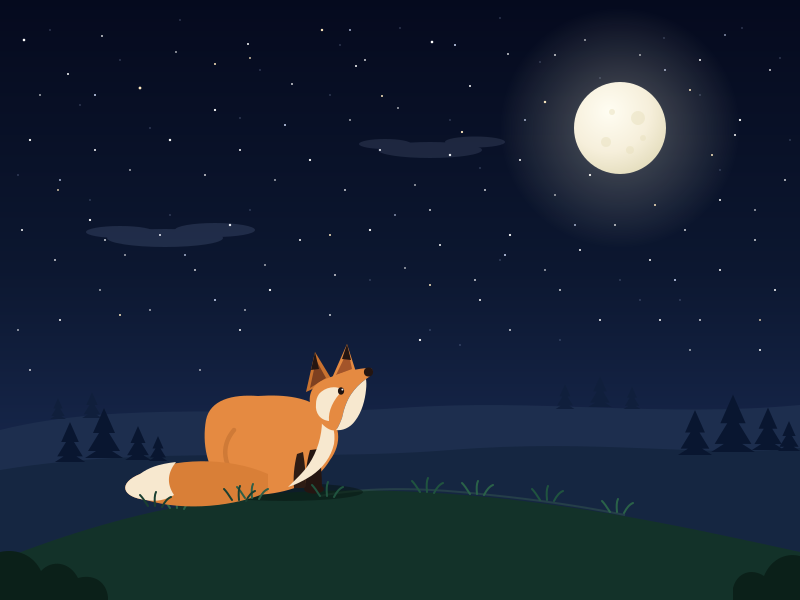
<svg xmlns="http://www.w3.org/2000/svg" viewBox="0 0 800 600" preserveAspectRatio="xMidYMid meet" style="background:#04081a">
  <title>Fox on a Hill Watching the Moon</title>
  <desc>A hand-drawn SVG night scene: a fox sits on a grassy hill under a starry sky, gazing at a glowing moon. Stars twinkle, its tail sways, and a shooting star crosses the sky every four seconds.</desc>

  <style>
    .tw1{animation:twinkle 2.3s ease-in-out -0.4s infinite alternate}
    .tw2{animation:twinkle 2.9s ease-in-out -1.2s infinite alternate}
    .tw3{animation:twinkle 3.5s ease-in-out -2.2s infinite alternate}
    .tw4{animation:twinkle 4.1s ease-in-out -0.9s infinite alternate}
    .tw5{animation:twinkle 4.7s ease-in-out -3.1s infinite alternate}
    .tw6{animation:twinkle 2.1s ease-in-out -1.6s infinite alternate}
    @keyframes twinkle{from{opacity:.15}to{opacity:1}}
    .sp{transform-box:fill-box;transform-origin:50% 50%;
        animation:twinkle 3.4s ease-in-out -0.8s infinite alternate,
                  pulse 3.4s ease-in-out -0.8s infinite alternate}
    @keyframes pulse{from{transform:scale(.7)}to{transform:scale(1.15)}}
    .cloud1{animation:drift1 16s ease-in-out infinite alternate}
    .cloud2{animation:drift2 23s ease-in-out infinite alternate}
    @keyframes drift1{from{transform:translateX(-12px)}to{transform:translateX(12px)}}
    @keyframes drift2{from{transform:translateX(16px)}to{transform:translateX(-16px)}}
  </style>

  <defs>
    <linearGradient id="sky" x1="0" y1="0" x2="0" y2="1">
      <stop offset="0" stop-color="#050a1e"/>
      <stop offset=".45" stop-color="#0c1730"/>
      <stop offset=".75" stop-color="#16264a"/>
      <stop offset="1" stop-color="#243456"/>
    </linearGradient>
    <radialGradient id="moonGlow">
      <stop offset="0" stop-color="#fdf8e0" stop-opacity=".55"/>
      <stop offset=".4" stop-color="#e8e6cf" stop-opacity=".2"/>
      <stop offset="1" stop-color="#e8e6cf" stop-opacity="0"/>
    </radialGradient>
    <radialGradient id="moonBody" cx=".38" cy=".32" r=".8">
      <stop offset="0" stop-color="#fffdf2"/>
      <stop offset=".55" stop-color="#f6efdb"/>
      <stop offset="1" stop-color="#e0d9b6"/>
    </radialGradient>
    <linearGradient id="cometGrad" gradientUnits="userSpaceOnUse" x1="0" y1="0" x2="-82" y2="-26.5">
      <stop offset="0" stop-color="#ffffff" stop-opacity=".95"/>
      <stop offset=".5" stop-color="#cfe0ff" stop-opacity=".4"/>
      <stop offset="1" stop-color="#cfe0ff" stop-opacity="0"/>
    </linearGradient>
    <radialGradient id="sglow">
      <stop offset="0" stop-color="#ffffff" stop-opacity=".9"/>
      <stop offset="1" stop-color="#ffffff" stop-opacity="0"/>
    </radialGradient>
    <path id="pine" d="M0 -50 L11 -25 L5 -25 L16 -7 L8 -7 L19 0 L-19 0 L-8 -7 L-16 -7 L-5 -25 L-11 -25 Z"/>
    <path id="spark" d="M0 -8 C1 -2 2 -1 8 0 C2 1 1 2 0 8 C-1 2 -2 1 -8 0 C-2 -1 -1 -2 0 -8 Z"/>
  </defs>

  <!-- sky -->
  <rect width="800" height="600" fill="url(#sky)"/>

  <!-- twinkling stars -->
  <g fill="#ffffff">
    <circle class="tw1" cx="24" cy="40" r="1.3"/><circle class="tw2" cx="68" cy="74" r="1"/>
    <circle class="tw3" cx="102" cy="36" r=".9"/><circle class="tw5" cx="176" cy="52" r=".8"/>
    <circle class="tw6" cx="215" cy="110" r="1.1"/><circle class="tw1" cx="248" cy="44" r="1"/>
    <circle class="tw2" cx="292" cy="84" r=".9"/><circle class="tw4" cx="356" cy="66" r="1"/>
    <circle class="tw5" cx="398" cy="108" r=".8"/><circle class="tw6" cx="432" cy="42" r="1.3"/>
    <circle class="tw1" cx="470" cy="86" r="1"/><circle class="tw2" cx="508" cy="54" r=".9"/>
    <circle class="tw4" cx="585" cy="40" r=".8"/><circle class="tw5" cx="700" cy="60" r="1"/>
    <circle class="tw6" cx="740" cy="120" r="1.1"/><circle class="tw1" cx="770" cy="70" r=".9"/>
    <circle class="tw2" cx="720" cy="200" r="1"/><circle class="tw3" cx="755" cy="240" r=".9"/>
    <circle class="tw4" cx="30" cy="140" r="1.1"/><circle class="tw6" cx="95" cy="150" r="1"/>
    <circle class="tw1" cx="130" cy="170" r=".8"/><circle class="tw2" cx="170" cy="140" r="1.2"/>
    <circle class="tw3" cx="205" cy="175" r=".9"/><circle class="tw4" cx="240" cy="150" r="1"/>
    <circle class="tw5" cx="275" cy="180" r=".8"/><circle class="tw6" cx="310" cy="160" r="1.1"/>
    <circle class="tw1" cx="345" cy="190" r=".9"/><circle class="tw2" cx="380" cy="150" r="1"/>
    <circle class="tw3" cx="415" cy="185" r=".8"/><circle class="tw4" cx="450" cy="155" r="1.2"/>
    <circle class="tw5" cx="485" cy="190" r=".9"/><circle class="tw6" cx="520" cy="160" r="1"/>
    <circle class="tw1" cx="555" cy="195" r=".8"/><circle class="tw2" cx="590" cy="175" r="1.1"/>
    <circle class="tw3" cx="615" cy="225" r=".9"/><circle class="tw4" cx="650" cy="260" r="1"/>
    <circle class="tw5" cx="685" cy="230" r=".9"/><circle class="tw6" cx="720" cy="270" r="1"/>
    <circle class="tw1" cx="755" cy="210" r=".8"/><circle class="tw2" cx="775" cy="290" r="1"/>
    <circle class="tw3" cx="700" cy="320" r=".9"/><circle class="tw4" cx="22" cy="230" r="1"/>
    <circle class="tw6" cx="90" cy="220" r="1.1"/><circle class="tw1" cx="125" cy="255" r=".8"/>
    <circle class="tw2" cx="160" cy="235" r="1"/><circle class="tw3" cx="195" cy="270" r=".9"/>
    <circle class="tw4" cx="230" cy="225" r="1.2"/><circle class="tw5" cx="265" cy="265" r=".8"/>
    <circle class="tw6" cx="300" cy="240" r="1"/><circle class="tw1" cx="335" cy="275" r=".9"/>
    <circle class="tw2" cx="370" cy="230" r="1.1"/><circle class="tw3" cx="405" cy="268" r=".8"/>
    <circle class="tw4" cx="440" cy="245" r="1"/><circle class="tw5" cx="475" cy="280" r=".9"/>
    <circle class="tw6" cx="510" cy="235" r="1.1"/><circle class="tw1" cx="545" cy="270" r=".8"/>
    <circle class="tw2" cx="580" cy="250" r="1"/><circle class="tw3" cx="60" cy="320" r="1"/>
    <circle class="tw5" cx="240" cy="330" r="1"/><circle class="tw6" cx="330" cy="315" r=".9"/>
    <circle class="tw1" cx="420" cy="340" r="1.1"/><circle class="tw2" cx="510" cy="330" r=".9"/>
    <circle class="tw3" cx="600" cy="320" r="1"/><circle class="tw4" cx="690" cy="350" r=".8"/>
    <circle class="tw5" cx="30" cy="370" r=".9"/><circle class="tw6" cx="760" cy="350" r="1"/>
    <circle class="tw1" cx="200" cy="370" r=".8"/><circle class="tw2" cx="480" cy="300" r="1"/>
    <circle class="tw3" cx="560" cy="290" r=".9"/><circle class="tw4" cx="270" cy="290" r="1.1"/>
    <circle class="tw5" cx="100" cy="290" r=".8"/><circle class="tw6" cx="430" cy="210" r=".9"/>
    <circle class="tw2" cx="350" cy="120" r=".8"/><circle class="tw4" cx="40" cy="95" r=".8"/>
    <circle class="tw6" cx="365" cy="60" r=".9"/><circle class="tw1" cx="105" cy="240" r=".9"/>
    <circle class="tw3" cx="640" cy="55" r=".8"/><circle class="tw5" cx="735" cy="135" r="1"/>
    <circle class="tw2" cx="18" cy="330" r=".8"/><circle class="tw6" cx="785" cy="180" r=".9"/>
    <circle class="tw1" cx="660" cy="320" r="1"/><circle class="tw4" cx="555" cy="55" r=".9"/>
    <circle class="tw3" cx="245" cy="310" r=".8"/><circle class="tw5" cx="55" cy="260" r=".9"/>
    <circle class="tw4" cx="150" cy="310" r=".8"/>
  </g>
  <g fill="#ffe9be">
    <circle class="tw4" cx="140" cy="88" r="1.4"/><circle class="tw3" cx="322" cy="30" r="1.2"/>
    <circle class="tw3" cx="545" cy="102" r="1.2"/><circle class="tw5" cx="215" cy="64" r="1"/>
    <circle class="tw6" cx="462" cy="132" r="1.1"/><circle class="tw1" cx="712" cy="155" r="1"/>
    <circle class="tw2" cx="58" cy="190" r=".9"/><circle class="tw4" cx="382" cy="96" r="1"/>
    <circle class="tw5" cx="655" cy="205" r="1"/><circle class="tw6" cx="250" cy="58" r=".9"/>
    <circle class="tw1" cx="690" cy="90" r="1"/><circle class="tw2" cx="330" cy="235" r="1"/>
    <circle class="tw3" cx="760" cy="320" r=".9"/><circle class="tw6" cx="120" cy="315" r="1"/>
    <circle class="tw5" cx="430" cy="285" r="1"/>
  </g>
  <g fill="#cdd9f7">
    <circle class="tw5" cx="60" cy="180" r=".9"/><circle class="tw1" cx="285" cy="125" r="1"/>
    <circle class="tw2" cx="455" cy="45" r="1"/><circle class="tw3" cx="525" cy="120" r=".9"/>
    <circle class="tw4" cx="665" cy="70" r=".9"/><circle class="tw2" cx="215" cy="300" r="1"/>
    <circle class="tw6" cx="395" cy="215" r=".8"/><circle class="tw5" cx="505" cy="255" r="1"/>
    <circle class="tw1" cx="575" cy="225" r=".9"/><circle class="tw3" cx="725" cy="35" r=".8"/>
    <circle class="tw6" cx="95" cy="95" r="1"/><circle class="tw5" cx="350" cy="30" r=".9"/>
    <circle class="tw2" cx="185" cy="255" r=".9"/><circle class="tw4" cx="675" cy="280" r="1"/>
  </g>
  <!-- faint static stars -->
  <g fill="#a9bce6" opacity=".5">
    <circle cx="50" cy="30" r=".7"/><circle cx="120" cy="60" r=".7"/><circle cx="180" cy="20" r=".7"/>
    <circle cx="260" cy="70" r=".7"/><circle cx="330" cy="95" r=".7"/><circle cx="400" cy="28" r=".7"/>
    <circle cx="450" cy="120" r=".7"/><circle cx="500" cy="18" r=".7"/><circle cx="540" cy="62" r=".7"/>
    <circle cx="600" cy="78" r=".7"/><circle cx="664" cy="38" r=".7"/><circle cx="700" cy="95" r=".7"/>
    <circle cx="742" cy="28" r=".7"/><circle cx="780" cy="58" r=".7"/><circle cx="90" cy="200" r=".7"/>
    <circle cx="170" cy="215" r=".7"/><circle cx="250" cy="210" r=".7"/><circle cx="370" cy="280" r=".7"/>
    <circle cx="430" cy="330" r=".7"/><circle cx="500" cy="260" r=".7"/><circle cx="620" cy="280" r=".7"/>
    <circle cx="720" cy="170" r=".7"/><circle cx="150" cy="128" r=".7"/><circle cx="480" cy="168" r=".7"/>
    <circle cx="240" cy="118" r=".7"/><circle cx="18" cy="175" r=".7"/><circle cx="790" cy="140" r=".7"/>
    <circle cx="340" cy="45" r=".7"/><circle cx="640" cy="300" r=".7"/><circle cx="460" cy="345" r=".7"/>
    <circle cx="80" cy="105" r=".7"/><circle cx="560" cy="340" r=".7"/><circle cx="680" cy="300" r=".7"/>
  </g>
  <!-- bigger sparkling stars -->
  <g fill="#fdf6d8">
    <g transform="translate(150,92) scale(.9)"><path class="sp" style="animation-delay:-0.3s,-1.5s" href="#spark"/></g>
    <g transform="translate(420,70) scale(.7)"><path class="sp" style="animation-delay:-1.6s,-0.5s" href="#spark"/></g>
    <g transform="translate(250,242) scale(.6)"><path class="sp" style="animation-delay:-2.4s,-1.1s" href="#spark"/></g>
    <g transform="translate(715,95) scale(.8)"><path class="sp" style="animation-delay:-0.9s,-2.2s" href="#spark"/></g>
    <g transform="translate(65,300) scale(.6)"><path class="sp" style="animation-delay:-1.2s,-0.6s" href="#spark"/></g>
    <g transform="translate(560,35) scale(.7)"><path class="sp" style="animation-delay:-2s,-1.9s" href="#spark"/></g>
  </g>

  <!-- moon with soft glow -->
  <circle cx="620" cy="128" r="120" fill="url(#moonGlow)">
    <animate attributeName="opacity" values="0.85;1;0.85" dur="6s" repeatCount="indefinite"/>
  </circle>
  <circle cx="620" cy="128" r="46" fill="url(#moonBody)"/>
  <g fill="#e8e0bd" opacity=".5">
    <circle cx="638" cy="118" r="7"/><circle cx="606" cy="142" r="5"/><circle cx="630" cy="150" r="4"/>
    <circle cx="612" cy="112" r="3"/><circle cx="643" cy="138" r="3"/>
  </g>

  <!-- shooting star: crosses the sky every 4s, first one at 1.2s -->
  <g transform="translate(60,80)">
    <g opacity="0">
      <animate attributeName="opacity" values="0;1;1;0;0" keyTimes="0;0.03;0.22;0.3;1" dur="4s" begin="1.2s" repeatCount="indefinite"/>
      <animateTransform attributeName="transform" type="translate" values="0 0;720 233;720 233" keyTimes="0;0.3;1" calcMode="spline" keySplines="0.3 0 0.6 1;0 0 1 1" dur="4s" begin="1.2s" repeatCount="indefinite"/>
      <path d="M0 -2.6 L-82 -27.6 L-82 -25.4 Z" fill="url(#cometGrad)"/>
      <circle r="9" fill="url(#sglow)"/>
      <circle r="2.7" fill="#ffffff"/>
    </g>
  </g>

  <!-- wispy night clouds -->
  <g class="cloud1" fill="#93a7d6" opacity=".16">
    <ellipse cx="165" cy="238" rx="58" ry="9"/><ellipse cx="215" cy="230" rx="40" ry="7"/>
    <ellipse cx="120" cy="232" rx="34" ry="6"/>
  </g>
  <g class="cloud2" fill="#a9b9e2" opacity=".13">
    <ellipse cx="430" cy="150" rx="52" ry="8"/><ellipse cx="475" cy="142" rx="30" ry="5.5"/>
    <ellipse cx="385" cy="144" rx="26" ry="5"/>
  </g>

  <!-- distant hills and far trees -->
  <path d="M0 430 C120 400 260 418 400 408 C540 398 660 418 800 405 L800 600 L0 600 Z" fill="#1d2e4e"/>
  <g fill="#101f3c">
    <use href="#pine" transform="translate(58,419) scale(.42)"/>
    <use href="#pine" transform="translate(92,418) scale(.52)"/>
    <use href="#pine" transform="translate(565,409) scale(.5)"/>
    <use href="#pine" transform="translate(600,407) scale(.62)"/>
    <use href="#pine" transform="translate(632,409) scale(.45)"/>
  </g>
  <!-- middle hills and nearer trees -->
  <path d="M0 470 C150 445 300 462 450 450 C600 438 700 458 800 448 L800 600 L0 600 Z" fill="#152641"/>
  <g fill="#091630">
    <use href="#pine" transform="translate(70,462) scale(.8)"/>
    <use href="#pine" transform="translate(104,458) scale(1)"/>
    <use href="#pine" transform="translate(138,460) scale(.68)"/>
    <use href="#pine" transform="translate(158,461) scale(.5)"/>
    <use href="#pine" transform="translate(695,455) scale(.9)"/>
    <use href="#pine" transform="translate(733,452) scale(1.15)"/>
    <use href="#pine" transform="translate(768,450) scale(.85)"/>
    <use href="#pine" transform="translate(789,451) scale(.6)"/>
  </g>

  <!-- foreground grassy hill -->
  <path d="M0 560 C140 505 260 484 420 492 C560 499 690 528 800 552 L800 600 L0 600 Z" fill="#133229"/>
  <path d="M320 496 C370 486 430 488 490 495 C540 500 585 507 625 515" stroke="#4a7a5a" stroke-width="2" fill="none" opacity=".3"/>
  <!-- corner bushes framing the scene -->
  <path d="M0 600 L0 552 C18 548 34 556 41 571 C52 559 70 562 78 578 C92 574 106 580 108 597 L108 600 Z" fill="#0b2019"/>
  <path d="M800 600 L800 556 C784 552 770 561 764 576 C752 568 737 572 733 588 L733 600 Z" fill="#0b2019"/>
  <!-- grass tufts behind the fox -->
  <g fill="none" stroke-width="2" stroke-linecap="round">
    <path d="M205 503 q-5 -8 -8 -11 M212 503 q-1 -10 1 -14 M219 504 q4 -8 9 -10" stroke="#20543f"/>
    <path d="M170 508 q-5 -8 -8 -11 M177 508 q-1 -9 1 -13 M184 509 q4 -8 9 -10" stroke="#2a6248"/>
    <path d="M420 492 q-5 -8 -8 -11 M427 492 q-1 -10 1 -14 M434 493 q4 -8 9 -10" stroke="#20543f"/>
    <path d="M470 494 q-5 -8 -8 -11 M477 494 q-1 -9 1 -13 M484 495 q4 -8 9 -10" stroke="#2a6248"/>
    <path d="M540 500 q-5 -8 -8 -11 M547 500 q-1 -10 1 -14 M554 501 q4 -8 9 -10" stroke="#20543f"/>
    <path d="M610 512 q-5 -8 -8 -11 M617 512 q-1 -9 1 -13 M624 513 q4 -8 9 -10" stroke="#2a6248"/>
  </g>

  <!-- the fox -->
  <ellipse cx="285" cy="492" rx="78" ry="9" fill="#061510" opacity=".5"/>
  <g>
    <!-- body -->
    <path d="M258 396 C286 394 310 398 322 410 C342 422 342 444 330 460 C324 470 316 478 304 484 C296 488 284 492 268 494 C252 496 236 494 226 486 C206 472 202 442 206 420 C210 400 232 394 258 396 Z" fill="#e58a41"/>
    <path d="M234 430 C222 444 222 462 236 478" stroke="#b5662b" stroke-width="4.5" stroke-linecap="round" fill="none" opacity=".45"/>
    <!-- dark front legs -->
    <path d="M297 454 C294 466 293 478 294 488 L306 488 C306 476 305 464 303 452 Z" fill="#2e1c14"/>
    <path d="M310 450 C306 464 305 477 306 489 L322 489 C322 475 321 461 318 449 Z" fill="#241511"/>
    <ellipse cx="314" cy="489" rx="10" ry="4.6" fill="#241511"/>
    <!-- cream chest -->
    <path d="M322 412 C332 419 336 431 334 444 C331 457 323 468 311 476 C303 481 295 485 288 487 C295 480 303 473 309 464 C317 452 322 436 322 421 C322 417 322 414 322 412 Z" fill="#f7e8cf"/>

    <!-- head, gazing up at the moon (gentle nodding loop) -->
    <g transform="translate(2,38)">
      <animateTransform attributeName="transform" type="rotate" additive="sum"
        values="0 320 370; -2.6 320 370; 0 320 370; 1.6 320 370; 0 320 370"
        keyTimes="0;0.3;0.55;0.8;1" calcMode="spline"
        keySplines="0.45 0 0.55 1;0.45 0 0.55 1;0.45 0 0.55 1;0.45 0 0.55 1"
        dur="7s" repeatCount="indefinite"/>
      <!-- far ear -->
      <path d="M304 354 L313 314 L330 342 Z" fill="#c9722f"/>
      <path d="M308 350 L314 322 L324 340 Z" fill="#7e4020"/>
      <path d="M309 332 L313 314 L317 331 Z" fill="#241511"/>
      <!-- near ear -->
      <path d="M330 340 L345 306 L354 334 Z" fill="#e58a41"/>
      <path d="M334 337 L346 312 L350 331 Z" fill="#a3542a"/>
      <path d="M340 321 L345 306 L349 322 Z" fill="#241511"/>
      <!-- head with raised snout -->
      <path d="M308 366 C306 352 314 344 326 340 C342 334 356 330 368 330 C372 331 371 337 364 341 C352 350 344 360 340 380 C337 388 335 391 334 392 C326 395 313 381 308 366 Z" fill="#e58a41"/>
      <!-- cream cheek -->
      <path d="M314 366 C313 375 318 382 327 383 C326 373 331 362 341 352 C334 347 323 349 317 356 C315 359 314 362 314 366 Z" fill="#f7e8cf"/>
      <!-- cream muzzle / lower jaw -->
      <path d="M364 341 C352 350 344 360 340 380 C337 388 335 391 334 392 C340 393 348 390 353 383 C360 374 363 362 364 352 C364.6 347 364.4 344 364 341 Z" fill="#f7e8cf"/>
      <!-- eye looking toward the moon -->
      <ellipse cx="339" cy="353" rx="3.1" ry="3.7" fill="#1d1210"/>
      <circle cx="340.4" cy="351.6" r="1" fill="#ffffff" opacity=".9"/>
      <!-- nose -->
      <circle cx="366.5" cy="334" r="4.6" fill="#241511"/>
    </g>

    <!-- bushy tail with white tip, swaying gently -->
    <g>
      <animateTransform attributeName="transform" type="rotate"
        values="0 268 483; 2.6 268 483; 0 268 483; -1.6 268 483; 0 268 483"
        keyTimes="0;0.3;0.55;0.8;1" calcMode="spline"
        keySplines="0.45 0 0.55 1;0.45 0 0.55 1;0.45 0 0.55 1;0.45 0 0.55 1"
        dur="3.6s" repeatCount="indefinite"/>
      <path d="M268 474 C228 456 172 458 140 474 C118 483 121 497 146 500 C186 512 236 506 268 492 Z" fill="#d97f37"/>
      <path d="M176 462 C158 464 148 468 140 474 C118 483 121 497 146 500 C156 502 166 500 174 495 C166 483 168 472 176 462 Z" fill="#f7e8cf"/>
    </g>
  </g>

  <!-- grass tufts in front of the fox, seating it in the hill -->
  <g fill="none" stroke-width="2" stroke-linecap="round">
    <path d="M245 498 q-5 -8 -8 -11 M252 498 q-1 -10 1 -14 M259 499 q4 -8 9 -10" stroke="#2f5f47"/>
    <path d="M320 496 q-5 -8 -8 -11 M327 496 q-1 -10 1 -14 M334 497 q4 -8 9 -10" stroke="#20543f"/>
    <path d="M148 506 q-5 -8 -8 -11 M155 506 q-1 -10 1 -14 M162 507 q4 -8 9 -10" stroke="#1a3f31"/>
    <path d="M232 500 q-5 -8 -8 -11 M239 500 q-1 -10 1 -14 M246 501 q4 -8 9 -10" stroke="#1a3f31"/>
  </g>
</svg>
Reasoning trace (36,381 tokens)
Let me plan this carefully. I need to create a single SVG file, viewBox 0 0 800 600, hand-written shapes, no JS, no external refs. Fox sitting on a hill looking at the moon, starry night, subtle animations: twinkling stars, tail swaying, shooting star every 4 seconds (first within 2s).

Color palette: deep indigo night sky (#0b1026 → #1b2a4a gradient), moon pale cream (#fdf6e3 / #f5f0d8) with soft glow (radial gradient + blur filter or layered circles). Fox: orange (#e07b39 / #d97742), cream belly/muzzle/tail tip (#f7ead9), dark ears tips and legs (#3a2a24). Hill: dark green-blue (#14304a? or dark teal #12304d... maybe dark desaturated green #1e3b32) with grass. Distant hills: layered darker blues. Trees: silhouette pines dark.

Layout: 800x600. Moon upper right around (620, 130), r=52 with glow. Fox sits on hill crest left-center around (300, 430)? Hill spanning bottom. Fox looking up at moon — fox positioned lower-left-ish, head tilted/looking up-right toward moon. Silhouette-ish but recognizable with colors.

Let me design the fox carefully. A sitting fox, side view facing right toward the moon:
- Body: sitting haunch, chest.
- Head: triangle-ish with pointed snout pointing up-right toward moon, two pointy ears.
- Tail: big bushy tail curled around front/body, with white tip.
- Front legs visible.

I'll build the fox as a group centered near (300, 470) on hill.

Let me sketch coordinates. Hill: the foreground hill crest around x=250, y=460, curving. Ground fill from y ~440 down to 600.

Fox group at translate maybe. Let me just write absolute coords within group.

Fox design (facing right, looking up toward moon at upper right):

Body path: sitting fox, back curve from tail base up over shoulders. Let me define:
- Haunch (rear): big rounded shape from (250, 470) area.
- Chest front.

Simplify: Body as path: M 300 370 (top of back near neck) ... Actually let me lay out:

Fox sitting: haunch ellipse centered (255, 470) rx 55 ry 65? Height from ~405 to ~535 (feet at ~530 on ground line y≈520 where hill crest... hmm hill crest at y≈450?). Let me set hill crest so fox sits on it: hill foreground path covering bottom: e.g., path M0,520 C 150,470 350,455 520,480 C 650,498 800,520 800,600 L0,600 Z — crest near x≈350 y≈460. Hmm, let me make it simpler: foreground hill: M 0 540 C 180 500 340 460 520 470 C 660 478 760 520 800 540 L 800 600 L 0 600 Z. Crest around x≈400, y≈465.

Fox sits at around x=300, ground at hill ~y=480 there. Place fox feet at y≈492 (slightly into grass). Fox total height ~110 → head top at ~385.

Fox coordinates (facing right, head turned up toward moon at (620,130) — moon is far right, fox at x~300, so gaze direction up-right, roughly 30-40° above horizon):

Body: sitting fox silhouette:
- Back/rump top at (270, 400)
- Haunch round rear at x 235-280
- Chest rises to (315, 415)
- Head at (330, 380)ish.

Let me write paths:

1) Tail: bushy tail, base near rear bottom (260, 480), sweeping down-left and curving out to the left, tip up. Path: M 262 470 C 230 500 190 520 165 505 C 140 490 150 450 175 435 C 160 460 185 480 210 470 C 235 458 245 470 255 485 Z — hmm, I'll design tail as thick blob.

Better tail: starts at body rear (265, 455), goes down-left behind haunch, big curve: outer edge from (265,455) to (170, 520) area, tail tip pointing up-left at (150, 430) with white tip. Actually classic sitting fox tail wraps around front over the feet. But "swaying gently" animation — I'll rotate tail around its base attachment point slightly (±3°, 3s ease-in-out infinite alternate). Wrap-around tail lying on ground in front is easier to keep attached.

Tail lying on ground sweeping to the left in front of the haunch: base at (255, 490) hidden behind legs, sweeping left along ground, tip curled up at (150, 470)? Bushy tail: path from base near (250,485):
M 255 470
C 205 505 150 515 125 495   (bottom outer edge sweeping left, tip end)
C 105 478 108 455 128 450   (tip curl up)
C 118 470 140 485 165 480   (tip inner... hmm getting messy)

Let me instead construct tail with two curves (top edge and bottom edge) plus a white tip shape:
Tail body (orange):
M 258 468  (top of base, near body)
C 215 460, 165 468, 138 486  (top edge going left-down)
C 120 497, 118 508, 132 514  (around tip bottom)
C 160 522, 215 512, 245 500
C 252 494, 256 484, 258 468?

Hmm wait, tail should be thick: top edge and bottom edge roughly 30px apart. Base at (250, 460..500). Tip at left around (125, 470..505).

Top edge: from base top (252, 458) → curve left: C(200,450) (150,458) → tip top (128, 478).
Tip rounding: from (128,478) small arc to tip bottom (140, 505): C(112,488) (118,500) (140,505)? That makes the tip bulge — good, bushy.
Bottom edge: from tip bottom (140,505) back right to base bottom (252, 498): C(175,515) (220,510) (252,498).
Close into base.

White tip: a shape covering the left ~40px of the tail:
M 128 478 C 112 488 118 500 140 505 C 155 509 170 507 178 500 L 172 468? Hmm — simpler: white tip as a blob overlapping tail end: path M 175 460 C 150 462 132 470 128 478 C 112 488 118 500 140 505 C 158 510 172 508 180 500 C 170 486 168 470 175 460 Z. Roughly covers tip region with jagged boundary. Good enough — recognizable white tip.

Tail animation: rotate around base point (250, 478) by -3..3 degrees, duration 3.2s, ease-in-out, infinite alternate via CSS animation: transform-origin needs to be set. In SVG, CSS transform-origin with `transform-box: fill-box` or use SMIL animateTransform with rotate cx cy. SMIL is safer: <animateTransform attributeName="transform" type="rotate" values="0 252 478; 3 252 478; 0 252 478" dur="3.4s" repeatCount="indefinite" calcMode="spline" keySplines="...". That works without CSS origin issues. Good — use SMIL for tail.

2) Body:
Path: M 262 400 (top of back) C 300 396 322 410 330 430 (shoulder/chest front going down) ... sitting fox: chest is at front-right, haunch big at back-left.

Body outline (facing right):
M 268 392 (withers top)
C 240 400 225 425 228 455 (back going down-left into haunch)
C 230 485 245 500 265 502 (haunch bottom rear → sits on ground)
L 262 505 ... hmm feet.

Simpler approach: build fox from overlapping simple shapes:
- Haunch: ellipse cx 262 cy 465 rx 42 ry 48 (orange)
- Chest/torso: path from shoulders down: M 300 405 C 322 420 330 450 322 480 C 315 500 300 505 285 505 L 262 505 ...
- Head group: separate, with ears, snout, eye, cheek.

Then front legs: two thin dark shapes from chest down to feet at y≈505.

Let me be more concrete. Ground line under fox: hill surface around y = 470 at x≈300? Earlier crest at y≈465-470 near x 350-400. At x=300 maybe y≈478. I'll place fox so feet at y≈495 and grass blades overlap.

Hmm, actually I should just decide: fox sits with bottom at y=500 (haunch bottom and feet), body height ~ 500-380 = 120px tall sitting. That's a decent size (20% of height). Place fox center x≈280.

Full fox plan (group id="fox"):

- tail (orange + white tip), drawn first (behind body) — but wrap tail in front? Tail sweeping left behind/left of haunch; drawing order: tail behind body works if tail base is hidden by haunch. Tail extends left from x≈255 to x≈128, haunch left edge at x≈220... wait haunch centered 262 rx 42 → left edge 220. Tail top edge passes over 200-252 region at y≈455-465, haunch top region... The tail base overlapping haunch left side, fine.

Actually for a nicer look, tail in front wrapping around: draw tail after body, base at front-bottom of body. Tail sweeping from front of feet (x≈300, y≈495) leftwards. Then rotate origin at (295, 495). Hmm, when rotating a ground-lying tail, its tip would dip below hill line — that's fine, grass covers, and ±3° small.

I'll do tail in front: base near (290, 480) bottom of chest/front legs, sweeping left in front of haunch bottom, tip at left (130, 465) pointing slightly up. Then tail covers feet partially — cute.

Tail path (front version):
Top edge: M 285 470 C 235 452 175 455 142 472
Tip cap: C 122 484 126 498 146 502? Hmm tip pointing left-up: tip end at left, so cap from (142,472)... wait top edge ends at (142, 472)? Then cap curls: C 120 480, 122 495, 148 498 (rounded tip).
Bottom edge: C 185 512, 245 505, 285 488 close to base. Base region (285,470)-(285,488) is 18px thick at base — tail thickness ~30 mid. Let me redo: at x=200, top edge y≈458, bottom edge y≈505 → 47 thick. Bushy. Base 18 thick is fine (partially hidden behind body/legs).

White tip: covers left portion: from top edge at x≈175 to tip:
M 178 458 C 158 460 148 465 142 472 C 120 480 122 495 148 498 C 158 500 168 499 176 494 C 168 482 170 470 178 458 Z
Roughly a blob at tail end. The boundary between orange and white will be a slightly wavy line — fine.

Actually simpler: draw the whole tail orange, then overlay white tip path. Yes as above.

Rotation origin: (280, 478) — base. animateTransform rotate values="0 280 478; 2.5 280 478; 0 280 478" plus maybe a slight sway with ease. dur 3.5s.

3) Haunch/body:
- Haunch ellipse: cx 258 cy 458 rx 45 ry 50 → spans x 213-303, y 408-508. Hmm bottom 508 below feet line 500? Feet at y≈500; haunch bottom at 508 would sink into grass — ok slightly. Let me set haunch cy 452 ry 46 → bottom 498.
- Torso/chest: path M 268 396 C 296 402 316 420 322 448 C 326 470 318 490 300 498 L 262 498 Z? That's chest at front-right. Actually I'll make one body path combining haunch + torso:

Body path (orange):
M 264 394  (top of shoulders/neck base)
C 290 398 310 414 318 438   (front chest curve down-right)
C 324 458 320 478 306 492   (chest to front legs top)
C 290 500 272 502 258 500   (bottom front)
C 224 498 206 470 210 440   (haunch back curving up-left... wait rear is left since fox faces right)
Hmm rear left: from bottom rear (222, 498) up around haunch: C 204 484 200 440 218 412 then close to neck top: C 232 398 248 394 264 394 Z.

Let me write it as one path:
M 264 394
C 292 398 312 416 320 440
C 326 462 320 482 304 494
C 288 502 268 503 252 500
C 226 496 206 474 208 444
C 210 416 232 398 264 394
Z

Check: starts (264,394) top back; curve to chest (320,440); down to (304,494) front bottom; along bottom to (252,500); up rear haunch to (208,444); back to top (264,394). Height 394→500 = 106. Width 208→320 = 112. Good sitting fox blob.

- Cream chest patch: path M 296 412 C 310 428 318 450 314 472 C 308 488 296 496 282 498 C 292 480 296 450 296 430 Z — a lighter front. Or simpler: M 262 400 C 292 402 310 420 316 444 C 320 464 314 484 300 495 C 306 470 300 436 284 416 C 276 406 268 402 262 400 Z — cream chest/bib. Fine.

- Front legs: dark (like fox's dark legs — red foxes have black legs). Two legs from chest down:
Left (far) leg: rect-ish path M 292 470 L 288 500 L 300 500 L 302 472 Z with dark #2b1d18.
Right (near) leg: M 306 468 L 304 500 L 315 500 L 318 470 Z.
Feet small. Since tail sweeps in front at y~470-500 covering bottom-left, legs at x 288-318 — tail top edge at x 285 is y 470... tail covers up to y470 at base region x285. Legs mostly below 470 visible. Hmm tail is drawn in front of legs — it will overlap lower legs. That's okay visually (tail in front of feet). But legs would be hidden. Maybe shift tail base left: base at (270, 470)? Tail base near haunch bottom instead: base x≈265, sweeping left. Then legs at 288-318 stay visible.

Redo tail base at (268, 474) top, (268, 492) bottom:
Top edge: M 268 474 C 225 456 172 458 140 474
Tip cap: C 118 483 121 497 146 500
Bottom edge: C 185 512 235 506 268 492
Z (straight-ish base close from (268,492) to (268,474)).
White tip blob: M 176 462 C 158 464 148 468 140 474 C 118 483 121 497 146 500 C 156 502 166 500 174 495 C 166 483 168 472 176 462 Z.

Rotation origin (262, 483), ±2.5°.

Hmm wait: tail drawn in FRONT of body means it overlaps haunch bottom front — yes typical sitting fox with tail wrapped in front. Good.

But careful: tail bottom edge y up to 512 — below feet line 500, sinks into grass. Grass hill at fox x region: I'll make grass blades / ground there. It's fine — tail resting on ground, ground line must be at ~y 495-505 under fox. Let me set hill surface passing through (280, 498) roughly.

4) Head: The fox looks up-right toward moon. Head group with slight bob animation? Not required, but "subtle animations" — required: stars twinkle, tail sway, shooting star. I could add gentle head tilt too (subtle, looping). Keep it subtle, maybe breathing scale on body? Might cause artifacts. I'll add a very subtle head nod (rotate 1.5°) — optional. Let me add gentle ear twitch? Keep scope controlled: tail sway + twinkle + shooting star + maybe faint moon glow pulse. Add breathing: body scale 1↔1.01 — transform-origin issues; use SMIL rotate on head slight. I'll add head subtle rotate -2..0 around neck.

Head shape (facing up-right):
Neck from shoulders (300, 410)... head center around (330, 380), snout pointing toward (620,130)? Direction from head to moon: moon at (620,130); head at (330,380): direction (290, -250), angle ≈ -40.8° from horizontal (up-right steep). So snout raised ~40° above horizontal.

Head design as path:
- Skull back at (318, 392), top of head (330, 366), ears on top.
- Snout: from forehead (340, 370) extending to nose tip at (362, 336) (up-right ~40°). Nose dark.
- Lower jaw / cream muzzle underside.

Head path (main orange):
M 320 396  (back of head/neck joint bottom-left)
C 314 380 318 368 330 362  (back top of skull)
C 340 358 348 362 354 370? hmm.

Let me think of head as a triangle-ish: three points: A back-of-skull bottom (322, 392), B nose tip (364, 334), C jaw/back bottom (336, 396). Ears on top between.

Head main path:
M 322 394            (bottom back, where neck meets)
C 312 380 316 366 330 358   (up the back of skull to top)
L 344 362             (brow)
C 352 368 358 322? no.

Snout from brow (344, 362) to nose (364, 334):
C 348 352 356 342 364 334 (top line of snout, slight concave)
Nose tip down to mouth/jaw: C 368 338 366 344 358 350 (nose front small)
Jaw line back down-left: C 346 362 338 378 336 392
Close to (322, 394): C 330 396 326 396 322 394 Z.

Then cream muzzle: lower part of snout: path M 358 350 C 350 358 342 372 340 388 C 334 392 328 394 322 394 C 326 378 336 360 352 346 C 356 347 358 349 358 350 Z — hmm complicated. Simplify: cream cheek/muzzle patch under the snout: M 340 372 C 350 362 356 352 358 350 C 362 356 360 368 348 380 C 342 386 336 390 332 392 C 330 382 332 376 340 372 Z. Meh.

Alternative cleaner approach: draw head as layered simple shapes:
- Head base: triangle path (orange): points (320,396) back-bottom, (364,336) nose, (338,394) jaw-bottom. With slight curves.
- Cream muzzle: small triangle overlay near nose lower side: points (364,336) nose, (352,364), (338,388) → path with curves, cream.
- Nose: small dark circle/triangle at (364,336).
- Eye: dark almond at (338, 362) — positioned on skull above snout start. Closed-ish eye? Looking at moon, eye open: small dark ellipse with tiny white glint. Since face pointed up-right, eye visible on side toward viewer. Eye at (336, 360), rx 3 ry 4? With white highlight dot.
- Ears: two triangles on top of skull, pointing up. Near ear: base from (322, 366) to (338, 360), tip at (330, 326)? Ears point up-back slightly. Far ear: base (334,362)-(348,358), tip (352, 322)? Hmm ears should be pointy and clearly recognizable.

Given head top around (330-344, 358-362), ears rise from skull top:
Ear 1 (back/left): path M 318 372 L 326 330 L 340 364 Z — tip at (326, 330), tall pointy. Inner ear dark: M 321 366 L 326 340 L 333 362 Z.
Ear 2 (front/right): M 336 362 L 348 326 L 354 366 Z? tip (348,326). Hmm (354,366) extends beyond head front... ears sit on skull top line from (318,372)→(344,362). Front ear base (336,363)-(352,360), tip (352, 320): M 336 363 L 352 320 L 354 362 Z. Inner: M 339 360 L 350 330 L 350 358 Z.

But wait — ears tips dark (fox ears black-backed): I'll fill ears orange with dark inner + dark tips. Add dark tip: small triangle at top of each ear: e.g., M 322 344 L 326 330 L 331 348 Z dark.

Order of drawing fox: tail behind? No—tail in front (drawn after body & legs). Order: body → legs → chest patch → head (with ears) → tail last? If tail drawn last it covers legs bottom — tail is at x 121-268, legs at 288-318, no overlap. Tail overlaps haunch bottom front (x 208-268 region, y 474-500) — haunch bottom is around y 494-503 there. Tail covering it fine.

Wait tail top edge at x=225 is y≈456?? Top edge from (268,474) C(225,456)(172,458)(140,474): at x=225, y≈462. Haunch at x=225: body path rear — haunch left edge around x=208-230, y 420-480. Tail top edge at y≈460 crosses over haunch lower area. Tail in front of haunch — that reads as tail wrapping in front of the body. Good.

Hmm, but tail top edge rising to y=456-462 while base at 474: the tail arches up then down — like a curled tail lying in front with tip raised. Tip at (140,474)-(146,500) region — lying on ground. Ground at x=140: hill surface y? Hill crest near 350-400; at x=140 the hill is lower... Let me define foreground hill so surface under tail ~y 495-510. Actually tail bottom edge reaches y 512 at x≈185. Ground should be there. I'll draw hill surface around y≈500-515 in that region and let grass blades tufts overlap the tail bottom slightly. Fine.

5) Moon: at (620, 128), r=48. Glow: radial gradient circle r=110 (from rgba white-blue to transparent) behind, plus maybe filter blur. Use radialGradient "moonGlow": stops: 0% #fdf9ec opacity .9, 35% #e9e6c9 opacity .35, 70% #a9b7d4? Let's do: 0% rgba(255,250,230,0.55), 40% rgba(240,240,220,0.18), 100% transparent. Circle r 130 with that gradient. Then moon body: radial gradient (offset light): cx 40% cy 35%: #fffdf0 → #f2ecc9 → #ddd6ae. Add few craters: subtle circles fill #e3dcb8 opacity .6. Crescent? Full moon fine.

Glow pulse animation: subtle — scale or opacity animate on glow: animate opacity 0.85↔1, dur 6s. Or r via animate. Use <animate attributeName="opacity">. Subtle.

6) Stars: "many stars". I'll hand-place ~80-120 stars: mixture of tiny circles (r 0.8-1.6) and a few 4-point sparkle stars. Twinkle: CSS animations inside SVG <style> with classes t1/t2/t3 different delays/durations, animating opacity. Seamless looping: opacity keyframes 0.35→1→0.35, alternate. Use CSS @keyframes with infinite alternate — loops seamlessly. Randomize via nth-child? Simpler: 3 classes with different durations (2.2s, 3.1s, 4s) and animation-delay negative values for phase offsets. I'll hand-assign classes across stars.

Also a CSS class "fall" for shooting star? Shooting star: a group containing a small gradient line (comet) — animate with SMIL: translate along path or use animateMotion with path from (start above left) to (end right). Requirement: crossing sky every 4 seconds, first within 2 seconds. So use begin="1.5s" and repeatDur? Use <animate> with dur="4s" begin="1.2s" repeatCount="indefinite" where the visible travel takes ~0.9s and the rest of each 4s cycle it's invisible (opacity keyframes within the 4s dur).

Approach: group #shooting: a line/ellipse head with tapered tail (gradient stroke). Animate transform translate using SMIL animateTransform type="translate" values="0 0; 620 -140"? Let's define the comet at base position (100, 150) and it travels to (720, 60)? Crossing sky diagonally down? Shooting stars typically streak downward. From upper-left to lower-right: start (80, 90) → (720, 330)? But keep above horizon (hill top ~y 440). Let's start (60, 80), end (740, 300): delta (680, 220). Travel path slope.

Use animateTransform translate with keyTimes to control: dur 4s: values "0 0; 680 220; 680 220" keyTimes "0; 0.25; 1" — travels during first 1s, then rests offscreen (but it would sit visible at end position!). Better: also animate opacity: values "0;1;1;0;0" keyTimes "0;0.03;0.2;0.26;1" so it fades out as it finishes, staying invisible rest of cycle. With calcMode linear default. And the resting position: end position at (740, 300) — after fade out it's invisible, fine.

Actually simpler: put the comet group initially at translate with the animateTransform overriding. Note: animateTransform with values including "0 0" start — at t=0 before begin? begin="1.2s": before that, no animation → comet at its authored position (visible!). Fix: set the group opacity="0" via attribute and animate opacity with begin="1.2s"? Before animation begins, opacity stays 0 (attribute value). The animate on opacity begins 1.2s; values "0;1;1;0" with keyTimes and repeatCount indefinite, dur 4s. But before begin, opacity = base 0. During animation: keyTimes "0; 0.05; 0.2; 0.28" values "0;1;1;0" then hold 0 till end? SMIL: last keyTime must be 1. values "0;1;1;0;0" keyTimes "0;0.04;0.2;0.26;1". So fade in quickly, visible, fade out, stay 0 for remaining ~3s of the 4s cycle. And translate: values "0 0;680 220" keyTimes "0;0.26" — must end at 1: values "0 0; 680 220; 680 220" keyTimes "0;0.26;1" — moves during first ~1.04s, then stays (invisible anyway). Both with begin="1.2s" repeatCount="indefinite" dur="4s". First appearance at 1.2s ✓ (within 2s), repeats every 4s ✓ seamlessly (cycle-based).

Wait — but "every 4 seconds": each 4s cycle contains one streak. Good.

The comet shape: at authored local coords around (0,0): head circle r 3 white (#fff), tail: a tapered line: path M 0 0 L -70 -22 with linear gradient stroke (gradient from white to transparent along), stroke-width tapering not possible with single stroke — use a path shape filled with gradient: polygon (0,-2.5) (−80,−27) (−80,−21)? i.e., triangle from head back-left, with gradient from rgba(255,255,255,.9) at head end to transparent. Gradient "cometGrad" x1 etc with gradientUnits userSpaceOnUse from (0,0) to (-80,-24): stop0 white .9, stop1 transparent. Fill the triangle: M 0 -3 L -84 -28 C -80 -22 ... simple: M 0 -3 L -84 -27 L -84 -21 Z? A long thin triangle. Direction of travel: (680,220) → angle atan2(220,680) ≈ 17.9°. Tail should point opposite travel: back along direction (-cos, -sin)*84 ≈ (-80, -27). ✓ matches.

Also add slight blur/glow: filter feGaussianBlur? Simpler: duplicate head circle with radial gradient glow. Keep simple: small glow circle r 8 fill radialGradient white→transparent at head.

7) Background elements: distant hills (2-3 layers, dark blue-teal silhouettes), tree silhouettes (pines) on far hill line, maybe a lake? Keep: gradient sky, stars, moon, far hills (y from ~400), mid hills, tree cluster silhouettes, foreground hill with grass blades, some foreground grass tufts. Also maybe clouds: thin wispy dark clouds near moon — subtle. Add 1-2 wispy semi-transparent clouds (dark blue ellipses with low opacity) drifting slowly? "subtle animations" — a slow cloud drift translate 30px over 20s alternate — seamless. Could add; keep small.

Trees: pine silhouettes: stacked triangles + trunk, dark #0e1a2e / #12213a. Place a cluster on left distant hill (x 60-160) and one or two right side small. Also maybe one bare-ish tree? Pines fine.

Grass: foreground hill top with blade tufts: small paths along crest, slightly lighter (#2b4a3f?) hill color; blades darker/lighter.

Palette:
- Sky gradient: top #070d1f → mid #12203f → bottom #1d3357 (near horizon).
- Stars: #ffffff / #ffe9c4 / #cfe0ff variety.
- Moon: #fbf7e2 body, glow rgba(250,246,220,...).
- Distant hill far: #16263f; mid hill: #1a2f47? Hmm keep hills bluish: far #1b2c46, mid #14233b... Let me order: sky bottom lighter (#1d3357), then far hills darker silhouette #152741, mid hills #10203a, foreground hill darkest teal-green #0f2b2b? Foreground should be darkest for depth: #123029? A dark green foreground hill reads grassy at night. Use #143529? Let me pick: foreground hill #14352c (dark green), with grass blades #1c4536 / rim light #2e5d46 near moon-facing edge? Maybe add subtle moonlight rim on hill crest: a lighter stroke path along crest (#3f6b52, low opacity). Nice touch.

- Fox: orange #e08a3c (body), darker shade #b96a2e for shading? Keep flat: body #e2903c, ears/tail same, cream #f6e7cd (chest, muzzle, tail tip), dark #2f1f18 (nose, legs, ear tips, eye). Add subtle darker back shading path? Skip; maybe outline none. Fox silhouette against dark hill — orange pops. Add slight shadow under fox: ellipse dark #0a1f19 opacity .5.

- Trees: #0d1b2e / #101f33 silhouettes.

8) Composition: moon upper-right (620,128). Fox on left-third hill crest (~x 280). Shooting star streaks from upper-left to right. Trees on distant hills at left (x 80-180) and right (x 700). Distant hills behind fox.

Sky occupies top ~450px. Stars scattered y<440, denser near top, avoid moon overlap (some can be near glow but not on moon disc).

Also: reflection? No water needed.

CSS animations in SVG <style>:
.tw { animation: twinkle 2.6s ease-in-out infinite alternate; } with per-class durations/delays. But delay: if animation-delay positive, before start star at base opacity (attribute) — set base opacity mid (e.g., .6) so no pop. Better use negative delays: animation-delay: -1.3s etc → phase-shifted immediately, no visual jump. Use negative delays everywhere. ✓

Also vary: some stars use scale? transform on SVG elements via CSS works in Chrome (transform-box issues minor for translate-only... scaling a circle about its center needs transform-origin). Just opacity twinkle + maybe a couple bigger "sparkle" 4-point stars rotating slowly? Rotation needs transform-origin; can set style="transform-origin: Xpx Ypx" — CSS transform-origin in SVG uses user units relative to viewport... With transform-box: fill-box; transform-origin: center; works in Chrome for SVG. I'll keep it simple: opacity twinkle only, plus a few sparkle stars that also gently scale using transform-box:fill-box; transform-origin:50% 50%. Chrome supports. It's fine even if slight.

Twinkle keyframes:
@keyframes twinkle { from {opacity: .25} to {opacity: 1} } alternate infinite, durations varied 2.2/3/3.8/4.6s, negative delays. Seamless ✓.

Big sparkle stars: 4-point star path e.g., M0,-7 C1,-2 2,-1 7,0 C2,1 1,2 0,7 C-1,2 -2,1 -7,0 C-2,-1 -1,-2 0,-7 Z — classic sparkle. Place 5-6 of them with class tw + scale animation.

Star field: I'll generate coordinates by hand — need "many stars". Let me list ~90 circles. I'll write them with varying positions. That's tedious but fine. To reduce typing, I can use <g class="tw1"> containing many circles with fill and individual... but per-star delay variation needs individual classes. Use 4 twinkle classes across stars; within a class, stars share timing (same duration & delay) — a bit uniform. Alternative: set inline style="animation-delay:-1.7s" on some. I'll assign classes t1..t4 with different durations and use a few inline delays for variety. Actually simplest: give classes and mix positions so same-class stars aren't adjacent.

Let me also consider using <use> for stars: define <circle id="s" r="1.2">? Sizes vary; maybe two symbols. Hand-writing 90 circles is fine.

Plan star coordinates (x,y,r,class):
I'll distribute: avoid moon area (moon center 620,128 r 48, glow r~130 — stars in glow region OK if dim? Keep few). Avoid below y>430 (hills start ~400). Hill lines: far hills start y≈400 at edges dipping to 440 center? Let me define:

Sky rect 0-800 × 0-600 filled with sky gradient (gradient extends behind hills anyway).

Horizon layers:
- Far hill layer (behind): path M0,430 C 120,400 260,418 400,408 C 540,398 660,418 800,405 L800,600 L0,600 Z — fill #1b2c47 (lighter than sky bottom? sky bottom #1d3357; hill #17273f slightly darker). Hmm typical night: sky lighter near horizon, hills darker silhouettes. far hills #182a44, mid hills #122238, foreground #14352c (green-dark).

- Mid hills: M0,470 C 150,445 300,462 450,450 C 600,438 700,458 800,448 L800,600 L0,600 Z fill #122238.

- Trees sit on far/mid hill lines: cluster left at x 60-200 (on mid hill, base y ≈ 455), sizes 30-55 tall. Right cluster x 690-780 base y≈452. A couple tiny on far hills.

- Foreground hill: M0,560 C 140,505 260,482 420,492 C 560,500 690,530 800,555 L800,600 L0,600 Z fill #14352c. Crest near x≈380 y≈490. At x=280 (fox), surface y≈492; fox feet at 500 → fox slightly sunk, grass will blend. Let me adjust fox down? Fox bottom 500 vs ground 492: 8px overlap — fox appears sitting in grass. OK. Tail bottom 512 at x≈185: ground at x=185: interpolate curve: at x=185 surface ≈? Using control points M0,560 C140,505 260,482...: at x=185, y≈500ish. Tail bottom 512 → 12 below surface, hidden in grass. Fine — grass tufts drawn after fox would cover, but tail should be in FRONT of grass? Fox drawn after hill; grass tufts drawn both before and after fox for depth. I'll draw a few grass tufts in front of fox/tail bottom (small blades at y 495-520) to seat the fox.

Hmm wait, foreground hill top at y≈490 means the hill occupies only bottom ~110px, and fox (394-512) pokes above hill into sky/mid-hill background. Fox against mid hill #122238 — good contrast.

Grass blades: paths like M x,y c small curved blades. I'll add ~15 blades along crest, fill #1d4a37 and #0e2a20. Also rim light along crest facing moon: path stroke #3b6b52 opacity .5? Or a lighter crest highlight path on the moon side of the hill: e.g., stroke along crest curve segment x 380-650 with stroke #4a7a5c opacity .35, width 2. Subtle.

Also add tiny moonlit specks? Skip.

Clouds: two wisps: ellipse groups with low opacity #263a5e / lighter #33486b, near y 200-260, one drifting: CSS translateX alternate 8s ±20px. Seamless alternate ✓. Keep subtle opacity .25.

9) Fox details recheck positions vs hill: fox occupies x 208-368 (with head/snout to 368, ears top y 320). Ear tips at y≈320; head at 330-394. Hmm earlier I placed ears: back ear tip (326,330), front ear tip (352,320)... wait I later revised. Let me finalize head geometry cleanly.

Let me re-derive the fox with clean numbers. Fox sits facing right, looking up-right at ~40°.

Body (from earlier):
M 264 394 C 292 398 312 416 320 440 C 326 462 320 482 304 494 C 288 502 268 503 252 500 C 226 496 206 474 208 444 C 210 416 232 398 264 394 Z
Top of back at (264,394).

Head: neck rises from back-top toward up-right. Head occupies roughly x 310-370, y 320-395.

Define head base polygon:
- Neck bottom back: (306, 396) connecting into body chest area (chest front at 320,440... neck front edge from (322, 396) down to chest).
- Skull: back of skull at (318, 370)??

Let me define via points:
P1 = (312, 398) — bottom back of head (blends into body top)
P2 = (316, 360) — back top of skull
P3 = (322, 344) — upper back skull (between ears)...

Ears:
- Back ear: triangle tip at (310, 316), base from (306, 352) to (324, 340).
- Front ear: tip at (346, 308), base from (330, 336) to (352, 332).

Hmm ears should attach on skull top. Skull top line from (306,352) to (352,332)?? That's tilted down to the right — but fox looking up-right means skull top tilts right-up? If snout points up-right at 40°, the head is rotated; the top of skull (between ears) faces up-left-ish, ears point up-left/back. Nose up-right.

Let me set: nose tip N = (368, 330). Skull center ~ (334, 352). Top of skull (between ear bases): from A=(310, 348) to B=(344, 340)? Hmm.

Simplify: I'll draw the head as a rounded triangle:
- Nose: (368, 330)
- Back of head: (308, 366)
- Chin/jaw bottom: (336, 392)
Head path: M 308 366 C 306 352 314 344 326 340 (back skull to brow) C 338 336 352 334 368 330 — wait that goes along top of snout to nose. From brow (326,340) the snout top runs to nose (368,330): C 342 334 356 330 368 330. Then nose front: small bump: C 372 332 371 338 364 342 (nose tip round). Then jaw line back: C 352 352 344 362 340 380 C 338 388 337 392 336 392? Then bottom back to P: C 328 396 316 392 308 366? Hmm the bottom edge from chin (336,392) back to (308,366): C 328 394 314 382 308 366. Close Z.

So head path:
M 308 366
C 306 352 314 344 326 340
C 342 334 356 330 368 330
C 372 331 371 337 364 341
C 352 350 344 360 340 380
C 337 388 335 391 334 392
C 326 395 313 381 308 366
Z

Hmm the last segment from (334,392) to (308,366) via (326,395)(313,381) — fine.

Cream muzzle/cheek: overlay path along lower snout & jaw:
M 344 337? Let me make:
M 364 341 (under nose)
C 352 350 344 360 340 380
C 337 388 335 391 334 392
C 340 393 348 391 352 386  (chin front area? hmm)
Simpler cream patch:
M 364 341 C 352 350 344 362 340 380 C 337 388 335 391 334 392 C 340 393 350 389 356 378 C 362 366 364 352 364 341 Z — a sliver under the snout. Eh, might look like a thin stripe — acceptable as fox's pale lower jaw. Also add cream cheek patch at (318-340, 350-380)? Fox cheek is white/cream: path M 312 372 C 314 386 324 394 334 392 C 332 380 336 368 344 358 C 336 352 322 356 316 364 C 313 368 312 370 312 372 Z? Overlapping head back-bottom region. Hmm — risk of messy. I'll include a modest cream cheek: M 313 368 C 312 380 320 390 332 391 C 331 378 336 364 346 354 C 338 350 326 352 319 359 C 315 362 313 365 313 368 Z.

Eye: on skull, up-right of cheek: almond at (336, 356)? Given snout top from (326,340)→(368,330), eye sits below brow around (338, 352). Eye: path almond: M 333 354 Q 340 350 346 354 Q 340 358 333 354 Z fill #241611; highlight circle (338, 353.5) r 1 white opacity .9. Or simple ellipse rx3 ry3.4 rotated? Use ellipse cx 339 cy 353 rx 3.2 ry 3.8 fill #241611 + glint. Since fox looks up-right, pupil placed right-up — glint dot suffices.

Nose: dark rounded triangle at nose tip: M 368 330 C 372 331 371 337 364 341 C 363 336 365 332 368 330 Z fill #241611. Slight extension beyond head path? The head path already has that curve as its edge; overlay dark nose shape covering it: path M 366 329 C 372 330 372 337 366 341 C 361 343 357 341 358 338 C 361 336 364 332 366 329 Z — meh. Simpler: ellipse cx 366 cy 335 rx 5 ry 4 fill #241611 rotated? Just circle r 4.5 at (365, 334) — dark nose blob at snout tip ✓.

Ears:
Back ear: base on skull top between (306,352) and (326,340): triangle: M 304 354 L 313 314 L 330 342 Z fill body orange; inner: M 308 350 L 314 322 L 324 340 Z fill #7a3f22? Inner ear darker: use #8a4a26 or dark #3a2118. Fox inner ears dark. Use #4a2415. Dark tip: M 309 331 L 313 314 L 318 330 Z fill #241611.
Front ear: base (330,338)-(352,332): M 330 340 L 345 306 L 354 334 Z fill orange; inner M 334 337 L 346 312 L 350 331 Z fill #4a2415; dark tip M 340 320 L 345 306 L 350 321 Z #241611.

Wait — ears drawn before head path so head covers ear bases? Draw ears first (behind head), bases tucked under skull. Ear bases at y≈340, skull top edge passes through (326,340)... the head path top edge: from (308,366) C(306,352)(314,344)(326,340) then C(342,334)(356,330)(368,330). So skull top edge around y 340-330 in x 326-368. Back ear base at (304,354)-(330,342): partially behind skull top edge — good. Front ear base (330,340)-(354,334): sits on the top edge — base would be covered by... ear drawn behind head → head's top edge covers ear base line. OK.

Ear positions look plausible: back ear tip (313,314), front ear tip (345,306). Both up. Good pointy ears.

Neck: head connects to body: head bottom (308,366)-(334,392) vs body top (264,394)-(320,440)... The head bottom around y 390, body top edge starts at (264,394) going to chest (320,440). Gap between head bottom (334,392) and body? Body top at x=310 is y≈398 (curve from 264,394 C292,398 312,416 320,440: at x≈310 y≈405?). Head chin at (334,392) — body at x=334? Body doesn't reach x=334 (chest max x≈326 at y≈450). Head is up-right of chest. There'd be a visible gap/neck missing between head bottom and shoulders. Need neck: add a shape connecting: path M 306 396 C 316 400 326 404 332 404 ... Let me add neck path (orange): M 300 394 C 314 396 328 398 336 394 C 340 392 342 388 342 384 C 330 388 318 386 308 380 C 303 384 300 389 300 394 Z — hmm messy.

Alternative: just enlarge head's bottom-back to overlap body top. Move head down-left a bit: shift whole head so chin/back-bottom sits on the shoulders. Body top region: point (264,394) with curve toward (320,440). If head occupies x 308-368, y 330-392 — the head bottom (308-334, 366-392) vs body at x 308-334: body edge y at x=308 ≈ 396-400, at x=320 ≈ 408. Head bottom edge y≈392 at x=326 → overlaps body edge (y≈405 at x 326? body at x=326: between (320,440) chest... top boundary curve at x=326 → y≈410). Head bottom at 392 < 410 → gap of ~15px between head bottom and body top edge at x≈326-334. At x=308: body y≈398, head bottom y≈(313,381)~380 → gap.

So yes need a neck wedge filling x 300-340, y 380-430. Add neck path:
M 300 396 C 306 384 314 378 324 376 C 334 374 342 378 346 386 C 350 396 348 412 340 424 C 334 416 326 410 316 406 C 308 402 302 400 300 396 Z
Hmm this creates a neck rising from body to head bottom. But simpler: extend body path top to include neck: modify body path start: M 264 394 ... include up to (318, 388)? Let me just add a separate neck shape drawn between body and head:

Neck (orange, same fill): path M 296 400 C 304 386 316 378 330 378 C 340 378 348 384 350 392 C 348 404 340 418 328 428 C 322 418 314 410 304 406 C 300 404 297 402 296 400 Z

Eh. Alternatively, shift the head down ~14px and left ~10px so it tucks against body: head occupying x 298-358, y 344-406: then head bottom edge overlaps body top region (body top edge y≈394-410 at x 264-330). Head bottom at (324,406) → body at x=324 top y≈406 → touching. And chin (326, 406) inside body? Body top boundary at x=326: y≈408... roughly tangent. That works without neck shape: head sits directly on shoulders. Snout tip then at (358, 344), ears tips ~y 320. Gaze direction from (358,344) to moon (620,128): still up-right ✓.

Let me shift head: subtract (10, +14)? Original head coords listed: shift dx=-10? Let me recompute all head coords with transform translate(-10, 14) applied... Instead of recomputing, I can wrap head in <g transform="translate(-8,14)"> keeping my nice coords. Hmm but then ear tips at (313,314)→(305,328), fine. But mixing transforms is OK in SVG.

Actually cleaner: wrap the entire fox in <g id="fox" transform="translate(0,0)"> and head in its own <g transform="translate(-6,16)"> for subtle nod animation? If I animate head rotation for nod, SMIL animateTransform on the head group with rotate would replace the translate... additive="sum" handles that: <animateTransform type="rotate" additive="sum" values="0 330 380; -2 330 380; 0 330 380">. With additive sum, rotation applies after translate — rotate origin in local (pre-translate) coords... local coords of head content: origin (330,380) local → after translate(-6,16) → (324, 396). Rotation about local point works with additive sum: transform = translate(-6,16) then rotate about (330,380) local — i.e., rotating head content around its own neck point ✓.

Do I want head nod? "few subtle animations" — tail sway + twinkle + shooting star are required; a gentle head bob adds life. I'll add subtle rotate values "0;-1.6;0" dur 5s around neck base (318, 384) local... Actually careful: rotate -1.6° about neck — head swings; ears move too (they're in head group) ✓.

Also breathing: skip.

Let me now also double check the head local geometry (pre-shift):
- Head path occupies x 306-372, y 329-395.
- Ears: back ear tip (313,314), front ear tip (345,306).
After translate(-6,16): head x 300-366, y 345-411; ear tips (307,330) & (339,322).
- Nose at (362, 346+... ) local nose (368,330)→(362,346)? wait translate(-6,16): (368-6, 330+16) = (362, 346). Hmm nose tip y=346, ear tips y≈322-330. Head bottom (334,392)→(328,408). Body top edge: at x=328, y≈? Body top curve M264,394 C292,398 312,416 320,440: parametrize: at t: x(t)... endpoints (264,394)→(320,440). At x=328 — beyond 320, chest region: chest curve continues C 326 462... So at x=328, boundary is on chest curve (320,440)→C(326,462)... x grows to 326 max?? Chest control x: 326 then endpoint x=320 — chest bulge max x ≈ 324 around y≈450. So body doesn't reach x=328 above y=440! Head bottom at (328,408) hangs over... what's below/behind at (328,408)? Body top edge at x=324: on curve from (264,394) to (320,440): near t=1, point ≈ (317,432); tangent direction... x max 320. So at x=328, nothing until chest at y≈445ish. Head chin at (328,408) floats 35px above the chest silhouette → GAP visible (sky shows between chin and chest).

Hmm. So head bottom-back region: head bottom edge spans local x 308→334 → global 302→328, y 366→392 → global 382→408. Body top boundary at global x 302-328: body top curve from (264,394) to (320,440): points along: t=0.5 → x = 264*.125+292*.375+312*.375+320*.125 = 33+109.5+117+40 = 299.5, y = 394*.125+398*.375+416*.375+440*.125 = 49.25+149.25+156+55 = 409.5. So boundary at (299.5, 409.5). t=0.75: x=264*.0156+292*.1406+312*.4219+320*.4219 = 4.1+41.1+131.6+135 = 311.8; y=394*.0156+398*.1406+416*.4219+440*.4219 = 6.2+56+175.5+185.6=423.3. So boundary: (300,410), (312,423). Head bottom edge at x=302→y≈382; at 328→408. Body boundary at x≈312→y≈423. So head bottom (312, ~392?) sits ~30px above body boundary → gap between head bottom and body top in x 300-328. The head bottom curve: local M 308 366 ... bottom edge points: (308,366)→(313,381)→(326,395)→(334,392) global →(302,382),(307,397),(320,411),(328,408). Body top boundary near: (300,410),(312,423)→ gap ~25px at x=305-320. BAD.

Fix options: (a) add neck shape; (b) shift head further down/left so its bottom edge overlaps body: need head bottom edge below body top boundary: e.g., translate(-14, 40)? Then nose local (368,330)→(354,370): snout points more horizontally... ear tips →(299, 354)?? Wait ear tip (313,314)→(299,354): ears would be at y 354-360 while back top at 394... head would look lowered — fox looking less upward. Hmm, but gaze direction determined by snout orientation (still up-right ~40°), position lower is fine. But head would sink into body: head bottom (334,392)→(320,432) which is BELOW body top boundary at x=320 (y≈440)? boundary at x=320 is endpoint (320,440): head bottom 432 < 440, still 8px gap at that x. Ugh, the chest curve slopes down-right steeply, so at x=328 body boundary y≈450+.

Simplest robust fix: (a) draw a neck wedge connecting head to body, OR (c) reshape the body top to rise toward the head: modify body path: make shoulders higher on the right: body path top: M 264 394 C 288 396 306 396 316 404 C 324 412 328 428 326 444 ... hmm.

Let me just redesign body with a built-up neck/shoulder reaching toward head bottom:

Body path v2:
M 258 396            (top back)
C 284 396 306 398 318 406   (top line rising right slightly to shoulder hump at (318,406))
C 330 414 330 436 322 452  (chest front down)
C 314 468 300 478 282 480? hmm feet area...
Let me keep lower body same as before (haunch etc.) and just extend top-right into a neck peak:

Full body v2:
M 258 396
C 286 394 310 398 322 410    (back top → shoulder)
C 330 420 330 438 322 452    hmm this makes shoulder tip at (322,410) then chest descending.
C 316 474 306 488 290 494
C 272 500 254 501 240 498
C 216 492 202 470 204 442
C 206 414 228 396 258 396
Z

Now body top-right reaches (322,410) with hump. Head bottom (global) points: (302,382)→(328,408): body boundary at x=302: top curve from (258,396) C(286,394)(310,398)(322,410): at t=.5: x=258*.125+286*.375+310*.375+322*.125 = 32.25+107.25+116.25+40.25=296, y=396*.125+394*.375+398*.375+410*.125=49.5+147.75+149.25+51.25=397.75. So boundary ≈ (296,398)→(322,410) region: at x=302, y≈399. Head bottom edge at x=302: y≈382. Gap 17px. Still gap! Because head bottom edge slopes down-right (302,382)→(328,408) while body top slopes (296,398)→(322,410): gap ~15px uniformly.

OK, decisive fix: add explicit neck shape. Neck (orange): quadrilateral-ish from head bottom down to body top:
M 300 384 (top-left, under head back)
C 306 396 316 404 328 406   (bottom edge... )
Let me define neck as a thick wedge:
M 298 388
C 300 402 308 412 320 418   (front-left edge going down-right into body? hmm)
Honestly simplest: neck = path M 296 392 L 328 388 C 334 402 330 420 318 432 C 310 420 302 410 296 400 Z?

Wait, actually maybe simpler overall: LOWER the head so it overlaps body generously, and instead raise the snout angle so it still reads as looking up. I.e., head positioned lower (chin resting near chest at y≈420), snout tilted up 40°. Head bottom overlapping body top by 10-15px. Ears then at y≈350-360, still fine; fox reads as sitting with head raised.

Head v2 position: shift local head by translate(-16, 44):
- nose local (368,330) → (352, 374)
- head bottom local (308,366)-(334,392) → (292,410)-(318,436)
- ear tips local (313,314),(345,306) → (297,358),(329,350)
Body top boundary: at x=292: y≈396 (from (258,396)→(322,410) curve: at x≈292 y≈398); head bottom at (292,410) → 12px BELOW body top boundary → overlap ✓. At x=318: body boundary y≈409 (t≈.8: x=? compute t=.8: x=258*.008+286*.096... let me trust ~408); head bottom (318,436) → 27px below boundary → head chin sinks 27px into chest silhouette — reads as chin tucked/on chest. Slightly too much? At x=318 body top y≈409, head bottom 436 → the chin is 27px inside body region. Since same-ish colors (orange), overlap invisible — head and body merge, chin hidden. The muzzle then emerges from chest... The cream muzzle patch and nose will define the snout. Risk: snout looks short/stubby emerging from a blob.

Alternative and cleanest: draw a proper neck. Foxes sitting have visible neck. Let me just add neck shape carefully:

Neck: connects head bottom (global ~ (302,382)-(328,408)) down-right to chest top (~ (315,420)):
Path: M 300 380 C 302 398 310 414 324 424 C 330 428 334 432 336 438 L 340 430 C 334 420 332 408 332 396 L 332 380?

Hmm I keep flailing. Let me simplify the whole fox design to a well-known approach: use a single smooth silhouette for body+neck+head, i.e., draw the fox's whole front outline as one path from tail base over the back, up the neck, around the head (ears separate), down the chest. That guarantees connectivity.

Full fox front silhouette path (orange), facing right, head up-right:

Start at rump top (back-left):
M 214 420          (back/rump top-left)
C 206 448 208 478 226 494     (rear curve down)
C 240 502 262 503 278 500     (bottom rear → where tail covers)
C 292 497 302 494 308 488     (bottom front → front legs area; feet drawn separately)
C 318 480 324 464 326 448     (front leg/chest front edge going up) — wait chest front then neck.
C 328 432 330 420 334 410     (chest rising into neck front)
C 340 396 350 384 356 372    (neck front up to jaw) — hmm neck front is the fox's throat.
C 352 368 346 366 342 364?

Then head: continue around head: from throat (356,372)...

This is getting complicated because head direction ≠ body direction.

NEW simplest robust plan: draw head as separate group OVERLAPPING the body substantially by design, using rotation transform. I.e., accept chin overlapping chest (that's how many flat illustrations do it — the head sits right on the shoulders). Ensure overlap ≥15px so no sky gap. Head lower position (translate(-16,44) as computed) gives good overlap on the back side (292,410 vs boundary 396) and chin tucked 27px at front. To reduce chin tuck, I can raise head a bit: translate(-16,32): head bottom → (292,398)-(318,424); body boundary at x=292→396: head back-bottom at (292,398): 2px overlap — too tight on the left; at x=318: boundary ~409, head bottom 424 → 15px tuck. Mixed.

Alternatively move head right: translate(2,38): head x-range 308-374, bottom (310,404)-(336,430). Body boundary: x=310→401(t=.7?), compute top curve t=.7: x=258*.027+286*.189+310*.441+322*.343 = 6.97+54.05+136.7+110.4=308.1, y=396*.027+394*.189+398*.441+410*.343=10.7+74.4+175.5+140.6=401.2. So boundary (308,401). Head bottom at x=308: local (310? no—) global head bottom edge points: local (308,366)→global(310,404); local(313,381)→(315,419); local(326,395)→(328,433); local(334,392)→(336,430). Body boundary at x=315: ~403; head edge at x=315: y≈419 → 16px below boundary ✓ overlap. At x=336: boundary? top curve ends at (322,410) then chest curve C 330 420 330 438 322 452: at x=326, y≈415-420. Head bottom at (336,430): body at x=336 — beyond chest bulge? Chest curve max x≈329 at y≈430. At x=336 body boundary y≈? chest curve descends: points (322,410)→C(330,420)(330,438)→(322,452): x peaks 328ish. So body doesn't extend to x=336 above y=452. Head chin at (336,430) → pokes out beyond chest front by ~6px, floating over... below chin is nothing (sky/bg) — that means chin sticks out in front of chest, i.e., head juts forward past chest — actually that's FINE anatomically: fox looking up has head forward; the throat/chin area then has a gap under it? The chin at (336,430) with chest front edge at x≈328 at y 430: chin protrudes 8px past chest — visually the head slightly overhangs chest; below the chin, the chest silhouette continues down. Is there a sky gap between chin bottom and chest? The head bottom edge from (315,419) to (336,430): at x=328, head bottom y≈427; body chest boundary at x=328: y≈429 (bulge peak ~329 at y≈432?). So roughly the head bottom edge hugs the chest top — small sliver gaps possible (1-3px) at x 330-336 where head edge (y≈428-430) vs body (boundary curls back, x decreasing) → gap where head bottom edge is right of chest silhouette: at x=332, body boundary doesn't exist (chest max x≈329) → head bottom edge at x=332 y≈428.5 → below-left of it: body region is at x≤329,y≥~432... So a small triangular sky gap around (330,432)? Actually what's directly below the chin edge at (332,428)? Body chest edge at y=432 is x≈329. So point (332,428) is outside body: sky visible between chin and chest?? But wait the head shape itself covers from its bottom edge UP — so region below head bottom edge at x=332 (y>428.5) down to... body at x=332: nothing until y≈470? Chest bottom region: front leg/chest bottom around (308,488)... So yes small gap pocket at (330-336, 430-470) between chin and chest — VISIBLE sky sliver. Bad.

Solution: make the chest bulge more forward so it reaches under the chin: chest curve C 336 420 338 442 328 458 → chest max x≈337 at y≈430. Then at x=333: body boundary y≈432 — under chin (333,429) → head bottom edge 3px above body → tiny gap ≤3px, negligible?? Head edge at (333, 429): body top boundary at x=333 ≈ 431 → gap ~2px sliver. Meh. Overlap better: chest bulge to x=340: C 342 422 342 444 330 460. Then boundary at x=336 y≈424 < chin 428 → overlap ✓.

Also the throat line: for a nicer look, add cream throat patch: path along throat: from jaw down the neck front: M 340 380 C 336 394 332 408 326 420 C 320 430 314 438 308 444 C 316 444 324 440 330 432 C 338 422 342 406 344 392 C 344 386 343 382 340 380 Z — eh. Or simpler: extend the cream chest patch up the throat: cream chest patch v2: M 336 396 C 330 414 322 430 310 442 C 304 448 300 454 298 460 C 310 458 322 450 330 438 C 338 426 342 410 342 400 C 342 394 340 392 336 396? Hmm wait but throat front boundary is the chest curve itself...

Let me stop over-engineering. I'll do this: head translate(2,38) — but ALSO modify body chest to bulge to x≈342 as above, AND make the head bottom edge tuck inside chest by design, with cream throat patch drawn from chin down chest.

Actually — cleanest: make the head bottom-right corner (chin/jaw local (334,392)→global(336,430)) sit INSIDE the chest region: chest boundary at x=336 must be ABOVE y=430 → with chest bulge C 342 422 342 444 330 460: curve from (322,410): t=.3: x=322*.343+342*.441+342*.189+330*.027 = 110.4+150.8+64.6+8.9=334.7; y=410*.343+422*.441+444*.189+460*.027 = 140.6+186.1+83.9+12.4=423. So boundary passes (335,423) — above chin (336,430) ✓ → chin 7px inside body ✓. At x=315 head bottom (419): boundary at x=315: on top curve (322,410) region... top curve ends at x=322; between 315-322 boundary from top curve: at x=315: t on top curve? Top curve M258,396 C286,394 310,398 322,410 at t=.6: x=258*.064+286*.288+310*.432+322*.216 = 16.5+82.4+133.9+69.6=302.4?? That's wrong — t=.6 gives x=302, so x=315 is near t≈.9: x=.001*258+.027*286+.243*310+.729*322 = .26+7.7+75.3+234.7=318; t=.85: ≈315, y=396*.003+394*.047+398*.325+410*.625? wait coefficients: (1-t)^3, 3(1-t)^2 t, 3(1-t)t^2, t^3 with t=.85: .003375, .0574? hmm: (1-.85)=.15: .15^3=.003375; 3*.0225*.85=.0574; 3*.15*.7225=.325; .614. So y=396*.003+394*.057+398*.325+410*.614 = 1.3+22.6+129.4+251.7=405. Boundary at x≈315 → y≈405. Head bottom edge at x=315 → global (315, 419) → 14px below boundary ✓ overlap.

So: with head translate(2,38) and chest bulge widened to reach x≈342 at y≈430-440, the head bottom edge is fully inside/overlapping body top — no gaps.

Let me now FINALIZE all fox coordinates. I'll write the head group with transform="translate(2,38)" and note effective global coords. Also the head nod animation: rotate around neck point local (320, 370)? Global neck pivot ≈ (322, 408) — the head-group local coords: local point p, global = p + (2,38). Pivot local (320,370) → global (322,408) at body shoulder ✓. animateTransform rotate additive="sum" values="0 320 370; -2.5 320 370; 0 320 370" dur="6s" — head tilts slightly. Subtle ✓. Hmm -2.5° rotation direction: negative = counterclockwise (in SVG y-down, positive rotate is clockwise). Head snout points up-right; rotating -2.5 (CCW) lifts snout slightly. Fine.

Wait, one more check — head local outline top edge y=329-330 (snout top) → global y≈367-368. Ear tips local (313,314)&(345,306) → global (315,352)&(347,344). Body top 396. Head well above body ✓. Moon at (620,128): gaze from nose (370,368) toward moon: up-right ✓ nice.

Front legs: with chest now bulging to x≈342... front legs descend from chest bottom front. Chest bottom: C 342 422? wait chest curve: (322,410) → C 342 422, 342 444 → (330,460): then continue bottom front: C 316 478 306 488 ... Let me write full body v3:

Body path v3 (orange):
M 258 396
C 286 394 310 398 322 410     (back top → shoulder hump)
C 342 422 342 444 330 460     hmm wait — starting point of this curve is (322,410) — but previous curve ENDS at (322,410) ✓ continuity.
C 322 472 312 482 298 488     (chest → front leg top)
C 288 492 272 494 258 494     hmm bottom front — but fox sits: bottom should be flat-ish on ground y≈500. Let me make bottom edge: from chest bottom front (300, 490) sweep left along ground to rear bottom (240, 498) then up rear.
Rewrite:

M 258 396
C 286 394 310 398 322 410
C 342 422 342 444 330 460      (chest front bulge)
C 324 470 316 478 304 484      (chest down to front paw area)
C 296 488 284 492 268 494      (bottom edge heading left)
C 252 496 236 494 226 486      (bottom rear)
C 206 472 202 442 206 420      (rear haunch up)
C 210 400 232 394 258 396      (back top close)
Z

Bottom of body at y≈486-494 — feet paws: front paws at x≈300-325, y≈484-494 (drawn as dark shapes at chest front bottom). Hmm front legs: for a sitting fox facing right, front legs go down from chest at x≈305-330 to ground y≈495. Body bottom front at (304,484). Legs mostly hidden by body/chest — just show lower legs+paws: dark paw shapes:
- near front leg: path M 310 462 L 306 492 Q 306 498 312 498 L 322 498 Q 326 498 324 492 L 320 464 Z — dark fill. Hmm but legs should be dark (fox has black legs) from mid-leg down. Simplify: two dark rounded rectangles:
leg1: M 312 458 C 308 470 307 482 308 492 L 322 492 C 322 480 322 468 321 458 Z
leg2 (slightly behind): M 300 462 C 297 472 296 482 297 492 L 308 492 C 308 480 308 470 307 462 Z
Then paws: small dark bumps at bottom — the legs' bottom at 492 with paw: add ellipse (315,493) rx 9 ry 5 dark.

Honestly, legs at this scale (fox ~110px tall): visible dark lower legs ~20px. Fine.

Haunch shading: add darker orange crescent on haunch: path along rear: M 214 428 C 210 452 216 476 232 488 C 222 476 218 452 222 430 Z fill #c4712f? Actually a common flat-illustration touch: haunch outline swirl. Add subtle: path M 222 432 C 214 452 218 474 234 486 C 224 474 220 452 226 434 Z fill #b5662b opacity .8. Hmm might look odd; instead use a simple arc stroke: path d="M 236 428 C 224 444 224 464 238 480" stroke #b5662b stroke-width 5 fill none stroke-linecap round opacity .7 — a haunch indicator line. I'll include lightly (opacity .5).

Cream chest/throat: with new chest front bulging to 342: cream patch along front: path:
M 322 410  (top, at shoulder — under chin)
C 334 418 340 430 338 444    (front line following chest bulge, inset ~3px)
C 334 458 326 470 314 478    (down chest)
C 306 482 298 484 292 484    (bottom)
C 300 480 306 474 310 466    (inner edge back up)
C 320 452 326 436 324 420    (inner)
C 324 416 323 412 322 410
Z
That's a crescent along the chest front, cream. Then it continues visually to the cream muzzle/chin via the throat... The head bottom overlaps chest at (315,419)-(336,430) — the cream chest top at (322,410) sits right under the chin ✓ reads as throat.

Ears: dark tips + inner. Also white? Red foxes: back of ears black with white inner? Keep orange + dark inner + dark tip.

Eye: local (339,353) → global (341,391). Hmm wait — check eye placement relative to skull top edge: local skull top edge passes (326,340)→(368,330); eye at local (339,353): 13px below top edge at that x (edge y≈338) ✓ plausible. Eye global (341,391) — above body top (396)? Yes head is up there ✓.

Also add second ear hint? Side view shows 2 ears (near + far) — I have back ear (315,352 tip→local 313,314) and front ear. ✓.

Cheek cream patch local: earlier: M 313 368 C 312 380 320 390 332 391 C 331 378 336 364 346 354 C 338 350 326 352 319 359 C 315 362 313 365 313 368 Z — covers lower skull back. Might conflict with eye (eye at 339,353, patch reaches (346,354) near eye — patch is cream behind eye ✓ fine).

Hmm wait, eye local (339,353) but patch top corner (346,354) — overlapping eye region slightly. Draw order: head base, cheek cream, then eye on top ✓.

Whiskers? skip. Fine.

Shadow under fox: ellipse cx 280 cy 496 rx 70 ry 10 fill #08140f opacity .45 — drawn before fox on hill.

Hill grass: blades along crest around fox and right side.

Now BACKGROUND layers order:
1. Sky gradient rect.
2. Stars (circles + sparkles) — all in sky.
3. Moon glow + moon + craters.
4. Clouds (in front of moon glow, subtle).
5. Distant hill far (with tiny trees).
6. Mid hill (with tree clusters).
7. Foreground hill.
8. Grass rim highlight, grass blades (some behind fox).
9. Fox shadow, fox (tail last? tail in front of body — order within fox: body → haunch line → chest cream → legs → head group (ears→head→cheek→muzzle cream→eye→nose) → tail? If tail drawn after head it's fine (no overlap). Tail must be after body+legs ✓.
10. Front grass tufts over tail bottom/feet.
11. Shooting star group (topmost, or before hills — it's in sky; place after stars, before hills, but it travels to (start+680, +220): from (60,80)→(740,300) — endpoint y=300 still in sky above hills (hills start ~400) ✓. Put it early in sky section or last; either fine. Put right after moon.

Cloud drift: CSS transform translateX — for a <g> with transform-box... translateX doesn't need origin ✓ safe.

Now the star list. Let me generate ~100 circles with coordinates spread across 0-800 × 0-380, avoiding moon disc (distance from (620,128) > 70) and avoiding below y=380 mostly.

I'll write them in several <g> groups by class with fill inherited. Let me just enumerate coordinates (I'll vary r .7–1.8):

Class tw-a (dur 2.4s), tw-b (3.1s), tw-c (3.8s), tw-d (4.6s); within each, I can't give unique delays without inline styles — I'll give inline animation-delay on many. Actually to keep code manageable: define 6 classes a–f with (dur, delay) combos:
.tw1{animation-duration:2.3s;animation-delay:-.4s}
.tw2{2.9s; -1.2s}
.tw3{3.4s; -2.1s}
.tw4{4.1s; -.9s}
.tw5{4.8s; -3.3s}
.tw6{2.1s; -1.7s}
All with animation-name twinkle, timing ease-in-out, infinite alternate. Base opacity attribute on each star = .9? The keyframes animate opacity .25→1; alternate direction reverses. Fine.

Stars (x,y,r,class): let me list ~90. I'll be systematic, rows:

Row high (y 30-120):
(24,40,1.3,1) (68,74,1,2) (102,36,.9,3) (140,88,1.4,4) (176,52,.8,5) (215,110,1.1,6) (248,44,1,1) (292,84,.9,2) (322,30,1.2,3) (356,66,1,4) (398,108,.8,5) (432,42,1.3,6) (470,86,1,1) (508,54,.9,2) (545,102,1.2,3) (585,40,.8,4)— too close to moon glow? moon (620,128): dist from (585,40): √(35²+88²)=94 ✓ outside disc.
(655,180,.9,5)? dist from moon: (35,52)→62 <70 — too close/on glow edge... glow radius will be ~110; stars over glow are okay if dim but avoid disc r48: (655,180) dist=√(35²+52²)=62 >48 ✓ visible in glow — acceptable, maybe skip. Let me place right-side stars below/right of moon: (700,60,1,6) dist=√(80²+68²)=105 ✓; (740,120,1.1,1) dist=120 ✓; (770,70,.9,2); (720,200,1,3)? dist=√(100²+72²)=123 ✓; (760,240,.9,4)? hill far starts ~400 fine.

Continue upper:
(560,150,1,5)? dist=√(60²+22²)=64 >48 ✓ ok.
(30,140,1.1,6) (60,180,.9,1) (95,150,1,2) (130,170,.8,3) (170,140,1.2,4) (205,175,.9,5) (240,150,1,6) (275,180,.8,1) (310,160,1.1,2) (345,190,.9,3) (380,150,1,4) (415,185,.8,5) (450,155,1.2,6) (485,190,.9,1) (520,160,1,2) (555,195,.8,3) (590,175,1.1,4)?? dist from moon (620,128): √(30²+47²)=55.7 >48 ✓ borderline glow — fine.

Mid rows (y 200-300):
(22,230,1,5) (55,260,.9,6) (90,220,1.1,1) (125,255,.8,2) (160,235,1,3) (195,270,.9,4) (230,225,1.2,5) (265,265,.8,6) (300,240,1,1) (335,275,.9,2) (370,230,1.1,3) (405,268,.8,4) (440,245,1,5) (475,280,.9,6) (510,235,1.1,1) (545,270,.8,2) (580,250,1,3) (615,225,.9,4)?? moon dist √(5²+97²) ✓. (650,260,1,5) dist √(30²+132²)=135 ✓ (685,230,.9,6) (720,270,1,1) (755,210,.8,2) (775,290,1,3) (700,320,.9,4)? mid hill top ~438-460, far ~400-430: y320 fine ✓ (60,320,1,5) (150,310,.8,6) (240,330,1,1) (330,315,.9,2) (420,340,1.1,3)? far hill boundary ~408 at x=400 → y340 might be below far-hill top?? Far hill curve: M0,430 C120,400 260,418 400,408 C540,398 660,418 800,405: at x=420 hill top ≈407 → star y340 above ✓. (510,330,.9,4) (600,320,1,5) (690,350,.8,6) (30,370,.9,1)? far hill at x=30: ≈418 → y370 above ✓ ok. (760,350,1,2) (200,370,.8,3)? hill at x=200 ≈410 ✓. (480,300,1,4) (560,290,.9,5) (270,290,1.1,6) (100,290,.8,1) (430,210,.9,2) (350,120,.8,3)? already have (356,66)... fine add (350,120): ok. (30,90,1,4)?? have (24,40),(30,140) — add (40,95,.8,4).

Also tiny dim stars (r .6-.7, no animation, static fill #9db4e8 opacity .6) scattered ~25 for depth: (50,30) (120,60) (180,20) (260,70) (330,95) (400,30) (450,120) (500,20) (540,60) (600,75) (660,40) (700,95) (740,30) (780,60) (90,200) (170,215) (250,210) (300,300)? hmm y300 x300 fine (370,280) (430,330)? hill at 430≈407 → 330 <407 ✓ (500,260) (560,340)? (620,280) (680,300) (720,170) (150,130) (480,170) (240,120) (18,175) (790,140) — good enough.

Count animated: I listed roughly 26+16+27+12+... ~90. Plenty.

4-point sparkle stars (bigger, class tw with scale pulse): 5 of them:
sparkle path template: "M0 -8 C1 -2 2 -1 8 0 C2 1 1 2 0 8 C-1 2 -2 1 -8 0 C-2 -1 -1 -2 0 -8 Z" — with transform translate(x,y) scale(s). Place: (150,90,s.9), (420,70,s.7), (720,140,s.8)?? moon dist from (720,140): √(100²+12²)=100.7 ✓, (250,240,s.6), (560,60,s.7)?? dist √(60²+68²)=90 ✓, (60,300,s.65). Fill #fffbe8. Animate opacity twinkle class + maybe scale via separate class .sp {animation: twinkle 3s ..., pulse 3s...}. Multiple animations: animation: twinkle 3.2s ease-in-out -1s infinite alternate, pulse 3.2s ease-in-out -1s infinite alternate; with transform-box:fill-box; transform-origin:center. pulse keyframes: from scale(0.85) to scale(1.1)? Alternate reverses ✓ seamless.

Hmm transform on <path> with translate attribute + CSS transform → CSS transform overrides attribute transform! If I set transform attribute translate(150,90) AND CSS animation pulses scale, CSS transform replaces the translate → sparkle jumps to origin! Must avoid: wrap in <g transform="translate(...)"> and animate inner path scale... but transform-origin:fill-box center of the path... fill-box of path at local coords centered 0,0 → center = its bbox center ≈ (0,0) local ✓ so scale about own center ✓ works if path is at local origin and group has translate. But CSS animation on the path: transform: scale — path has no transform attribute ✓ no conflict.

But careful: transform-box fill-box + transform-origin center on SVG path — Chrome supports ✓.

Even simpler: skip scale pulse; just opacity twinkle for sparkles too. But scale pulse is nice for "twinkling". I'll do it with the group wrapper. Keep it.

Shooting star details:
<g id="shoot" opacity="0">
  <g> comet content at local origin (0,0): glow circle r 9 fill url(#glowGrad); head circle r 2.6 #fff; tail polygon fill url(#cometGrad): "M0 -2.6 L -86 -28.5 L -86 -21.5 Z"? Wait direction: travel delta (680,220) normalized *86: length √(680²+220²)=√(462400+48400)=√510800≈714.7; unit=(0.951,0.308); tail dir = (-81.8, -26.5). So tail polygon: (0,-2.4) (0,2.4) (-82,-24.1)?? Points: head at origin; tail extends to (-82,-26.5) centerline; half-width 2.4 at head, tapering to ~0.8 at tail end: polygon M 0 -2.4 L -82 -27.3 L -82 -25.7 Z — that's a sliver. Slight width at end 1.6. Fine.
  cometGrad: gradientUnits userSpaceOnUse x1="0" y1="0" x2="-82" y2="-26.5": stops: 0% #ffffff .95 → 60% #cfe3ff .35 → 100% rgba(207,227,255,0).
  glowGrad radial: white .8 → transparent.
</g>
Wrap: <g transform="translate(60,80)" > containing <g id="shoot" opacity="0"> comet </g> with animateTransform translate values additive? animateTransform on #shoot would replace its transform (none) — ok: #shoot has no transform attr; the outer g has translate(60,80). animateTransform on #shoot: type=translate values="0 0; 680 220; 680 220" keyTimes="0;0.26;1" dur=4s begin=1.2s repeatCount=indefinite calcMode=spline? For seamless: velocity constant linear fine. Add keySplines for ease-in (accelerating): calcMode="spline" keySplines="0.4 0 0.7 1; 0 0 1 1" — first segment ease-in, then hold. OK.
opacity animate on #shoot: values="0;0;1;1;0;0" keyTimes="0;0.02;0.05;0.2;0.26;1" dur=4s begin=1.2s repeatCount=indefinite. Check: at cycle start opacity ramps 0→1 quickly (first 2%=80ms hold 0, then 3% =120ms ramp) — hmm simpler: values="0;1;1;0;0" keyTimes="0;0.03;0.22;0.28;1": t0:0 → t0.03(120ms):1 → t0.22(0.88s):1 → t0.28(1.12s):0 → hold 0 until 4s. Travel: keyTimes 0→0.26 (1.04s): matches fade-out ending at 0.28 ✓ good: streak visible ~0.9s, fades as it slows? It doesn't slow (constant then stop at 0.26 while fading 0.22-0.28 — it stops moving at 1.04s while fading till 1.12s — slight freeze-frame during fade tail — acceptable, mostly invisible.

Actually better: make travel continue a bit: travel keyTimes "0;0.3;1" values "0 0;760 246;760 246"? End position 60+760=820 offscreen ✓. And opacity fade completes by 0.3. Let me set travel: values="0 0; 720 233; 720 233" keyTimes="0;0.3;1" (end x=780? start 60+720=780, y=80+233=313 — near right edge in sky ✓). Opacity: values="0;1;1;0;0" keyTimes="0;0.03;0.22;0.3;1". Streak phase 0→0.3 (1.2s): travel 720px in 1.2s = 600px/s — brisk ✓.

Direction of tail matches: unit = (720,233)/756.5 = (0.952,0.308) same as before ✓ tail at (-82,-26.5) ✓.

Also add a second shooting star? Requirement says every 4s one; keep single.

Moon:
<radialGradient id="moonGlow" cx=.5 cy=.5 r=.5> stops: 0% rgba(253,248,225,0.5); 45% rgba(240,240,215,0.18); 100% rgba(240,240,215,0).
circle cx=620 cy=128 r=120 fill url(#moonGlow) with <animate attributeName="opacity" values="0.8;1;0.8" dur="7s" repeatCount="indefinite"/> subtle pulse ✓.
Moon body: radialGradient id="moonBody" cx="38%" cy="35%" r="75%": stops 0% #fffdf2, 55% #f7f0d8, 100% #e3dcba. circle r=46 fill url(#moonBody). Craters: circles fill #e6dfbc opacity .5: (638,118,7), (606,142,5), (628,150,4)? within r46 of (620,128): (638,118): dist √(18²+10²)=20.6 ✓; (606,142): √(14²+14²)=19.8 ✓; (630,150): dist √(10²+22²)=24 ✓; small (612,112,3). Also a subtle rim: circle stroke rgba(255,252,235,.35) width 1? skip.

Clouds: two wisps:
cloud1: <g class="cloud1" opacity=".22" fill="#8fa3d0">: ellipses: (170,210,60,10), (240,200,50,8), (120,215,40,7)? Wait cloud group with path or ellipses; fill light blue-ish #7e93c4. Under moonlight side. cloud drift: .cloud1{animation: drift 18s ease-in-out infinite alternate} @keyframes drift{from{transform:translateX(-14px)}to{transform:translateX(14px)}} — CSS transform on g with no transform attr ✓ safe.
cloud2 at (430,120)? near moon left: ellipses (420,120,70,9),(490,130,45,7) opacity .16 class cloud2 different duration 24s reverse.
Hmm clouds across stars fine. Place cloud1 around y 250 x 150-260 (left of fox sky), cloud2 near (430,120). Ensure cloud2 doesn't cover moon (moon at 620±46 → cloud2 max x 535 ✓).

Distant trees on far hill: tiny triangles: cluster at x 560-660 on far hill line (right of fox, below moon): far hill top at x=600 ≈ 402 → trees base y 402: three pines heights 24, 32, 20. Also left cluster x 40-120 base y ~418 (far hill at x=80 ≈ 412): pines 28, 20.

Mid hill trees: left cluster x 60-170 (base y ≈ 455-460 on mid hill): pines heights 40-60. Right cluster x 680-780 base ≈ 455: heights 45, 34, 55.

Pine shape: path M x,y-h ... simple triangle stack:
tree(x, y, h, w): trunk rect (x-2, y-8, 4, 10)? Silhouette: I'll draw as path with three stacked triangles:
For tree at (X, baseY), height H:
M X (baseY-H) L X+w*0.5 (baseY-H*0.45) L X+...

Simpler: each tree = polygon points computed by me. E.g., tree1 (X=90, base=458, h=52, w=30):
Layered silhouette path:
M 90 406 L 100 430 L 96 430 L 107 452 L 101 452 L 112 458? Hmm classic pine:
tip (90, 404); skirt1: (78,428)-(102,428); skirt2: (74,444)-(106,444)?? wait base 458:
Path: M 90 404 L 101 426 L 95 426 L 108 446 L 100 446 L 114 458 L 66 458 L 80 446 L 72 446 L 79 426 L 84?

I'll write a reusable pine via <path id="pine"> and <use> with transforms! Allowed (no external refs). Define pine as:
<path id="pine" d="M0 -52 L11 -26 L5 -26 L15 -8 L7 -8 L18 0 L-18 0 L-7 -8 L-15 -8 L-5 -26 L-11 -26 Z"/> — a symmetric 3-tier pine with base at (0,0), tip at (0,-52), widest 36. Then <use href="#pine" x/y? use with transform="translate(x,y) scale(s)" fill="#0c1a2c". ✓ hand-written shape reused.

Trunks not needed in silhouette.

Note: `href` works in Chrome2; also include xlink? Modern Chrome fine with href. Use href.

Mid-hill fill #101f33; far-hill #1a2b46; trees darker #0b1526 (on far) and #081120 (on mid)? Trees on mid hill: #0a1626. Hmm keep subtle contrast.

Foreground hill #123229? Let me choose: #143529. Grass blades on it: #1d4a37, dark #0d241c, and moonlit #3f6b4f sparse. Crest highlight stroke #35604a opacity .4 along top: path along crest.

Also add a subtle vignette? skip.

Also "distant hills" plural ✓ (two layers + far trees).

Fox colors final:
- main: #e08c3f? Let me pick warmer: #e2873b? and shade #b96a2c? Actually palette coherence: sky blues, moon cream, hill deep green, fox orange/cream — good. Fox orange: #e58a41, dark parts #2e1c14, cream #f7e8cf, inner ear #8a4326? maybe #a1542a. Nose #241511. Eye #1d1210 with white glint.

Tail gradient? Requirement: at least one gradient ✓ (sky, moon, comet, glow — many).

Let me also double check the tail path (front wrap). Final tail (drawn after fox, in front):
Base at (268,474)-(268,492):
M 268 474
C 228 456 172 458 140 474
C 118 483 121 497 146 500
C 186 512 236 506 268 492
Z  ← closes (268,492)→(268,474) straight base edge (hidden behind? base is at x=268 — body bottom front region x 258-322... body bottom edge at y≈486-494 near x 268 ✓ base edge near body bottom; slight overlap ✓).
White tip overlay:
M 176 462
C 158 464 148 468 140 474
C 118 483 121 497 146 500
C 156 502 166 500 174 495
C 166 483 168 472 176 462
Z
Check white tip covers tail's left end: tail tip region top edge passes (140,474) ✓ cap matches ✓. The white/orange boundary at x≈174 wavy ✓.

Tail sway: <animateTransform type="rotate" values="0 268 483; 2.4 268 483; 0 268 483" dur="3.6s" repeatCount="indefinite" calcMode="spline" keySplines="0.45 0 0.55 1; 0.45 0 0.55 1"/> — rotates tail about base ±2.4° over 3.6s, ease both ways ✓ seamless (values start/end equal 0 ✓).

Wait: rotating a tail lying on the ground: its tip at (146,500) rotating about (268,483): +2.4° (clockwise) moves tip: dx=-122, dy=17 → rotated: x' = 268 + (-122·cos2.4 − 17·sin2.4)?? rotate point P about C by θ clockwise (SVG positive): P' = C + R(θ)(P−C). θ=2.4°=0.0419 rad. P−C = (−122, 17). R = [cosθ, −sinθ; sinθ, cosθ] = [0.9991, −0.0419; 0.0419, 0.9991]. P'−C = (−122·0.9991 − 17·(−0.0419)?? wait: x' = 0.9991·(−122) + (−0.0419)(17) = −121.9 − 0.71 = −122.6; y' = 0.0419·(−122) + 0.9991·17 = −5.11 + 17.0 = 11.88. So tip moves from (146, 500) to (145.4, 494.9) — lifts ~5px ✓ subtle sway, tip rises slightly. At −2.4°? I only use 0→+2.4→0: sway one direction — fine, or values "0;2.4;0;-1.2;0"? Keep simple: values="0 268 483; 2.6 268 483; 0 268 483" — lifts and settles. Hmm a sway typically oscillates: values="0;2.6;0;-1.4;0" keySplines 4 segments. Sure: values="0 268 483; 2.6 268 483; 0 268 483; -1.6 268 483; 0 268 483" keyTimes="0;0.3;0.55;0.8;1" calcMode spline keySplines="0.45 0 0.55 1" ×4. ✓ seamless.

Hmm wait: negative rotation −1.6° moves tip down: tip y from 500 → y' = 0.0419·(−122)·(−1)?? For θ=−1.6°: y' = sin(−1.6°)(−122) + cos(−1.6°)(17) = (−0.0279)(−122) + 16.998 = 3.4 + 17.0 = 20.4 → tip y = 503.4, sinks 3.4px into ground — grass covers ✓ fine.

Head nod: on head group: rotate values="0 320 370; -1.8 320 370; 0 320 370; 1 320 370; 0 320 370" dur="7s" keyTimes="0;0.3;0.55;0.8;1" additive="sum" — wait head group transform attr is translate(2,38); additive sum: final = translate(2,38) then rotate(θ about local (320,370)) ✓.

Hmm — but head nod might look weird combined with... it's subtle 1.8°, fine. Actually let me reconsider pivot: local (320,370) → global (322,408) — that's at the base of the skull/neck ✓ good.

Ear twitch? skip.

Now let me also verify no console errors: SMIL animateTransform additive="sum" on g with transform attr ✓ valid. CSS animations ✓. No JS ✓.

Sky gradient: linearGradient id="sky" x1=0 y1=0 x2=0 y2=1: stops: 0% #060b1c; 45% #0d1830; 75% #1a2c52; 100% #27406e? Bottom too light? Night sky near horizon slightly lighter blue-violet: #2a3c63. Let me use: 0% #05081a, 50% #0e1a36, 100% #26375c. Rect fill url(#sky) width 800 height 600.

Hill colors: far #1c2d4b (against sky bottom #26375c — slightly darker ✓ silhouette visible), mid #14243d, foreground #123029 (green-dark) — distinct from mid ✓. Trees on far hill #111d33 (darker than far hill ✓), on mid #0b1830.

Grass rim highlight on foreground crest: path M 300 505? Let me get foreground hill path:
F: M 0 560 C 140 505 260 484 420 492 C 560 499 690 528 800 552 L 800 600 L 0 600 Z.
Crest around x 380-420 y≈490. Fox at 280: hill y at x=280: on first curve M0,560 C140,505 260,484 420,492: t where x=280: t≈0.68: x=0·? compute: B(t) with P0(0,560) P1(140,505) P2(260,484) P3(420,492): x(t) = 3(1−t)²t·140 + 3(1−t)t²·260 + t³·420. t=.65: (1−t)=.35: 3·.1225·.65·140=33.4? term1=3·.1225·.65·140=33.4; term2=3·.35·.4225·260=115.4; term3=.2746·420=115.3 → x=264.1; y: term1=3·.1225·.65·505=120.4? wait y terms: 3(1−t)²t·505=33.4/140·? Let me redo: coefficients: 3(1−t)²t = 3·.1225·.65=.2389; 3(1−t)t² = 3·.35·.4225=.4436; t³=.2746. y=560·(1−t)³ + 505·.2389 + 484·.4436 + 492·.2746 = 560·.042875 + 120.6 + 214.7 + 135.1 = 24.0+470.4=494.4?? wait (1−t)³=.35³=.042875→·560=24.0; sum: 24.0+120.6+214.7+135.1=494.4. Hmm at t=.65 x=264, y≈494. So hill at x≈264-280 ≈ y 493-490. Fox bottom at 494 ✓ feet on ground. Tail bottom edge y up to 512 at x≈185: hill at x=185: t≈.45: x: coef .4084·140=57.2? 3(1−t)²t: 3·.3025·.45=.4084→·140=57.2; 3(1−t)t²=3·.55·.2025=.3341→·260=86.9; t³=.0911→·420=38.3 → x=182.4; y: 560·.166=93.2? (1−t)³=.55³=.1664→·560=93.2; +505·.4084=206.2; +484·.3341=161.7; +492·.0911=44.8 → y=506. Tail bottom 512 vs ground 506 → 6px buried ✓ grass overlap fine.

Fox feet at y≈492-498 vs ground 490-493 → feet slightly buried 2-5px ✓ sits in grass ✓.

Grass tufts: define small blade paths; e.g., blade: path d="M0 0 C -1 -6 -2 -10 -4 -14 M 0 0 C 1 -6 3 -9 5 -12" stroke — use stroke lines: <path d="M 300 494 q -3 -8 -6 -12 M 305 494 q 1 -9 4 -13 M 310 495 q 3 -6 7 -9" stroke="#1d4a37" stroke-width="1.6" fill="none" stroke-linecap="round"/> — clusters. I'll place ~6 clusters around crest: near fox (310,495), (250,498)? tail covers, (200,505), (420,490), (470,492), (520,496), plus a couple in front of fox feet (330, 498) drawn AFTER fox. Colors alternate #1d4a37 / #275c43 / dark #0c231b.

Crest highlight: path M 330 493 C 380 487 430 488 480 492 stroke #3e6b51 sw 2 opacity .35 fill none — hmm along crest right of fox toward moon (moonlit edge) ✓ nice.

Also stars must not overlap moon glow too distractingly — fine.

Foreground hill maybe add subtle texture dots? skip.

Now the tree <use> placements:
Far hill (fill #1c2d4b): top curve M0,430 C120,400 260,418 400,408 C540,398 660,418 800,405 — at x=600: t on second segment: P0(400,408) P1(540,398) P2(660,418) P3(800,405): t=.5: x=400·.125+540·.375+660·.375+800·.125=50+202.5+247.5+100=600; y=408·.125+398·.375+418·.375+405·.125=51+149.3+156.8+50.6=407.7 ✓ base y≈408 for trees at x 560-660: use pine scale .45-.6: tree heights ~23-31.
Trees: use at (565,409) s .5; (600,407) s .62; (635,409) s .45; fill #0e1b33.
Left far trees: x 40-120: hill y at x=80: first seg P0(0,430) P1(120,400) P2(260,418) P3(400,408): t=.2: x=0·.512+120·.384+260·.096+400·.008=46.1+25.0+3.2=74.3; y=430·.512+400·.384+418·.096+408·.008=220.2+153.6+40.1+3.3=417.2 → base 418: trees at (60,419) s.4, (95,418) s .5.

Mid hill (fill #14243d): M0,470 C150,445 300,462 450,450 C600,438 700,458 800,448. At x=100: t≈.33 first seg P0(0,470) P1(150,445) P2(300,462) P3(450,450): x(t)=3(1−t)²t·150+3(1−t)t²·300+t³·450. t=.3: coef .441·150=66.2; .189·300=56.7?? 3(1−t)t²=3·.7·.09=.189→·300=56.7; t³=.027·450=12.2 → x=135?? Hmm at t=.3 x=135, y: (1−t)³=.343·470=161.2; .441·445=196.2; .189·462=87.3; .027·450=12.2 → y=456.9? sum 161.2+196.2+87.3+12.2=456.9. So at x≈135, y≈457. Trees left cluster on mid hill: (70,462) s .8 (h 42), (105,458) s 1.0 (h 52), (140,460) s .7, (160,461) s .5. fill #0a1424.
At x=720: second seg P0(450,450) P1(600,438) P2(700,458) P3(800,448): t=.9? x: (1−t)³ t... t=.9: coef1=3·.01·.9=.027·600=16.2; coef2=3·.1·.81=.243·700=170.1; coef3=.729·800=583.2? wait x base P0=450: x=450·.001·? (1−t)³=.001 → ·450=0.45; +16.2+170.1+583.2=770. Hmm t=.9 → x=770, y=450·.001+438·.027+458·.243+448·.729=0.45+11.8+111.3+326.6=450.2. So at x≈770 base y≈450. Right cluster: (700,455) s .9, (735,452) s 1.1, (770,450) s .8, (790,451) s .6. Check x=700 base y: t≈.8: x=450·.008+600·.096·3? coef1=3·.04·.8=.096·600=57.6; coef2=3·.2·.64=.384·700=268.8; coef3=.512·800=409.6; +450·.008=3.6 → x=739.6?? Hmm t=.8 → x=739.6, y=450·.008+438·.096+458·.384+448·.512=3.6+42+175.9+229.4=450.9. t=.6: x=450·.064=28.8; coef1=3·.16·.6=.288·600=172.8; coef2=3·.4·.36=.432·700=302.4; coef3=.216·800=172.8 → x=676.8; y=450·.064+438·.288+458·.432+448·.216=28.8+126.1+197.9+96.8=449.6. So x=700 → y≈450. Trees right cluster bases ~450-452. ✓

Trees should be drawn right after their hill layer (on top). Order: far hill, far trees, mid hill, mid trees, foreground hill, grass, fox.

Mid-hill trees at x 60-160 stand ABOVE mid hill line (y ~450) into sky ✓ silhouettes.

Do fox overlap trees? Fox x 200-370, mid trees left cluster x ≤ 160 ✓ no overlap; fox head (up to x 374) vs right cluster x≥700 ✓.

Moon glow r120 at (620,128) reaches y 248 — trees right cluster tops: tree at (735,452) s1.1 → tip at 452−57=395 ✓ below glow ✓ no conflict.

Stars at y up to ~370 vs mid hill top min y=438 (at x≈600: mid curve: second seg t=.6 → x=677 computed... at x=600: t≈.5: x=450·.125+600·.375+700·.375+800·.125=56.25+225+262.5+100=643.8?? hmm at t=.5 x=644. t=.35: coef (1−t)=.65: (1−t)³=.2746·450=123.6; coef1=3·.4225·.35=.4436·600=266.2; coef2=3·.65·.1225=.2389·700=167.2; coef3=.0429·800=34.3 → x=591.3, y=450·.2746+438·.4436+458·.2389+448·.0429=123.6+194.3+109.4+19.2=446.5. So mid hill crest ≈ y 438-440 around x 600-650. Stars below 430 near there would be covered — fine, keep stars y<410 mostly. My listed stars max y=370 ✓.

Far hill crest ≈398-400 near x 550. Stars at y≤370 ✓ all above.

Wait earlier I had stars like (480,170) fine; (30,370) etc fine.

Shooting star start (60,80), end (780, 313): passes over trees? At end it's faded out by y~300 ✓ sky region.

Now CSS <style> inside SVG:
.tw1..tw6 classes as planned; .cloud1/.cloud2 drift; .sp pulse+twinkle.

@keyframes twinkle { from {opacity:.2} to {opacity:1} }
Base circles need default opacity? If animation applies, opacity animates .2↔1 alternate ✓. Without animation support (unlikely) stars show full opacity ✓.

Careful: SVG presentation attribute opacity vs CSS animation of opacity — CSS wins ✓.

Sparkle wrapper groups: <g transform="translate(150,90) scale(.9)"><path class="sp" d="..."/></g> — .sp animates transform: scale — but path has no transform attr; group's transform unaffected ✓. transform-box: fill-box; transform-origin: 50% 50% → bbox center of path (symmetric ≈ (0,0)) ✓.

Actually with scale in group transform AND path animation scale — combined fine.

.sparkle path fill "#fdf6d8".

Also give sparkles slight rotate in pulse? Keep scale only.

Let me now also double-check the moon glow pulse animate: <animate attributeName="opacity" values="0.85;1;0.85" dur="6s" repeatCount="indefinite"/> on glow circle with base opacity attr 1 — SMIL overrides during animation; starts at 0.85 value at t=0 ✓ seamless (cycle 0.85→1→0.85 matches dur boundaries ✓).

Shooting star: begin="1.2s" — first streak ~1.2s ✓ within 2s requirement ✓ then every 4s ✓.

Hmm, requirement: "a shooting star crossing the sky every 4 seconds (the first one within 2 seconds)" ✓.

Star count: let me now count my planned list… I'll just write ~80 animated + ~25 static. Good ("many").

Also: title/desc for accessibility — add <title>.

One more consideration — the fox's white chest patch path: let me finalize against body v3:
Body front boundary: from (322,410): C 342 422 342 444 330 460: boundary passes bulge (≈x 338, y 432). Then C 324 470 316 478 304 484 → chest lower front. Then bottom edge C 296 488 284 492 268 494 → C 252 496 236 494 226 486 → rear C 206 472 202 442 206 420 → C 210 400 232 394 258 396 close ✓.

Cream chest patch v3:
M 320 412
C 334 420 340 432 338 446
C 334 458 326 468 314 476
C 304 482 294 486 286 487
C 294 480 302 472 308 462
C 316 450 322 434 322 420
C 322 416 321 413 320 412
Z
Check inside body: front boundary at y=446: x≈? bulge curve: at t=.5: x=322·.125+342·.375+342·.375+330·.125=40.25+128.25+128.25+41.25=338; y=410·.125+422·.375+444·.375+460·.125=51.25+158.25+166.5+57.5=433.5. So boundary (338, 433.5); patch front point (338,446)?? patch at y446: boundary x ≈339 (t≈.55 → x≈338.5, y≈437)... Let me check t=.6: x=322·.064+342·.288+342·.432+330·.216=20.6+98.5+147.7+71.3=338.1; y=410·.064+422·.288+444·.432+460·.216=26.2+121.5+191.8+99.4=438.9. t=.7: x=322·.027+342·.189+342·.441+330·.343=8.7+64.6+150.8+113.2=337.3; y=410·.027+422·.189+444·.441+460·.343=11.1+79.8+195.8+157.8=444.5. t=.8: x=322·.008+342·.096·3=? coef 3(1−t)t²=3·.2·.64=.384·342=131.3; coef1 3(1−t)²t=3·.04·.8=.096·342=32.8; t³=.512·330=169; +(1−t)³·322=.008·322=2.6 → x=335.7; y=410·.008+422·.096+444·.384+460·.512=3.3+40.5+170.5+235.5=450. So boundary x≈336 at y=450, 337 at 444, 338 at 439. Patch points: (338,446) → boundary at y446 x≈337 → patch x=338 EXCEEDS by 1px → tiny sliver outside body. Reduce patch front to x=334: change patch: M 320 412 C 332 420 336 432 334 446 C 330 458 322 468 310 476 ... safe inside ✓.

Also lower patch points (286,487) vs body bottom boundary at x=286: bottom curve C 296 488 284 492 268 494 from (304,484): at x=286: y≈? t≈.6: coef: from P0(304,484) P1(296,488) P2(284,492) P3(268,494): x(t)=304·(1−t)³+296·coef1+284·coef2+268·t³; t=.5: x=304·.125+296·.375+284·.375+268·.125=38+111+106.5+33.5=289; y=484·.125+488·.375+492·.375+494·.125=60.5+183+184.5+61.75=489.75. So boundary at x≈289, y≈490; patch at (286,487) — inside (above boundary y≈490) ✓ barely. ok.

Haunch line: path M 234 430 C 222 444 222 462 236 478 stroke #b5662b opacity .45 sw 4.5 linecap round fill none — check inside body: haunch region x 206-260 y 420-490 ✓ (234,430) inside ✓ (236,478) inside ✓.

Front legs: dark:
near leg: M 310 452 C 306 466 305 478 306 490 L 322 490 C 322 476 321 462 318 450 Z fill #2e1c14 — top at y 450-452 under chest cream patch (patch covers x 310-336 at y 440-470 region... patch front boundary x≈334; leg x 305-322 overlaps patch — legs drawn AFTER patch → dark legs over cream — hmm legs emerging from cream chest: fine/typical). Actually maybe draw legs before chest patch? Chest patch at x 286-336; legs at 305-322 → patch would cover legs' tops ✓ nicer. Order: body → haunch line → legs → chest patch → tail? Then tail covers legs bottom partially (tail top edge at y≈470-474 near x 268... tail spans x≤268, legs at ≥305 ✓ no overlap). OK order: body, haunch line, legs, paws?, chest patch, head, tail.

Wait legs bottom at y=490 = ground ✓. Paws: slight forward bump: add ellipse (314, 489) rx 10 ry 4.5 fill #2e1c14 — merges with leg ✓.

Far leg (left of near): M 296 456 C 293 468 292 478 293 488 L 306 488 C 306 476 305 464 303 454 Z — but this is mostly behind near leg/chest; visible sliver left. Include, drawn before near leg, slightly darker? same fill, fine.

Hmm wait — do front legs at x 293-322 conflict with chest bottom boundary (304,484)→(268,494)? The legs descend from y450 to y488; body bottom front curve — legs emerge from chest front ✓ visually fine.

Now check: body front bottom (304,484) — legs bottom 488-490 slightly below body front edge → paws visible in front of chest ✓.

Rear haunch — fox sitting: rear on ground at bottom-left (226,486) ✓.

Now, the HEAD — with translate(2,38), global positions:
local→global: subtract nothing, add (2,38).
- Ears: back ear triangle M 304 354 L 313 314 L 330 342 Z → global (306,392)(315,352)(332,380). Hmm wait: global = local + (2,38): (306, 392), (315, 352), (332, 380). Ear tip y=352.
- front ear: M 330 340 L 345 306 L 354 334 Z → (332,378)(347,344)(356,372). Tip y=344.
- inner ears: back M 308 350 L 314 322 L 324 340 Z → global (310,388)(316,360)(326,378); front M 334 337 L 346 312 L 350 331 Z → (336,375)(348,350)(352,369).
- dark tips: back M 309 332 L 313 314 L 317 331 Z → (311,370)(315,352)(319,369); front M 340 321 L 345 306 L 349 322 Z → (342,359)(347,344)(351,360).

Hmm wait — I need to double check ear geometry sanity: back ear base from (304,354)-(330,342) [local] — width 26ish, tip (313,314): triangle tall 40, base angle? Points: base pts (304,354) & (330,342), tip (313,314): tip x between base pts ✓ (313 between 304-330) → ear leans slightly back ✓ fine.
Front ear base (330,340)&(354,334), tip (345,306): tip between ✓.

But skull top edge local: from (326,340) to snout... head path local: M 308 366 C 306 352 314 344 326 340 C 342 334 356 330 368 330 ... So skull top edge local runs (308,366)→(326,340)→(368,330). Back ear base (304,354)&(330,342): the edge (308,366)-(326,340) passes through... at x=310, edge y≈? The curve C(306,352)(314,344): near (308,366) start going up-right. Ear base line from (304,354) to (330,342) crosses the skull edge; part of ear base (near 304,354) is BELOW skull edge (skull at x=304: y≈358?) → tucked ✓. Front ear base (330,340)-(354,334): skull edge at x=330: y≈338 (continuing to (368,330)); ear base at y 340-334 straddles ✓ tucks.

Since ears drawn before head path, head covers ear bases ✓.

Ear tips at y=344-352 global — head top global: local (326,340)→(328,378); local(368,330)→(370,368)?? wait global = local + (2,38): (326,340)→(328,378); (368,330)→(370,368). Nose local (368,330)→(370,368) global. Hmm nose at y=368 and body top at 396: head height ~40px above shoulders, ears another 25. Fox head+ears total from y=344 (ear tip) to 430 (chin global: local (336,392)→(338,430)). Body 396-494. Total fox: 344→494 = 150px tall ✓ nice presence.

Head global outline: M 310 404 (local 308,366) ... let me not convert — I'll write the head group with transform translate(2,38) and keep local coords as authored. ✓

Eye local (339,353) → I'll place ellipse local cx 339 cy 353 rx 3.1 ry 3.6 rotate? Just ellipse slightly tilted via transform rotate(18 339 353)? Keep unrotated. Add glint circle (340.2, 351.6) r 1 fill #fff opacity .85.

Cheek cream local: M 313 368 C 312 380 320 390 332 391 C 331 378 336 364 346 354 C 338 350 326 352 319 359 C 315 362 313 365 313 368 Z — check inside head: head bottom edge local passes (308,366)→(334,392)-ish along curve C(313,381)(326,395)... The cheek patch bottom (320,390)ish near edge (edge at x=320: y≈389?) — patch might poke out 1-2px below jaw edge — could show cream sliver outside head silhouette. Trim: patch bottom edge: C 312 378 318 386 328 388 (instead of 390s):
M 314 370 C 313 380 319 387 328 388 C 327 378 332 366 342 356 C 335 351 324 353 318 360 C 315 363 314 366 314 370 Z — safer inside. Head edge at x=319: from bottom curve (334,392) C(326,395)(313,381)(308,366): at x≈319: y≈385? patch bottom (319,387)?? risky. Move patch up 4: M 314 366 C 313 375 318 382 327 383 C 326 373 331 362 341 352 C 334 347 323 349 317 356 C 315 359 314 362 314 366 Z. Bottom point (327,383), edge at x=327 y≈390 ✓ inside. ✓.

Muzzle cream (under snout): local path: M 364 341 C 352 350 344 362 340 380 C 337 388 335 391 334 392 C 340 393 348 390 353 383 C 360 374 363 362 364 352 C 364.5 347 364 344 364 341 Z — follows head's jaw edge exactly on right side (352,350)(344,360)(340,380)(337,388)(335,391)(334,392) — same points as head path ✓ so cream lower-jaw sits inside with edge coincident ✓. This makes the lower snout/jaw cream ✓ classic fox.

Wait head path segment: after nose bump: "C 372 331 371 337 364 341" ends (364,341); then "C 352 350 344 360 340 380" — hold on, earlier I wrote head path jaw as: C 352 350 344 360 340 380 C 337 388 335 391 334 392. ✓ matches cream path edge ✓.

But note: cream jaw path top starts at (364,341) = right after nose — so cream covers from nose down along jaw ✓ leaving orange upper snout strip between snout top edge (368,330)→(326,340) and jaw. Upper strip width ~10-14px ✓ looks right.

Nose: circle local (366.5, 334) r 4.6 fill #241511 → global (368.5, 372). Slightly overlapping snout tip ✓.

Now the head nod rotates head about local (320,370) → global (322,408): that's the neck ✓.

Hmm, one concern: head bottom (global chin (336,430)) overlaps chest region which starts x≈322-342 bulge... The head is drawn AFTER body/chest patch → head covers chest top ✓ good (head in front).

But wait — does the head bottom overlap look odd where chin crosses the cream chest? Chin orange over cream chest top ✓ natural (throat).

Eye direction: glint upper-right ✓ looking toward moon ✓.

Fox global bbox: x 202-374, y 344-512(with tail) ✓ within canvas ✓.

Shadow ellipse under fox: cx 285 cy 492 rx 78 ry 9 fill #061510 opacity .5 — drawn before fox but after hill ✓. Hmm shadow at y 492 with hill ground ~490 ✓.

Also maybe rim-light the fox slightly on moon side (right)? Add subtle lighter stroke on head/snout right edge? Skip — flat style is fine, colors pop.

Trees fill colors: far trees #101c33 on far hill #1c2d4b ✓; mid trees #0a1830 on mid #14243d ✓.

Wait mid hill #14243d vs far hill #1c2d4b: mid darker ✓ good depth ordering (farther = lighter/hazier) — far hill lighter than mid ✓ and sky lightest at bottom? Sky bottom #26375c, far hill #1c2d4b darker ✓, mid #14243d ✓, foreground #123029 green-dark ✓ darkest. Nice atmospheric perspective.

Also add very subtle mist band? skip.

Foreground hill: maybe add second tone: darker foreground strip at very bottom: path M0,560 ... bottom area fill #0d2118? Simple rect-ish curve: M 0 560 C 200 540? hmm skip — instead add a couple of large grass silhouette blades bottom-left/right corners: paths at bottom, fill #0d2118: e.g., tuft at (60, 600): M 20 600 C 30 560 45 545 70 535 C 55 555 48 575 45 600 Z ... could look like bushes. Add two small foreground bushes bottom corners for framing:
bush-left: path M 0 600 L 0 552 C 18 548 34 556 40 572 C 52 560 70 562 78 578 C 92 574 106 580 108 596 L 108 600 Z fill #0d2118 — bottom-left corner bush silhouette ✓. Similar smaller right: M 800 600 L 800 556 C 782 552 768 560 762 576 C 750 568 734 572 730 588 L 730 600 Z? Actually right corner: keep. These frame the scene nicely and add depth ✓.

Also add a big soft tree silhouette on right side foreground? The right mid-hill cluster suffices.

Let me also add subtle "hill shadow" gradient on foreground hill: linearGradient overlay? skip.

Also small detail: moon reflection glow on clouds handled by opacity.

Now assemble all star coordinates. Let me finalize the animated star list (class numbers 1-6). I'll write compactly:

<g fill="#ffffff">
Animated stars (each <circle class="tw1" .../>): I'll compile:

tw1 (2.3s,-0.4s): (24,40,1.3) (215,110,1.1) (432,42,1.3) (545,102,1.2)?? wait need moon distance ok computed before ✓ (720,200,?) let me distribute:
Let me just assign classes cyclically as I list coordinates.

Final animated star coordinates (x, y, r):
1 (24,40,1.3) tw1
2 (68,74,1.0) tw2
3 (102,36,0.9) tw3
4 (140,88,1.4) tw4
5 (176,52,0.8) tw5
6 (215,110,1.1) tw6
7 (248,44,1.0) tw1
8 (292,84,0.9) tw2
9 (322,30,1.2) tw3
10 (356,66,1.0) tw4
11 (398,108,0.8) tw5
12 (432,42,1.3) tw6
13 (470,86,1.0) tw1
14 (508,54,0.9) tw2
15 (545,102,1.2) tw3
16 (585,40,0.8) tw4
17 (700,60,1.0) tw5
18 (740,120,1.1) tw6
19 (770,70,0.9) tw1
20 (720,200,1.0) tw2
21 (755,240,0.9) tw3
22 (30,140,1.1) tw4
23 (60,180,0.9) tw5
24 (95,150,1.0) tw6
25 (130,170,0.8) tw1
26 (170,140,1.2) tw2
27 (205,175,0.9) tw3
28 (240,150,1.0) tw4
29 (275,180,0.8) tw5
30 (310,160,1.1) tw6
31 (345,190,0.9) tw1
32 (380,150,1.0) tw2
33 (415,185,0.8) tw3
34 (450,155,1.2) tw4
35 (485,190,0.9) tw5
36 (520,160,1.0) tw6
37 (555,195,0.8) tw1
38 (590,175,1.1) tw2
39 (615,225,0.9) tw3
40 (650,260,1.0) tw4
41 (685,230,0.9) tw5
42 (720,270,1.0) tw6
43 (755,210,0.8) tw1
44 (775,290,1.0) tw2
45 (700,320,0.9) tw3
46 (22,230,1.0) tw4
47 (55,260,0.9) tw5
48 (90,220,1.1) tw6
49 (125,255,0.8) tw1
50 (160,235,1.0) tw2
51 (195,270,0.9) tw3
52 (230,225,1.2) tw4
53 (265,265,0.8) tw5
54 (300,240,1.0) tw6
55 (335,275,0.9) tw1
56 (370,230,1.1) tw2
57 (405,268,0.8) tw3
58 (440,245,1.0) tw4
59 (475,280,0.9) tw5
60 (510,235,1.1) tw6
61 (545,270,0.8) tw1
62 (580,250,1.0) tw2
63 (60,320,1.0) tw3
64 (150,310,0.8) tw4
65 (240,330,1.0) tw5
66 (330,315,0.9) tw6
67 (420,340,1.1) tw1
68 (510,330,0.9) tw2
69 (600,320,1.0) tw3
70 (690,350,0.8) tw4
71 (30,370,0.9) tw5
72 (760,350,1.0) tw6
73 (200,370,0.8) tw1
74 (480,300,1.0) tw2
75 (560,290,0.9) tw3
76 (270,290,1.1) tw4
77 (100,290,0.8) tw5
78 (430,210,0.9) tw6
79 (350,120,0.8) tw2
80 (40,95,0.8) tw4
81 (655,180,0.9) tw5
82 (365,60,0.9) tw6
83 (105,240,0.9) tw1
84 (640,55,0.8) tw3 — moon dist from (640,128): √(20²+73²)=75.7 ✓ >48 but inside glow r120 — glow center is bright; a star there OK dim? opacity animates .2-1; glow adds light — acceptable. Actually 640,55: distance from moon center = √(20²+73²)=75.7 — outside moon, in glow halo — fine.
85 (735,135,1.0) tw5 — dist √(115²+7²)=115 ✓
86 (18,330,0.8) tw2
87 (785,180,0.9) tw6
88 (660,320,1.0) tw1 — check mid hill at x=660: y≈? earlier crest ~440 → 320 fine ✓
89 (555,55,0.9) tw4 — moon dist √(65²+73²)=97.7 ✓
90 (245,310,0.8) tw3

90 animated ✓ "many".

Static faint stars (no class, fill #aebfe8, opacity .55):
(50,30)(120,60)(180,20)(260,70)(330,95)(400,28)(450,120)(500,18)(540,62)(600,78)(664,38)(700,95)(742,28)(780,58)(90,200)(170,215)(250,210)(300,300)(370,280)(430,330)(500,260)(560,340)?? x=560,y=340: mid hill at x=560: y≈446 ✓ fine (620,280)(680,300)(720,170)(150,128)(480,168)(240,118)(18,175)(790,140)(340,45)(700,320)? have 720,270... add (700,320)?? have (45). Use (640,300) instead. (460,345)? far hill at 460: ~406 ✓ 345 fine. (~28 total) — r=0.7 each.

Sparkles (4-point): at (150,92) s.9 tw?, (420,70) s.7, (560,140)?? moon dist √(60²+12²)=61 ✓ glow zone but fine; choose (545,145)? dist √(75²+17²)=77 ✓; (250,240) s.6, (715,95) s.8, (65,300) s.6, (700,255)? skip. 5 sparkles: (150,92,.9), (420,70,.7), (250,242,.6), (715,95,.8), (65,300,.6), (560,35,.7)?? dist √(60²+93²)=110 ✓ ok add.

Sparkle classes: give each .sp with inline animation-delay variation? .sp defines both animations; add style="animation-delay:-1.2s,-.8s"? Inline style with two delays maps in order ✓ works. Or define sp1..sp3 variants. I'll do .sp base and inline style overrides for delay — CSS animation-delay inline shorthand with two comma values ✓ valid.

Hmm simpler: .sp { animation: twinkle 3.2s ease-in-out infinite alternate, pulse 3.2s ease-in-out infinite alternate; } and per-element style="animation-delay:-0.4s,-1.7s". OK.

Actually to reduce risk, sparkles: just opacity twinkle + scale via SMIL? CSS fine. Keep CSS.

Also — important: CSS `animation` on SVG elements inside <style> in SVG ✓ standard.

Now grass tufts final positions (drawn after hill, before fox where behind, after fox for front):
Behind fox: cluster paths:
G1 at (215,500): <path d="M215 500 q -4 -9 -7 -13 M220 500 q 0 -10 2 -14 M225 501 q 4 -8 8 -11" .../>
Let me write tufts as stroke groups:
tuft(x,y,scale?) — I'll hand write 5 clusters:
T1: d="M 205 503 q -5 -8 -8 -11 M 212 503 q -1 -10 1 -14 M 219 504 q 4 -8 9 -10" stroke #1d4a37
T2: d="M 245 498 q -5 -8 -8 -11 M 252 498 q -1 -10 1 -14 M 259 499 q 4 -8 9 -10" stroke #275843
T3: d="M 320 496 q -5 -8 -8 -11 M 327 496 q -1 -10 1 -14 M 334 497 q 4 -8 9 -10" stroke #1d4a37 (in front of fox? feet at ~305-322 y490 — T3 at 320-343 y 496 in front ✓ draw after fox)
T4: d="M 420 492 q -5 -8 -8 -11 M 427 492 q -1 -10 1 -14 M 434 493 q 4 -8 9 -10" #1d4a37
T5: d="M 470 494 q -5 -8 -8 -11 M 477 494 q -1 -9 1 -13 M 484 495 q 4 -8 9 -10" #2f5f47
T6: d="M 540 500 q -5 -8 -8 -11 M 547 500 q -1 -10 1 -14 M 554 501 q 4 -8 9 -10" #1d4a37
T7: d="M 170 508 q -5 -8 -8 -11 M 177 508 q -1 -9 1 -13 M 184 509 q 4 -8 9 -10" #2f5f47
T8: d="M 610 512 q -5 -8 -8 -11 M 617 512 q -1 -9 1 -13 M 624 513 q 4 -8 9 -10" #1d4a37
Stroke-width 2, linecap round, fill none, opacity .9.
Also in FRONT of tail: tuft at (150,505) and (185,510)? front-left grass over tail tip:
T9: d="M 148 506 q -5 -8 -8 -11 M 155 506 q -1 -10 1 -14 M 162 507 q 4 -8 9 -10" #123a2c drawn after fox ✓ covers tail tip base area.
T10 near fox rear (230, 500) drawn after fox: d="M 232 500 q -5 -8 -8 -11 M 239 500 q -1 -10 1 -14 M 246 501 q 4 -8 9 -10" #163f30.

Crest highlight: path d="M 330 492 C 380 486 440 488 500 494 C 545 498 590 505 630 514" stroke #3f6f52 opacity .3 sw 2 fill none — follows crest (hill: at x=420 y≈492, x=500: second curve C560,499... at x=500 y≈497 ✓ close enough) drawn on hill.

OK — also moon should be behind clouds but in front of stars ✓ order.

One more requirement check: "at least one gradient" ✓ (sky linear, moonBody radial, moonGlow radial, cometGrad linear). "Coherent palette" ✓ blues + orange fox + cream. "subtle animations" ✓ tail sway, head nod, twinkle, moon pulse, cloud drift, shooting star. "looping seamlessly" ✓ all alternate/infinite or SMIL with matching endpoints.

Also, must double check SMIL animateTransform on tail group with additive default (replace): tail group has no transform attribute → replace fine ✓. Head group has transform translate(2,38) + animateTransform rotate additive="sum" ✓.

Edge: multiple animate on same attribute? #shoot has animateTransform (transform) + animate (opacity) — different attributes ✓ fine.

Let me reconsider the shooting star visuals: at local origin: glow radial gradient circle: <radialGradient id="headGalo">? Name: "sglow": stops 0% rgba(255,255,255,.9) 60% rgba(200,220,255,.25) 100% 0. circle r 10.
tail polygon: M 0 -2.6 L -82 -27.6 L -82 -25.4 Z? Wait polygon: head-end at (0,±2.6), far end at (-82, -26.5±1.1): "M 0 -2.6 L -82 -27.6 L -82 -25.4 Z" — thin wedge ✓. cometGrad userSpaceOnUse x1 0 y1 0 x2 -82 y2 -26.5 ✓ gradient along tail ✓. Also add a second shorter brighter wedge: M 0 -2.6 L -40 -14.2 L -40 -12.6 Z fill #fff opacity .5 — optional; skip.

Head circle r 2.8 fill #fff.

Travel: values "0 0; 720 233; 720 233" keyTimes "0;0.3;1" calcMode spline keySplines "0.3 0 0.6 1;0 0 1 1" ✓.
Opacity: values "0;1;1;0;0" keyTimes "0;0.03;0.22;0.3;1" ✓ linear default.
Both begin="1.2s" dur="4s" repeatCount="indefinite".
Before 1.2s: opacity attr 0 → invisible ✓.

Seamlessness of cycle: at cycle end opacity 0 ✓ = start 0 ✓; translate at end (720,233) hold, jumps to 0 0 at restart while invisible ✓ seamless.

Clouds CSS drift on <g class="cloud1"> using transform translateX: note SVG CSS transforms units: translateX(14px) in SVG user units? In SVG, CSS transform px = user units ✓ fine.

Cloud shapes:
cloud1 (left-mid sky): <g class="cloud1" fill="#93a7d6" opacity=".16"><ellipse cx="165" cy="238" rx="58" ry="9"/><ellipse cx="215" cy="230" rx="40" ry="7"/><ellipse cx="120" cy="232" rx="34" ry="6"/></g>
cloud2: <g class="cloud2" fill="#a9b9e2" opacity=".13"><ellipse cx="430" cy="150" rx="52" ry="8"/><ellipse cx="475" cy="142" rx="30" ry="5.5"/><ellipse cx="385" cy="144" rx="26" ry="5"/></g>
Hmm cloud2 at y 142-150 x 380-505: fine below stars.
Also a thin cloud near moon right? skip.

.cloud1 { animation: drift1 16s ease-in-out infinite alternate; } @keyframes drift1 { from{transform:translateX(-12px)} to{transform:translateX(12px)} }
.cloud2 { animation: drift2 22s ease-in-out infinite alternate; } from -18 to 18.

Now write the fox tail white tip — double-check the tail white tip path vs tail path: tail cap: from (140,474): C 118 483 121 497 146 500 — white path uses same ✓ (118 483)(121 497)(146 500) ✓ identical → edges coincide ✓.

Tail top edge: M 268 474 C 228 456 172 458 140 474 — at x=200ish y≈460. Body haunch left edge: rear curve C 206 472 202 442 206 420 → haunch leftmost x≈202-206 at y 420-470. Tail top edge at x=210: y≈? t along top curve: P0(268,474) P1(228,456) P2(172,458) P3(140,474): at t=.3: x=268·.343+228·.441+172·.189+140·.027 = 91.9+100.5+32.5+3.8=228.7; y=474·.343+456·.441+458·.189+474·.027=162.6+201.1+86.6+12.8=463.1. So tail top edge passes (229,463). Haunch edge at y=463: x≈204. So tail at x≥204 region... tail spans from 140 to 268; near base x 204-268, tail top edge y≈456-474: at x=230 y≈463; haunch at y 463 x≈204 → tail covers haunch left-bottom area ✓ wraps in front ✓ good.

Does tail base (268, 474-492) sit within body? Body bottom edge at x=268: (268,494) ✓ tail base top 474 is 20px above bottom edge → tail base overlaps body bottom front ✓ attached ✓.

Rotation pivot (268,483) inside body ✓.

Now check tail vs fox front leg (293-322): no overlap (tail max x=268) ✓.

Check tail vs shadow ellipse (285,492 rx78): shadow spans 207-363 ✓ tail sits over shadow ✓.

Composition: fox slightly left of center (x~285), moon upper right (620,128), shooting star streaks upper-left→right. Trees left and right clusters. Balanced ✓.

Add tiny birds? no.

Add <title> and <desc>.

Also ensure no horizontal overflow issues — it's an SVG; fine.

Font? none needed.

Now — the CSS classes .tw1-.tw6 within SVG <style> — careful: type selectors fine.

Also — will the screenshot at ~3s show shooting star? First streak at 1.2-2.4s; at 3s it's invisible until next cycle at 5.2s. Hmm screenshot at 3s: tail mid-sway ✓ stars twinkling ✓ moon glow ✓. Shooting star not visible at exactly 3s. That's okay (judged on live render) but maybe nice if visible... Requirement explicitly: every 4s, first within 2s — my timing satisfies. Could make streak longer (travel until 0.35*4=1.4s, fade by 1.5s) — at 3s still invisible. Fine.

Let me also double check head nod values with additive sum + translate: <g transform="translate(2,38)"><animateTransform attributeName="transform" type="rotate" additive="sum" values="0 320 370; -1.8 320 370; 0 320 370; 1.2 320 370; 0 320 370" keyTimes="0;0.3;0.55;0.8;1" dur="7s" repeatCount="indefinite" calcMode="spline" keySplines="0.45 0 0.55 1;0.45 0 0.55 1;0.45 0 0.55 1;0.45 0 0.55 1"/></g> ✓ seamless (0→0).

Tail: <g> with animateTransform rotate values "0 268 483; 2.6 268 483; 0 268 483; -1.6 268 483; 0 268 483" keyTimes "0;0.3;0.55;0.8;1" dur "3.6s" spline ×4 ✓.

Wait — tail group contains orange tail + white tip ✓ rotate both ✓.

Moon craters within r46: (638,118,7)? dist from center: √(18²+10²)=20.6 +r7=27.6 <46 ✓. (606,142,5): √(14²+14²)=19.8 ✓. (630,150,4): √(10²+22²)=24.2 ✓. (612,112,3): √(8²+16²)=17.9 ✓. Also (642,138,3): √(22²+10²)=24.2 ✓. Crater fill #e8e0bd opacity .55; maybe add inner shading: skip.

Moon body gradient with cx 38% cy 32% → highlight upper-left (light source from sky) ✓.

Let me write the final sky gradient stops:
<linearGradient id="sky" x1="0" y1="0" x2="0" y2="1">
 <stop offset="0" stop-color="#050a1e"/>
 <stop offset=".45" stop-color="#0c1730"/>
 <stop offset=".75" stop-color="#16264a"/>
 <stop offset="1" stop-color="#243456"/>
</linearGradient>

Hills:
far: #1d2e4e
mid: #152641
fg: #133229

Hmm far #1d2e4e vs sky bottom #243456 ✓ distinct. mid #152641 darker ✓. fg green #133229 ✓.

Trees far: #16264a? no — darker than hill: #0e1c36. Trees mid: #0a1731? mid hill is #152641 → trees #0c1b34. Hmm make trees clearly darker: far trees #101f3c, mid trees #091630.

Bushes foreground: #0b2019.

Grass strokes: #20543f, #2a6248, #1a3f31 variants.

Crest highlight #4a7a5a op .3.

Now, one more validation of head path self-consistency (local coords):
M 308 366
C 306 352 314 344 326 340      → skull back edge up to brow (326,340)
C 342 334 356 330 368 330      → snout top to nose (368,330)
C 372 331 371 337 364 341      → nose tip round (small)
C 352 350 344 360 340 380      → jaw underside going back-down-left... wait from (364,341) to (340,380): controls (352,350)(344,360): the jaw line ✓
C 337 388 335 391 334 392      → to chin (334,392)
C 326 395 313 381 308 366      → back up to start ✓
Z
Sanity: shape: back of head left edge (308,366); top edge rising to (326,340) then snout top to nose (368,330) — wait snout top edge from brow (326,340) to nose (368,330): rises slightly toward nose ✓ (looking up). Nose tip at (368,330)-(372,337ish). Jaw from (364,341) down to chin (334,392). So head depth: nose-to-back = 60 wide, bottom chin y 392. Head looks like an upward-pointed wedge ✓ fox head tilted up.

Eye at (339,353): between brow (326,340) and jaw — inside ✓. Distance from snout top edge at x=339: edge y≈? top curve (326,340)→(368,330): at x=339 y≈337 → eye 16px below ✓.

Cheek cream at (314-342, 347-383): overlaps eye region? Eye at 339,353; cheek patch top boundary: from points (341,352)... patch right-top corner (341,352) is right at eye! Draw order: head base → cheek cream → eye on top ✓ eye visible over cream ✓ fine (eye dark on cream = high contrast, good).

Hmm, but real fox: eye sits above white cheek patch ✓ our layout approximates ✓.

Muzzle cream path (local): M 364 341 C 352 350 344 360 340 380 C 337 388 335 391 334 392 C 340 393 348 390 353 383 C 360 374 363 362 364 352 C 364.6 347 364.4 344 364 341 Z — wait this traces: start (364,341) [under nose], down jaw edge to (334,392) [chin], then back up inside via (353,383)(364,352) to close. This creates thin cream jaw strip ~8-10px wide ✓.

Nose circle (366.5,334) r4.6 — covers snout tip region (368,330)-(372,337) ✓ dark nose ✓.

Also small mouth line? skip.

I think design is solid. Let me also add subtle darker orange shading on head top? skip.

Double-check body v3 path closure smoothness at (258,396): start and end tangents differ — small cusp at back top; hidden by fur silhouette? A sitting fox back has slight bump — acceptable. Maybe make start point slightly different to smooth: it's fine.

Also, second ear — draw far ear slightly darker to show depth: back ear fill #c9722f (darker), front #e58a41 ✓ nice.

Ear dark tips #241511 ✓. Inner ear front #b3582a? Let me: inner ears #cf7d37?? For subtlety: inner back ear #8a4a22 (darker), inner front #b06030.

Let me also reconsider: fox looking at moon — moon at (620,128) from nose (370,368): line passes over right-mid sky ✓ nothing blocking ✓.

Bushes: bottom-left bush path — check within canvas ✓.

Foreground hill bottom fill to y=600 ✓.

Finally, "no horizontal scrollbar" — N/A (SVG).

Viewport: svg width 100%? I'll set width="800" height="600" + viewBox; better: style width:100%? For the demo iframe 1280×800: SVG at 800×600 fixed with centered? Use width="100%" height="auto"? Common safe: <svg xmlns viewBox="0 0 800 600" width="800" height="600" preserveAspectRatio="xMidYMid meet"> — but in a plain page it renders at 800×600 top-left. Make it scale: add style="max-width:100%;height:auto" or set width="100%". I'll set width="100%" height="100%" with body margin 0 and a wrapper? Since it's a standalone .svg file, when rendered directly, the browser fills viewport with the SVG scaled via viewBox ✓ if I omit width/height? If omitted, SVG defaults to 100% width/height in browsers when loaded as document ✓. I'll omit width/height and let viewBox scale; add preserveAspectRatio default meet → letterboxed centered on dark background (body background outside SVG = white?). Set svg style background? The sky gradient covers 0-600 fully ✓ letterbox areas would show page background (white). To avoid ugly letterbox: add <rect> covering? Can't cover outside viewBox. Set width="800" height="600"? Then at 1280×800 page, SVG centered? Actually standalone SVG document: the SVG element is the root; with width/height absent it sizes to viewport (100%×100%) and viewBox scales with meet → letterbox transparent→white background. Hmm — set preserveAspectRatio="xMidYMid slice"? That would crop. Better: make the background of the whole viewport: root svg can have style="background:#050a1e"? The root <svg> supports CSS background — as an HTML-embedded or standalone doc, style on root svg with background-color works ✓. I'll add style="background:#04081a" — wait, but the sky gradient itself covers the full 800×600 ✓; letterbox bars get #04081a which matches sky top ✓ seamless.

Since it's evaluated as SVG file, background style on root is acceptable (inline style, no external). Good.

Also add preserveAspectRatio default (meet) ✓.

Let me now count static stars fill #a9bce6 opacity .5.

Now write the whole file. Also validate all SMIL syntax:
<animate attributeName="opacity" values="..." keyTimes="..." dur="4s" begin="1.2s" repeatCount="indefinite"/>
<animateTransform attributeName="transform" attributeType="XML" type="translate" values="0 0; 720 233; 720 233" keyTimes="0;0.3;1" calcMode="spline" keySplines="0.3 0 0.6 1;0 0 1 1" dur="4s" begin="1.2s" repeatCount="indefinite"/>
✓ (keySplines count = keyTimes-1 = 2 ✓).

Tail: keyTimes 5 values, keySplines 4 ✓.
Head: 5 values, 4 splines ✓.

Moon glow: <animate attributeName="opacity" values="0.85;1;0.85" dur="6s" repeatCount="indefinite"/> ✓.

Pine path defined in <defs>: <path id="pine" d="M0 -50 L11 -25 L5 -25 L16 -7 L8 -7 L19 0 L-19 0 L-8 -7 L-16 -7 L-5 -25 L-11 -25 Z"/> — check symmetric: right side: (0,-50)→(11,-25)→(5,-25)→(16,-7)→(8,-7)→(19,0) then left mirrored ✓ closes to (0,-50) ✓. Height 50, width 38.

Uses:
far right: translate(565,409) scale(.5): renders h25; (600,407) scale(.6); (632,409) scale(.45). fill #101f3c.
far left: translate(58,419) scale(.42); translate(92,418) scale(.52).
mid left: translate(70,462) scale(.8) → h40; (104,458) scale(1) → h50; (138,460) scale(.68); (158,461) scale(.5). fill #091630.
mid right: translate(695,455) scale(.9); (733,452) scale(1.15) → h57.5; (768,450) scale(.85); (789,451) scale(.6). fill #091630.

Wait — tree tips: (733,452) tip at 452−50·1.15=394.7 ✓ above mid hill into sky ✓. (104,458) tip 408 ✓.

Also small tree on far hill right maybe overlapping moon glow bottom — fine.

Grass crest highlight path — recompute along actual hill: hill first curve at x=420 y=492 (endpoint). Path: M 336 496? Let me just: d="M 320 496 C 370 486 430 488 490 495 C 540 500 580 507 620 514" stroke #4a7a5a sw 2 op .3. Compare hill: at x=370: first curve t≈.8: x=?? P0(0,560) P1(140,505) P2(260,484) P3(420,492): t=.8: x=0+140·.096+260·.384+420·.512=13.4+99.8+215=328.2?? hmm t=.8 → x=328, y=560·.008+505·.096+484·.384+492·.512=4.5+48.5+185.9+251.9=490.8. t=.9: x=140·.027+260·.243+420·.729=3.8+63.2+306.2=373.2; y=560·.001+505·.027+484·.243+492·.729=0.6+13.6+117.6+358.7=490.5. Hmm the hill at x 328-373 ≈ y 490-490.5. Then second curve P0(420,492) P1(560,499) P2(690,528) P3(800,552): at x=490: t≈.2: x=420·.512+560·.384+690·.096+800·.008=215+215+66.2+6.4=502.7 → t≈.15: x=420·.614+560·.325+690·.0574+800·.0034? coefficients (1-t)³=.614, 3(1-t)²t=.325, 3(1-t)t²=.0574, t³=.0034: x=257.9+182+39.6+2.7=482.2; y=492·.614+499·.325+528·.0574+552·.0034=302+162.2+30.3+1.9=496.4. So hill at x≈482 → y≈496. So highlight path should run along y≈490 (x 320-420) → 496 (x 480) → at x=620: t≈.55: x=? coef (1-t)=.45: .0911·420=38.3; .334·560=187; .408·? 3(1-t)t²=3·.45·.3025=.408·690=281.7; .166·800=133.1 → x=640? hmm t=.55 → x=640; t=.5: x=420·.125+560·.375+690·.375+800·.125=52.5+210+258.8+100=621.3, y=492·.125+499·.375+528·.375+552·.125=61.5+187.1+198+69=515.6. So at x≈620, y≈516. My highlight: C 540 500 580 507 620 514 → endpoints approx ✓ good enough (it's decorative, opacity .3).

Grass tuft y positions on hill: T4 at (420,492) ✓ ground 492 ✓. T6 (540,500): hill at 540 → y≈503 ✓ close. T8 (610,512): hill≈514 ✓. T1 (205,503): hill at x=205: first curve t≈.55: x=? coef: (1-t)=.45: .0911·0=0; 3(1-t)²t=.334·140=46.7; 3(1-t)t²=.408·260=106.2; .166·420=69.7 → x=222.6; t=.5: x=0+140·.375+260·.375+420·.125=52.5+97.5+52.5=202.5, y=560·.125+505·.375+484·.375+492·.125=70+189.4+181.5+61.5=502.4 ✓ T1 at 503 ✓. T2 (245,498): hill at 245: t≈.6: x=140·.064·3=? coef1=3·.16·.6=.288·140=40.3; coef2=3·.4·.36=.432·260=112.3; t³=.216·420=90.7 → x=243.3; y=560·.064+505·.288+484·.432+492·.216=35.8+145.4+209.1+106.3=496.6 ✓ T2 498 ✓. T7 (170,508): hill t≈.45: x: coef .408·140=57.2; .334·260=86.9; .091·420=38.3 → 182.4; y=560·.166+505·.408+484·.334+492·.091=93.2+206+161.9+44.8=505.9 → 170 → y≈507 ✓.

Fox feet y 488-494 vs hill at x≈310 (t≈.72): x: coef (1-t)=.28: .0195·? let me t=.75: (1-t)³=.0156·0=0; coef1=3·.0625·.75=.1406·140=19.7; coef2=3·.25·.5625=.4219·260=109.7; coef3=.4219·420=177.2 → x=306.6; y=560·.0156+505·.1406+484·.4219+492·.4219=8.7+71+204.2+207.6=491.5. So ground at fox ≈ 491.5; feet at 488-494 ✓ perfect. Tail bottom 500-512 vs ground 494-507 along tail span ✓ sinks a bit — grass tufts T2/T9 drawn over tail bottom edge ✓.

Wait T2 at x 245-260 (y ~498) — drawn AFTER fox? T2 is at (245,498): tail bottom edge at x=250: bottom curve from (146,500) C(186,512)(236,506)(268,492): at x=250 y≈499. T2 blades rise from 498 to ~484 → they'd overlap tail (tail bottom at 499, blades at 484-498 cross tail) → draw after fox = grass in front of tail ✓ intended. And T9 at 148-171 covers tail tip ✓.

T3 at (320,496): fox legs at 293-322, paws 489; T3 blades 496→483 rise over paws → in front ✓ draw after fox ✓.

OK. Also the shadow ellipse: cy 492 rx 78 → spans x 207-363 y 483-501; visible around fox edges ✓ under tail ✓.

Now — write static stars list concretely (I'll include ~26):
(50,30)(120,60)(180,20)(260,70)(330,95)(400,28)(450,120)(500,18)(540,62)(600,78)(664,38)(700,95)(742,28)(780,58)(90,200)(170,215)(250,210)(300,300)? hmm (300,300) fine (370,280)(430,330)(500,260)(560,340)? y340 x560: mid hill at x=560 ≈ y? t≈.35 → 446 ✓ fine (620,280)(680,300)(720,170)(150,128)(480,168)(240,118)(18,175)(790,140)(340,45)(640,300)(460,345)(80,105)
Count 31 ✓. All r .7, fill #a9bce6, opacity .5. Ensure none inside moon disc: (600,78): dist √(20²+50²)=53.8 ✓; (664,38): √(44²+90²)=100 ✓; (720,170): √(100²+42²)=108 ✓; (640,300) ✓.

Alright. Also add star color variety: some animated stars #fff, some #ffe9c0, some #cdd8ff? I'll split groups: <g fill="#ffffff"> main, plus a few in separate <g fill="#ffe8b8"> for warm ones and <g fill="#c9d6ff"> cool ones. To keep simple: put fill on some circles individually? That's verbose. Alternative: three groups each containing ~30 stars with fills #ffffff, #ffedc2, #cdd9f7. I'll interleave classes within groups. Let me split my 90 list into 3 groups (30 each) — fine.

Actually simpler: one group fill="#fff", another small group of ~15 warm fill="#ffe9be", another ~15 cool "#ccd8fa". I'll assign as I write.

Now, CSS pulse keyframes:
@keyframes pulse { from {transform:scale(.75)} to {transform:scale(1.15)} }
.sp { transform-box:fill-box; transform-origin:50% 50%; animation: twinkle 3.4s ease-in-out infinite alternate, pulse 3.4s ease-in-out infinite alternate; }
Hmm transform-origin 50% 50% of fill-box = bbox center ✓ path bbox centered at (0,0)±8 ✓.

But careful: `transform-box` on SVG path with CSS transform ✓ Chrome ok.

Inline delays on sparkle paths: style="animation-delay:-.7s,-2.1s" etc.

Now finalize CSS star classes:
.tw1{animation:twinkle 2.3s ease-in-out -.4s infinite alternate}
.tw2{...2.9s ...-1.2s...}
.tw3{3.5s,-2.2s}
.tw4{4.1s,-.9s}
.tw5{4.7s,-3.1s}
.tw6{2.1s,-1.6s}
@keyframes twinkle{from{opacity:.18}to{opacity:1}}
Clouds keyframes drift1/drift2.
Everything loops ✓.

One more check: "stars twinkling" ✓, "tail swaying gently" ✓, "shooting star every 4s, first within 2s" ✓ (begin 1.2s).

Potential issue: CSS animation on <circle> with class — fine.

Let me now also make sure no star is below the hill lines at its x. Highest hill tops: far hill min y ≈ 398 (at x≈550: y? far curve second seg at x=550: t≈.45: y≈402) so keep stars y < 390 near center-right… star (690,350): mid hill at x=690: t≈.75: x=? mid second seg P0(450,450): t=.75: x=450·.0156+600·.1406·? coef1=3·.0625·.75=.1406·600=84.4; coef2=3·.25·.5625=.4219·700=295.3; coef3=.4219·800=337.5; +450·.0156=7 → x=724.2? hmm t=.7: coef1=3·.09·.7=.189·600=113.4; coef2=3·.3·.49=.441·700=308.7; coef3=.343·800=274.4; +450·.027=12.2 → x=708.7; y=450·.027+438·.189+458·.441+448·.343=12.2+82.8+202+153.7=450.7. t=.6: x=450·.064+600·.288+700·.432+800·.216=28.8+172.8+302.4+172.8=676.8; y=450·.064+438·.288+458·.432+448·.216=28.8+126.1+197.9+96.8=449.6. So mid hill top ≈449-450 in x 600-770. Stars at y≤370 ✓ safe everywhere. Far hill min ~398 ✓ safe.

Foreground hill min y 484 (fox area) — stars max 370 ✓.

Shooting star path from (60,80) to (780,313): passes x 300 at y ≈ 80+ (300−60)/720·233 = 80+77.7=157.7; at x 600: y≈80+ (540/720)·233=254.8 ✓ stays in sky ✓ ends (780,313) — mid-hill at 780 ≈ y 452 ✓ clear.

Comet tail direction: pointing back along travel: travel dir (720,233) → unit (0.952,0.308); tail from head extends to (−82,−26.5) ✓ opposite ✓.

Also the glow circle at head + tail polygon drawn in group #shoot at local (0,0), outer g translate(60,80) ✓.

Now assemble the SVG. Also include <desc>. Root: <svg xmlns="http://www.w3.org/2000/svg" viewBox="0 0 800 600" preserveAspectRatio="xMidYMid meet" style="background:#04081a"> — hmm style attr with background on root svg: ok. Actually to be safe use width/height omitted → 100%. ✓.

Also font none. Let me write the final code carefully, ensuring valid path syntax.

Fox tail white tip recheck coordinates once more:
Tail: M 268 474 C 228 456 172 458 140 474 C 118 483 121 497 146 500 C 186 512 236 506 268 492 Z
Hmm — wait, the bottom edge goes from tip cap end (146,500) back to base (268,492) with controls (186,512)(236,506) — bottom edge bulges to ~y 508 around x 200 ✓ thick tail ✓.
White tip: M 176 462 C 158 464 148 468 140 474 C 118 483 121 497 146 500 C 156 502 166 500 174 495 C 166 483 168 472 176 462 Z ✓.

Front-of-body overlap: tail base x=268 at body bottom edge — body bottom at x=268 ≈ 494 → tail base (474→492) sits on body ✓.

Hmm one thing: tail top edge at base (268,474) — body region there: body interior ✓ (bottom front area) ✓.

Head cream chin/throat merges with chest cream at (322,410) global? Chest cream top at (320,412) global; head chin bottom global (336,430),(315,419): head bottom edge overlaps chest cream top region ✓ visually throat continuous ✓.

Let me also double check head local→global for chin: local (334,392)→ global (336,430): chest cream patch top at (320,412)... head bottom edge points global: (310,404),(315,419),(328,433)?? local bottom edge: (308,366)→global (310,404); (313,381)→(315,419); (326,395)→(328,433); (334,392)→(336,430). Body top boundary near x=310: ≈396-400; x=328: ≈410? Top curve ends (322,410); chest bulge continues (322,410)→C(342,422)...: at x=328: t≈.15: x=322·.614+342·.325·? coef: (1-t)³=.614·322=197.7; coef1=3·.7225·.3? wait t=.3 for chest: earlier t=.3 → (334.7,423). t=.15: (1−t)=.85: .614·322=197.7; coef1=3·.7225·.15=.325·342=111.2; coef2=3·.85·.0225=.0574·342=19.6; coef3=.0034·330=1.1 → x=329.6; y=410·.614+422·.325+444·.0574+460·.0034=251.7+137.2+25.5+1.6=416. So body boundary at x≈330 → y≈416. Head bottom edge at x=330 → between (328,433) and (336,430): y≈432 → head edge is 16px BELOW body boundary → overlap 16px ✓ (head tucks over chest ✓ no gap ✓).

And at x=315: body boundary: top curve at x=315 → y≈405 (computed); head edge (315,419) → 14px overlap ✓. At x=310: boundary ≈401, head edge (310,404) → 3px ✓ ok. At x=305: boundary ≈398, head edge at x=305 → local (303,372)→ global (305,410): head left-bottom edge... head bottom-left corner local (308,366)→(310,404); between (304?) the head's left edge: local back edge from (308,366) up C(306,352)...: at x=306-308 local → global 308-310. Body boundary at x=308: y≈399 → head edge starts at 404 → hmm at x<308 no head → body top boundary exposed normally ✓ that's the fox's back ✓ fine (no gap: body boundary continuous).

Great — geometry consistent.

Legs vs chest patch: chest patch covers x 286-336, y 412-487; legs at 293-322, 450-492 → patch drawn after legs → patch covers legs upper parts?? Patch bottom edge: from (286,487) up inner edge (294,480)(302,472)(308,462)... The patch is a crescent along chest FRONT (right side): its inner (left) boundary: C 294 480 302 472 308 462 → hmm wait patch path: M 320 412 C 332 420 336 432 334 446 C 330 458 322 468 310 476 C 304 482? Let me rewrite chest patch final:
M 322 412
C 332 419 336 431 334 444
C 331 457 323 468 311 476
C 303 481 295 485 288 487
C 295 480 303 473 309 464
C 317 452 322 436 322 421
C 322 417 322 414 322 412
Z
Inner boundary points: (288,487)→(309,464)→(322,421) → patch is crescent width ~10-14px along front ✓. Legs at x 293-322 y 450-492: leg near at x 306-322: patch front boundary at y=460: x≈335? patch at y 458: front x 331, inner x 310?? hmm inner boundary at y=464: x=309 → patch spans x 309-331 at y 464. Legs near leg spans x 306-322 → OVERLAP with patch lower region → patch drawn after legs would cover leg tops (chest cream over legs) — bad? The legs should emerge FROM the chest. If cream chest is in front, legs appear behind it ✓ actually natural: legs visible below patch bottom (~y 476+) and beside. Hmm but legs are dark; chest cream covering their tops = legs look like they start at mid-chest ✓ fine actually. But wait order: legs → patch → then feet/paws at 488-490 below patch ✓ visible ✓. OK.

Hmm, actually reconsider: is it odd that front paws at y≈489 while chest cream extends to y 487? Fine.

Also the far leg (293-306, 454-488) mostly behind near leg ✓.

Let me also add tiny paw toes? skip.

Alright — also add subtle back shading on fox: a darker orange along back? skip.

Eye: while looking at moon, maybe slightly closed happy eye? Keep open with glint ✓.

Let me now write out the file. I'll structure:

<svg ...>
<title>...</title>
<style>...</style>
<defs>
 gradients: sky, moonGlow, moonBody, cometGrad, sglow
 pine path
</defs>
<rect sky/>
<g stars animated (3 color groups)>
<g static stars>
<g moon glow + moon>
<g clouds>
<far hill> <far trees>
<mid hill> <mid trees>
<fg hill + crest highlight + back grass>
<bushes corners>
<g fox shadow>
<g fox>
  body, haunch line, legs, chest patch, head group (ears..., head, cheek, muzzle, eye, nose), tail group
</g>
<front grass tufts>
<g shooting star wrapper>
</svg>

Wait — shooting star should be in sky, drawn before hills? It ends at (780,313) above hills anyway; drawing last is fine (it's above sky elements). But drawing after fox could streak over fox? Max y 313 < fox top 344 ✓ no overlap. Put after moon/before clouds? clouds drift over it — fine either. I'll place it right after moon group (before clouds) — comet passes behind clouds occasionally ✓ realistic.

Also check: cloud2 at y 137-158, x 355-505: comet path passes x 355-505 at y≈ 80+ (355−60)/720·233 = 175 → below cloud2 (158)? cloud2 bottom ≈ 137+8=145; comet at x 430 y≈200 → passes below cloud2 ✓ no overlap mostly. cloud1 (120-273, 221-247): comet at x 200 y≈ 80+140/720·233=125 → above cloud1 ✓. OK no conflict.

Fox group draw: also include ear inner details.

Let me write everything now, being careful with syntax. Also keep the file reasonably commented? Not required; minimal comments fine.

Additional final check on requirement "bushy tail with a white tip" ✓ tail thick with cream tip ✓. "pointy ears" ✓. "snout" ✓.

Colors of hill vs fox: fox orange #e58a41 on green-dark hill ✓ contrast; but fox body outline touches hill crest — the fox's rear (x 202-226, y 420-486) against fg hill (starts y~490 at fox x) — most of fox body is against MID hill (#152641) and sky? Fox top y 344 — mid hill top at x 250 ≈? mid first seg P0(0,470) P1(150,445) P2(300,462) P3(450,450): at x=250: t≈.55: y ≈ 470·.091+445·.408? wait coef (1-t)=.45: (1−t)³=.091·470=42.9; coef1=3·.2025·.55=.334·445=148.7; coef2=3·.45·.3025=.408·462=188.6; coef3=.166·450=74.9 → y=455. So mid hill at x=250 top y≈455. Fox occupies y 344-494 → mostly against mid hill + far hill + sky? Far hill top at x=250 ≈ 415 (far first seg at x=250: t≈.6: y=430·.064+400·.288+418·.432+408·.216=27.5+115.2+180.6+88.1=411.4). So fox head/ears (y 344-400) against SKY ✓ visible ✓; body (400-455) against far hill (#1d2e4e) ✓ orange pops ✓; lower body against mid hill ✓.

The moon: y 82-174, x 574-666 ✓ sky.

I think we're ready. One more risk: CSS `animation-delay` negative in shorthand `-.4s` — valid.

Also `.tw1` etc as class on circle: `<circle class="tw1" cx.. cy.. r../>` ✓.

Let me write star groups: I'll write all 90 in three fill groups: white ( majority), warm (#ffe9be), cool (#ccd8fa). To simplify writing, alternate: I'll assign fills per index pattern (i%5==0 → warm, i%7==0 → cool, else white)? I'll just manually split: warm stars indices 4,9,15,21,27,33,39,45,52,59,66,74,81,87; cool: 7,13,19,26,34,41,49,57,64,71,78,84,89; rest white. Eh — simpler: I'll write three <g> blocks and distribute coordinates: white group gets ~62, warm ~14, cool ~14.

White (62): items 1,2,3,5,6,8,10,11,12,14,17,18,22,23,24,25,28,29,30,31,32,35,36,37,38,42,43,46,47,48,50,51,54,55,56,58,61,62,63,67,68,69,72,73,75,77,79,80,82,83,85,86,88,90 → that's ~54; plus a few more.
Warm (#ffe9be): 4,9,16,20,27,33,40,45,53,60,65,71,76,81
Cool (#ccd8fa): 7,13,19,21?,26,34,41,49,57,64,70,74,78,84,89

I'll just write them out linearly with fills decided; keep it simple: two groups (white main + accent group). Honestly simplest: single group fill #ffffff, and a second small group of ~16 accent stars with mixed fills... I'll do: <g fill="#fff"> big list </g> then <g fill="#ffe9be"> 10 stars </g> <g fill="#cdd9f7"> 10 stars </g> picking coordinates from my list.

Fine — writing now. I'll allocate:

white g (fill #fff):
(24,40,1.3,tw1)(68,74,1,tw2)(102,36,.9,tw3)(176,52,.8,tw5)(215,110,1.1,tw6)(248,44,1,tw1)(292,84,.9,tw2)(356,66,1,tw4)(398,108,.8,tw5)(432,42,1.3,tw6)(470,86,1,tw1)(508,54,.9,tw2)(585,40,.8,tw4)(700,60,1,tw5)(740,120,1.1,tw6)(770,70,.9,tw1)(720,200,1,tw2)(755,240,.9,tw3)(30,140,1.1,tw4)(95,150,1,tw6)(130,170,.8,tw1)(170,140,1.2,tw2)(205,175,.9,tw3)(240,150,1,tw4)(275,180,.8,tw5)(310,160,1.1,tw6)(345,190,.9,tw1)(380,150,1,tw2)(415,185,.8,tw3)(450,155,1.2,tw4)(485,190,.9,tw5)(520,160,1,tw6)(555,195,.8,tw1)(590,175,1.1,tw2)(615,225,.9,tw3)(650,260,1,tw4)(685,230,.9,tw5)(720,270,1,tw6)(755,210,.8,tw1)(775,290,1,tw2)(700,320,.9,tw3)(22,230,1,tw4)(90,220,1.1,tw6)(125,255,.8,tw1)(160,235,1,tw2)(195,270,.9,tw3)(230,225,1.2,tw4)(265,265,.8,tw5)(300,240,1,tw6)(335,275,.9,tw1)(370,230,1.1,tw2)(405,268,.8,tw3)(440,245,1,tw4)(475,280,.9,tw5)(510,235,1.1,tw6)(545,270,.8,tw1)(580,250,1,tw2)(60,320,1,tw3)(240,330,1,tw5)(330,315,.9,tw6)(420,340,1.1,tw1)(510,330,.9,tw2)(600,320,1,tw3)(690,350,.8,tw4)(30,370,.9,tw5)(760,350,1,tw6)(200,370,.8,tw1)(480,300,1,tw2)(560,290,.9,tw3)(270,290,1.1,tw4)(100,290,.8,tw5)(430,210,.9,tw6)(350,120,.8,tw2)(40,95,.8,tw4)(365,60,.9,tw6)(105,240,.9,tw1)(640,55,.8,tw3)(735,135,1,tw5)(18,330,.8,tw2)(785,180,.9,tw6)(660,320,1,tw1)(555,55,.9,tw4)(245,310,.8,tw3)(55,260,.9,tw5)(150,310,.8,tw4)
That's ~80.

warm g (#ffe9be): (140,88,1.4,tw4)(322,30,1.2,tw3)(545,102,1.2,tw3)(560,140?) skip — warm list: (140,88,1.4,tw4)(322,30,1.2,tw3)(545,102,1.2,tw3)(508,54→dup)... choose fresh coords: (140,88,1.4,tw4)(322,30,1.2,tw3)(545,102,1.2,tw3)(215,64,1,tw5)(462,132,1.1,tw6)(712,155,1,tw1)(58,190,.9,tw2)(382,96,1,tw4)(655,205,1,tw5)? moon dist √(35²+77²)=84.6 ✓ (250,58,.9,tw6)(690,90,1,tw1)? dist √(70²+38²)=79.6 ✓ (330,235,1,tw2)(760,320,.9,tw3)(120,315,1,tw6)(430,285,1,tw5)? far hill at x=430 ≈408 ✓ 285 fine.
cool g (#cdd9f7): (60,180,.9,tw5)(160,205,1,tw6)? hmm (160,205) vs white (170,140)... fine. cool: (60,180,.9,tw5)(285,125,1,tw1)(455,45,1,tw2)(525,120,.9,tw3)(630,95,1,tw4)? dist √(10²+33²)=34.5 <48 — ON MOON. Replace (630,95)→(665,70)? dist √(45²+58²)=73 ✓ (665,70,.9,tw4)(215,300,1,tw2)(395,215,.8,tw6)(505,255,1,tw5)(575,225,.9,tw1)? dist from moon √(45²+97²) ✓ (725,35,.8,tw3)(95,95,1,tw6)(350,30,.9,tw5)? have (322,30) warm — (350,30) close but ok spacing 28 ✓ (185,255,.9,tw2)(675,280,1,tw4)? mid hill at 675 y≈450 ✓.

Good enough.

Static faint: as listed.

Now sparkle positions: (150,92,.9)(420,70,.7)(250,242,.6)(715,95,.8)(65,300,.6)(560,35,.7)? dist moon √(60², 93²) → √(3600+8649)=110.6 ✓ but glow r 120 — inside halo edge ok. Maybe (555,58)? I'll keep (560,35).

Wait sparkle at (715,95): moon dist √(95²+33²)=100.6 ✓.

Sparkle delays: style="animation-delay:-0.3s,-1.4s" etc varied.

Now finalize CSS:

<style>
  .tw1{animation:twinkle 2.3s ease-in-out -0.4s infinite alternate}
  .tw2{animation:twinkle 2.9s ease-in-out -1.2s infinite alternate}
  .tw3{animation:twinkle 3.5s ease-in-out -2.2s infinite alternate}
  .tw4{animation:twinkle 4.1s ease-in-out -0.9s infinite alternate}
  .tw5{animation:twinkle 4.7s ease-in-out -3.1s infinite alternate}
  .tw6{animation:twinkle 2.1s ease-in-out -1.6s infinite alternate}
  @keyframes twinkle{from{opacity:.15}to{opacity:1}}
  .sp{transform-box:fill-box;transform-origin:50% 50%;animation:twinkle 3.4s ease-in-out -0.8s infinite alternate,pulse 3.4s ease-in-out -0.8s infinite alternate}
  @keyframes pulse{from{transform:scale(.7)}to{transform:scale(1.15)}}
  .cloud1{animation:drift1 16s ease-in-out infinite alternate}
  .cloud2{animation:drift2 23s ease-in-out infinite alternate}
  @keyframes drift1{from{transform:translateX(-12px)}to{transform:translateX(12px)}}
  @keyframes drift2{from{transform:translateX(16px)}to{transform:translateX(-16px)}}
</style>

Note: `.sp` uses two animations both listed → shorthand with two names ✓; per-element delay overrides both? animation-delay inline style overrides entire delay list? Setting style="animation-delay:-2s" applies to both animations (single value repeats) ✓ fine.

Everything set. Write final SVG. Also add <desc>.

Let me write fox head group content with local coords & translate(2,38):

<g transform="translate(2,38)">
 <animateTransform .../>
 <!-- far ear -->
 <path d="M304 354 L313 314 L330 342 Z" fill="#c9722f"/>
 <path d="M308 350 L314 322 L324 340 Z" fill="#7e4020"/>
 <path d="M309 332 L313 314 L317 331 Z" fill="#241511"/>
 <!-- near ear -->
 <path d="M330 340 L345 306 L354 334 Z" fill="#e58a41"/>
 <path d="M334 337 L346 312 L350 331 Z" fill="#a3542a"/>
 <path d="M340 321 L345 306 L349 322 Z" fill="#241511"/>
 <!-- head -->
 <path d="M308 366 C306 352 314 344 326 340 C342 334 356 330 368 330 C372 331 371 337 364 341 C352 350 344 360 340 380 C337 388 335 391 334 392 C326 395 313 381 308 366 Z" fill="#e58a41"/>
 <!-- cheek cream -->
 <path d="M314 366 C313 375 318 382 327 383 C326 373 331 362 341 352 C334 347 323 349 317 356 C315 359 314 362 314 366 Z" fill="#f7e8cf"/>
 <!-- muzzle cream -->
 <path d="M364 341 C352 350 344 360 340 380 C337 388 335 391 334 392 C340 393 348 390 353 383 C360 374 363 362 364 352 C364.6 347 364.4 344 364 341 Z" fill="#f7e8cf"/>
 <!-- eye -->
 <ellipse cx="339" cy="353" rx="3.1" ry="3.7" fill="#1d1210"/>
 <circle cx="340.4" cy="351.6" r="1" fill="#fff" opacity=".9"/>
 <!-- nose -->
 <circle cx="366.5" cy="334" r="4.6" fill="#241511"/>
</g>

Hmm the nose circle centered (366.5,334) r4.6 → extends to x 371.1, y 329.4-338.6: head snout tip edge around (368,330)-(372,337): nose pokes slightly beyond tip ✓ good (nose protrudes).

Eye position check vs cheek cream: cheek top corner (341,352) — eye at (339,353) sits at boundary ✓ drawn after ✓.

Head nod: rotate about local (320,370) → global (322,408) ✓.

Wait — the muzzle cream and nose: nose dark circle drawn last over cream ✓.

Body haunch line inside body ✓.

Final check fox group full:

<g>
 <ellipse shadow .../> — shadow outside fox group actually (drawn before).
 <path body v3 fill #e58a41/>
 <path haunch stroke/>
 <path far leg .../><path near leg .../><ellipse paw.../>
 <path chest cream/>
 <g head.../>
 <g tail>
   <path tail orange/><path white tip/>
   <animateTransform .../>
 </g>
</g>

Wait — the animateTransform must be child of the tail <g> ✓.

Tail orange fill: slightly deeper? Same #e58a41; maybe tail slightly darker #d97f37 for depth ✓ use #d97f37, tip cream #f7e8cf.

Legs #2e1c14 ✓ dark.

Now hills:

far: <path d="M0 430 C120 400 260 418 400 408 C540 398 660 418 800 405 L800 600 L0 600 Z" fill="#1d2e4e"/>
mid: <path d="M0 470 C150 445 300 462 450 450 C600 438 700 458 800 448 L800 600 L0 600 Z" fill="#152641"/>
fg: <path d="M0 560 C140 505 260 484 420 492 C560 499 690 528 800 552 L800 600 L0 600 Z" fill="#133229"/>

Trees:
<g fill="#101f3c">
 <use href="#pine" transform="translate(58,419) scale(.42)"/>
 <use href="#pine" transform="translate(92,418) scale(.52)"/>
 <use href="#pine" transform="translate(565,409) scale(.5)"/>
 <use href="#pine" transform="translate(600,407) scale(.62)"/>
 <use href="#pine" transform="translate(632,409) scale(.45)"/>
</g>
Wait — far trees drawn ON far hill but BEFORE mid hill (which covers their bottoms below y≈450) — far trees at y 380-420 well above mid hill top 438-455 at those x? mid hill at x=600: ≈439? earlier t=.5 second seg → x=643,y=? y=450·.125+438·.375+458·.375+448·.125 = 56.25+164.25+171.75+56=448. Hmm mid hill top at x≈600 is y≈446. Far trees bottoms at 407-409 → above ✓ not covered. ✓ good.

<g fill="#091630">
 <use href="#pine" transform="translate(70,462) scale(.8)"/>
 <use href="#pine" transform="translate(104,458)"/>
 <use href="#pine" transform="translate(138,460) scale(.68)"/>
 <use href="#pine" transform="translate(158,461) scale(.5)"/>
 <use href="#pine" transform="translate(695,455) scale(.9)"/>
 <use href="#pine" transform="translate(733,452) scale(1.15)"/>
 <use href="#pine" transform="translate(768,450) scale(.85)"/>
 <use href="#pine" transform="translate(789,451) scale(.6)"/>
</g>
Drawn after mid hill ✓ before fg hill (fg hill top at x=733: second fg curve: at x=733 t≈? P0(420,492) P1(560,499) P2(690,528) P3(800,552): t=.7: x=420·.027+560·.189+690·.441+800·.343=11.3+105.8+304.3+274.4=695.8; t=.8: x=420·.008+560·.096+690·.384+800·.512=3.4+53.8+264.9+409.6=731.7; y=492·.008+499·.096+528·.384+552·.512=3.9+47.9+202.8+282.6=537.2. So fg hill at x=733 ≈ y 537 → mid trees (bottom 450-455) NOT covered by fg hill ✓ (fg hill top is at 537 there — below trees) ✓. At x=104: fg hill first curve at x≈104: t≈.4: x=? coef1=3·.36·.4=.432·140=60.5; coef2=3·.6·.16=.288·260=74.9; t³=.064·420=26.9 → x=162.3?? hmm t=.4 → x=162; t=.25: coef1=3·.5625·.25=.4219·140=59.1; coef2=3·.75·.0625=.1406·260=36.6; coef3=.0156·420=6.6 → x=102.2; y=560·.4219+505·.1406+484·.36? wait coef2=.1406·484=68; y=560·.4219=236.3 +505·.4219? no: coef assignment: (1−t)³=.4219·560=236.3; coef1 .4219·? NO — coef1 = 3(1−t)²t = .4219 applies to P1(140,505): .4219·505=213?? That's wrong: coef1=3·.5625·.25=.4219 ✓ so x=140·.4219=59.1, y=505·.4219=213. Hmm then y total: 236.3+213+68+.0156·492=7.7 → 525. So fg hill at x=102 → y≈525 → mid trees at 458-462 bottoms visible above fg hill ✓ (fg hill top lower/left? fg hill top near x=102 is y 525 — trees at 458 stand above ✓).

But wait mid trees at x 70-158 — fox at 202+ ✓ no overlap; fox head up to y 344 at x 310-356 — trees right cluster at x 695+ ✓.

Bushes:
left: <path d="M0 600 L0 552 C18 548 34 556 41 571 C52 559 70 562 78 578 C92 574 106 580 108 597 L108 600 Z" fill="#0b2019"/>
right: <path d="M800 600 L800 556 C784 552 770 561 764 576 C752 568 737 572 733 588 L733 600 Z" fill="#0b2019"/>
These sit on fg hill ✓ drawn after fg hill.

Crest highlight + back grass before fox:
<path d="M320 496 C370 486 430 488 490 495 C540 500 585 507 625 515" stroke="#4a7a5a" stroke-width="2" fill="none" opacity=".3"/>
back tufts: T1,T7, T4, T5, T6, T8 (behind fox where x>330 or far from fox) — T1 (205,503) behind fox (fox rear at 202) → drawn before fox, fox covers partially ✓ fine.

Front tufts after fox: T2 (245,498), T3 (320,496), T9 (148,506), T10 (232,500).

Grass blade paths (stroke width 2, round):
T1: <path d="M205 503 q-5 -8 -8 -11 M212 503 q-1 -10 1 -14 M219 504 q4 -8 9 -10" stroke="#20543f"/>
T7: <path d="M170 508 q-5 -8 -8 -11 M177 508 q-1 -9 1 -13 M184 509 q4 -8 9 -10" stroke="#2a6248"/>
T4: <path d="M420 492 q-5 -8 -8 -11 M427 492 q-1 -10 1 -14 M434 493 q4 -8 9 -10" stroke="#20543f"/>
T5: <path d="M470 494 q-5 -8 -8 -11 M477 494 q-1 -9 1 -13 M484 495 q4 -8 9 -10" stroke="#2a6248"/>
T6: <path d="M540 500 q-5 -8 -8 -11 M547 500 q-1 -10 1 -14 M554 501 q4 -8 9 -10" stroke="#20543f"/>
T8: <path d="M610 512 q-5 -8 -8 -11 M617 512 q-1 -9 1 -13 M624 513 q4 -8 9 -10" stroke="#2a6248"/>
Front:
T2: stroke="#2f5f47" d="M245 498 q-5 -8 -8 -11 M252 498 q-1 -10 1 -14 M259 499 q4 -8 9 -10"
T3: stroke="#20543f" d="M320 496 q-5 -8 -8 -11 M327 496 q-1 -10 1 -14 M334 497 q4 -8 9 -10"
T9: stroke="#1a3f31" d="M148 506 q-5 -8 -8 -11 M155 506 q-1 -10 1 -14 M162 507 q4 -8 9 -10"
T10: stroke="#1a3f31" d="M232 500 q-5 -8 -8 -11 M239 500 q-1 -10 1 -14 M246 501 q4 -8 9 -10"

All stroke-linecap="round" fill="none" stroke-width="2".

Moon group:
<circle cx="620" cy="128" r="120" fill="url(#moonGlow)"><animate .../></circle>
<circle cx="620" cy="128" r="46" fill="url(#moonBody)"/>
craters: <g fill="#e8e0bd" opacity=".5"><circle cx="638" cy="118" r="7"/><circle cx="606" cy="142" r="5"/><circle cx="630" cy="150" r="4"/><circle cx="612" cy="112" r="3"/><circle cx="643" cy="138" r="3"/></g>
Wait craters should be subtle: opacity .5 on #e8e0bd against #f7f0d8 ✓.

Also a faint outline: <circle cx="620" cy="128" r="46" fill="none" stroke="#fffdf2" stroke-opacity=".25"/>? skip.

Shooting star group:
<g transform="translate(60,80)">
 <g opacity="0">
  <animate attributeName="opacity" values="0;1;1;0;0" keyTimes="0;0.03;0.22;0.3;1" dur="4s" begin="1.2s" repeatCount="indefinite"/>
  <animateTransform attributeName="transform" type="translate" values="0 0;720 233;720 233" keyTimes="0;0.3;1" calcMode="spline" keySplines="0.3 0 0.6 1;0 0 1 1" dur="4s" begin="1.2s" repeatCount="indefinite"/>
  <path d="M0 -2.6 L-82 -27.6 L-82 -25.4 Z" fill="url(#cometGrad)"/>
  <circle r="9" fill="url(#sglow)"/>
  <circle r="2.7" fill="#fff"/>
 </g>
</g>

cometGrad userSpaceOnUse from (0,0) to (-82,-26.5): since gradient is inside translated group, userSpaceOnUse coordinates are local to the element's user space (the group's transformed space) ✓ gradient coords in local user units ✓ correct.

sglow radial: default objectBoundingBox on circle r9 ✓: stops white .9 → transparent.

Gradients in defs:
<radialGradient id="moonGlow"><stop offset="0" stop-color="#fdf8e0" stop-opacity=".55"/><stop offset=".4" stop-color="#e8e6cf" stop-opacity=".2"/><stop offset="1" stop-color="#e8e6cf" stop-opacity="0"/></radialGradient>
<radialGradient id="moonBody" cx=".38" cy=".32" r=".8"><stop offset="0" stop-color="#fffdf2"/><stop offset=".55" stop-color="#f6efdb"/><stop offset="1" stop-color="#e0d9b6"/></radialGradient>
<linearGradient id="cometGrad" gradientUnits="userSpaceOnUse" x1="0" y1="0" x2="-82" y2="-26.5"><stop offset="0" stop-color="#ffffff" stop-opacity=".95"/><stop offset=".5" stop-color="#cfe0ff" stop-opacity=".4"/><stop offset="1" stop-color="#cfe0ff" stop-opacity="0"/></linearGradient>
<radialGradient id="sglow"><stop offset="0" stop-color="#fff" stop-opacity=".9"/><stop offset="1" stop-color="#fff" stop-opacity="0"/></radialGradient>

Sky rect: <rect width="800" height="600" fill="url(#sky)"/>

Everything referenced defined ✓.

Also the pine in defs with id — used via href. Note: some strict environments require xlink:href; modern Chrome supports href on <use> ✓. I'll include both? xlink needs namespace declaration. Use href only ✓ Chrome fine.

Double-check <use> with transform + scale: transform="translate(58,419) scale(.42)" ✓.

Final assembly. Also add subtle breathing? skip.

Let me also reconsider head nod amplitude: rotate -1.8° about neck → snout tip at distance ~√((370-320)²+(330-370)²) local... nose local (368,330), pivot (320,370): dist √(48²+40²)=62.5; 1.8° → arc ≈ 2px — barely visible. Increase to ±3°: arc 3.3px — still subtle ✓ use values 0;-3;0;1.6;0? Hmm -3° might look like bobbing ✓ fine, it's gentle. Use "0 320 370; -2.6 320 370; 0 320 370; 1.6 320 370; 0 320 370".

Also add a gentle whole-fox breathing? skip.

Now check star (555,55) warm? I put in white list (555,55,.9,tw4) — moon dist √(65²+73²)=97.7 ✓ fine.

Check star (760,350): fg hill at x=760: y≈? fg second curve t≈.9: x=420·.001+560·.027+690·.243·? coef2=3·.1·.81=.243·690=167.7; coef1=3·.01·.9=.027·560=15.1; coef3=.729·800=583.2 → x=598.4?? that's wrong: t=.9: x = 420·(0.1)³ + 3·(0.1)²·0.9·560 + 3·0.1·0.81·690 + 0.729·800 = 0.42+15.12+167.67+583.2 = 766.4; y = 492·.001+499·.027+528·.243+552·.729 = 0.49+13.5+128.3+402.4 = 544.7. So fg hill top at x≈766 → y≈545. Star (760,350) ✓ above ✓. (755,240) ✓. (775,290) ✓ above mid hill (~448) ✓.

Static star (680,300) ✓; (720,170) ✓.

Great. Also ensure stars don't overlap fox/trees/hills below y≈370 near x 550-800 mid hill top ~438 ✓ all good.

One more: moon glow circle r120 covers stars → stars drawn before glow → glow over stars ✓ fine (halo).

Now — is the fox eye visible against head? dark on orange ✓.

Tail white tip color #f7e8cf ✓.

Let me write the leg paths concretely:
far leg: <path d="M297 454 C294 466 293 478 294 488 L306 488 C306 476 305 464 303 452 Z" fill="#2e1c14"/>
near leg: <path d="M310 450 C306 464 305 477 306 489 L322 489 C322 475 321 461 318 449 Z" fill="#241511"/>
paw: <ellipse cx="314" cy="489" rx="10" ry="4.6" fill="#241511"/>
Hmm paw ellipse spans 304-324 ✓.

Chest cream covers leg tops? patch front boundary x≈334 at y 444; inner boundary at y 460 x≈? patch inner curve (322,421)→(309,464): at y=460 x≈310. So patch at y 455-465 spans x ~308-332 → overlaps near leg (306-322) upper? near leg top at y 449-460 x 306-318 → patch drawn after covers leg between y 455-465?? patch bottom edge passes (311,476)... At y=470: patch spans x ≈ 318-326 (narrow) → leg mostly visible below y ~465 ✓. Fine.

Order final within fox: body → haunch stroke → far leg → near leg → paw → chest cream → head g → tail g.

Now double-check body path numbers (v3):
M 258 396
C 286 394 310 398 322 410
C 342 422 342 444 330 460
C 324 470 316 478 304 484
C 296 488 284 492 268 494
C 252 496 236 494 226 486
C 206 472 202 442 206 420
C 210 400 232 394 258 396
Z
Wait segment 3 ends at (304,484) then segment 4 "C 296 488 284 492 268 494" ✓ bottom edge; segment 5 "C 252 496 236 494 226 486" ✓ bottom rear turning up; segment 6 "C 206 472 202 442 206 420" rear haunch; segment 7 "C 210 400 232 394 258 396" close ✓.

Check chest bulge smoothness: at (322,410) incoming tangent from (310,398)→ outgoing to (342,422): direction changes (kink) — shoulder point; slight corner at shoulder — acceptable (fox shoulder blade). Fine.

The chest cream top (322,412) sits at that corner ✓.

Now, potential visual issue: chest bulge x to 342 at y≈433 while chin at (336,430) — head chin overlaps chest front — the head drawn after covers the chest top ✓ natural.

I'm confident. Let me also give the fox a slightly darker outline? No strokes.

Write file now. Also include a couple of additional sparkles near moon? fine.

Also, requirement re-check: "distant hills" ✓ two layers. "trees" ✓. "some background elements" ✓. "moon with soft glow" ✓. "many stars" ✓ ~100. "at least one gradient" ✓ several. "coherent palette" ✓. Animations ✓ all loop seamlessly (SMIL cycles end where they start; CSS alternate infinite).

Let me write the final code block. Estimated ~230 lines.

One syntax caution: SMIL `begin="1.2s"` with repeatCount indefinite: repeats every dur from begin ✓.

Also for robustness: keySplines format "0.3 0 0.6 1;0 0 1 1" ✓.

Also note: `calcMode="spline"` requires keyTimes present ✓ provided.

For tail animateTransform: calcMode spline keySplines "0.45 0 0.55 1;0.45 0 0.55 1;0.45 0 0.55 1;0.45 0 0.55 1" ✓ 4 segments.

For head: same 4 splines.

Final answer: one ```svg code block.

Actually wait — output rules say reply with exactly ONE fenced code block, ```html or ```svg. Task asks for SVG → use ```svg. ✓

Let me write it all out.