Grok 4.7
by SpaceXAIreasoning defaultClean
Running live in a sandboxed frame. Click inside it before using the keyboard.
How it went
- Total time
- 17 min 37 s
- Cost
- $0.383
- Output tokens
- 63,562
- Spent thinking
- 54,444 tokens
- Speed
- 60.2 tok/s
- Console errors
- 0
- First token after
- 1.5 s
- First visible text after
- 16 min 12 s
- Prompt tokens
- 1,762
- Code size
- 21.1 KB
- Finish reason
- stop
- Served by
- xAI
- Model id
x-ai/grok-4.7- Reasoning sent
model default- Max output
- 450,000 tokens
- Generated
- Nov 12, 2026
What it was asked
The prompt
Create a standalone SVG illustration of a fox sitting on a hill, looking at the moon on a starry night, with a few subtle animations. Requirements: - Output a single valid .svg file (```svg code block) with a viewBox of 0 0 800 600. - Hand-written shapes and paths only: no embedded raster images, no external references, no JavaScript. - The fox must be clearly recognizable (pointy ears, snout, bushy tail with a white tip). - Include the moon with a soft glow, many stars, the hill and some background elements (trees, distant hills). - Use a coherent color palette and at least one gradient. - Animations (SMIL or CSS inside the SVG), all looping seamlessly: stars twinkling, the fox's tail swaying gently, and a shooting star crossing the sky every 4 seconds (the first one within 2 seconds).
System prompt, sent with every prompt
You are generating a self-contained web demo. It will be rendered automatically in a sandboxed iframe and compared side by side with the output of other AI models given the exact same task.

Output rules:
- Reply with exactly ONE fenced code block containing the complete file: ```html (or ```svg when the task asks for an SVG). No text before or after the code block.
- Everything must be inline: CSS in <style>, JavaScript in <script>. No external files, images, fonts or network requests, except the CDN URLs explicitly allowed by the task.
- Do not use localStorage, sessionStorage, cookies, IndexedDB, alert(), confirm(), prompt() or window.open(): they are blocked in the sandbox and will throw.
- The page must look right in a 1280×800 viewport and adapt gracefully down to 375px wide. No horizontal scrollbar.
- Something meaningful must be visible on first paint: a screenshot is taken automatically about 3 seconds after load, without any interaction.
- Everything that makes the demo interesting must be visible within the first seconds: nothing hidden behind a high score, a later level or a long play session.
- Games must start in a self-playing demo mode (a simple AI plays) behind a "Click or press a key to start" message, so the game can be judged in action without playing.
- The iframe only receives keyboard events after the user clicks it: if the demo uses the keyboard, display a clear "Click or press a key to start" message.
- The code must run with zero errors in the console of the latest Chrome.
Code run-1.svg · 407 lines
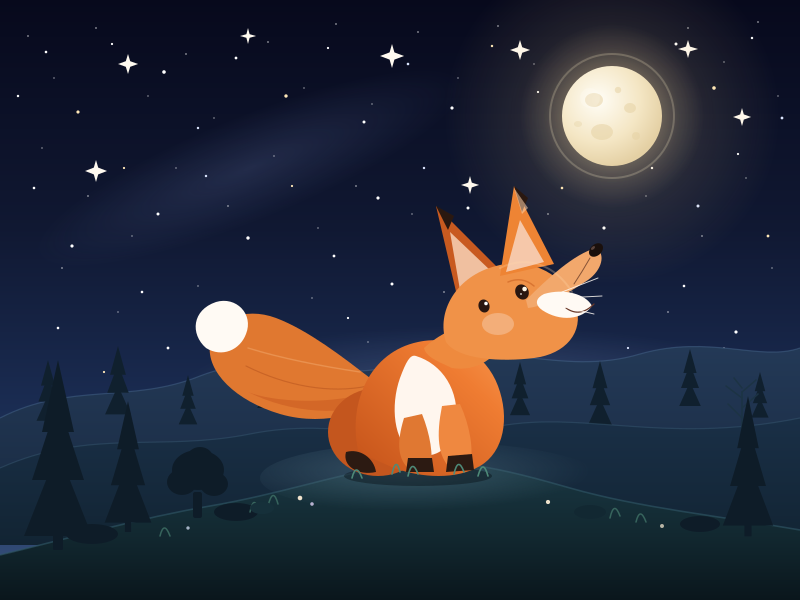
<svg xmlns="http://www.w3.org/2000/svg" viewBox="0 0 800 600" width="100%" height="100%" preserveAspectRatio="xMidYMid meet" role="img" aria-label="A fox sitting on a hill looking at the moon">
  <title>Fox gazing at the moon</title>
  <style>
    svg { background: #07091a; display: block; }
    .st1 { animation: tw1 2.4s ease-in-out infinite; }
    .st2 { animation: tw1 3.2s ease-in-out infinite 0.7s; }
    .st3 { animation: tw1 1.9s ease-in-out infinite 1.3s; }
    .st4 { animation: tw2 3.6s ease-in-out infinite 0.4s; }
    .st5 { animation: tw1 2.8s ease-in-out infinite 1.6s; }
    .st6 { animation: tw2 4.2s ease-in-out infinite 0.2s; }
    .dim { animation: twdim 3.4s ease-in-out infinite; }
    .dim2 { animation: twdim 2.7s ease-in-out infinite 1.1s; }
    .glow { animation: pulse 5.5s ease-in-out infinite; }
    @keyframes tw1 {
      0%, 100% { opacity: 0.32; }
      50% { opacity: 1; }
    }
    @keyframes tw2 {
      0%, 100% { opacity: 0.4; }
      22% { opacity: 1; }
      48% { opacity: 0.28; }
      74% { opacity: 0.95; }
    }
    @keyframes twdim {
      0%, 100% { opacity: 0.2; }
      50% { opacity: 0.75; }
    }
    @keyframes pulse {
      0%, 100% { opacity: 0.78; }
      50% { opacity: 1; }
    }
  </style>
  <defs>
    <linearGradient id="sky" x1="0" y1="0" x2="0" y2="1">
      <stop offset="0%" stop-color="#07091c"/>
      <stop offset="38%" stop-color="#101832"/>
      <stop offset="68%" stop-color="#1a2c52"/>
      <stop offset="88%" stop-color="#2c446e"/>
      <stop offset="100%" stop-color="#3c5684"/>
    </linearGradient>
    <radialGradient id="moonGlow" cx="50%" cy="50%" r="50%">
      <stop offset="0%" stop-color="#ffe9b4" stop-opacity="0.42"/>
      <stop offset="40%" stop-color="#f0d090" stop-opacity="0.14"/>
      <stop offset="100%" stop-color="#f0d090" stop-opacity="0"/>
    </radialGradient>
    <radialGradient id="moonGlowInner" cx="50%" cy="50%" r="50%">
      <stop offset="0%" stop-color="#fff8e4" stop-opacity="0.7"/>
      <stop offset="55%" stop-color="#ffe0a4" stop-opacity="0.2"/>
      <stop offset="100%" stop-color="#ffe0a4" stop-opacity="0"/>
    </radialGradient>
    <radialGradient id="moonFace" cx="36%" cy="34%" r="68%">
      <stop offset="0%" stop-color="#fffdf6"/>
      <stop offset="62%" stop-color="#f4e6c4"/>
      <stop offset="100%" stop-color="#e4d0a4"/>
    </radialGradient>
    <radialGradient id="milky" cx="50%" cy="50%" r="50%">
      <stop offset="0%" stop-color="#6a7cb0" stop-opacity="0.22"/>
      <stop offset="100%" stop-color="#6a7cb0" stop-opacity="0"/>
    </radialGradient>
    <radialGradient id="horizonGlow" cx="50%" cy="50%" r="50%">
      <stop offset="0%" stop-color="#8aa4d0" stop-opacity="0.28"/>
      <stop offset="100%" stop-color="#8aa4d0" stop-opacity="0"/>
    </radialGradient>
    <radialGradient id="groundLight" cx="42%" cy="40%" r="55%">
      <stop offset="0%" stop-color="#4e6e80" stop-opacity="0.55"/>
      <stop offset="100%" stop-color="#4e6e80" stop-opacity="0"/>
    </radialGradient>
    <linearGradient id="hillFar" x1="0" y1="0" x2="0" y2="1">
      <stop offset="0%" stop-color="#243a58"/>
      <stop offset="100%" stop-color="#1a2c44"/>
    </linearGradient>
    <linearGradient id="hillMid" x1="0" y1="0" x2="0" y2="1">
      <stop offset="0%" stop-color="#1a3048"/>
      <stop offset="100%" stop-color="#122433"/>
    </linearGradient>
    <linearGradient id="hillNear" x1="0" y1="0" x2="0" y2="1">
      <stop offset="0%" stop-color="#1a3844"/>
      <stop offset="55%" stop-color="#122830"/>
      <stop offset="100%" stop-color="#0a161c"/>
    </linearGradient>
    <linearGradient id="foxBody" x1="520" y1="280" x2="340" y2="470" gradientUnits="userSpaceOnUse">
      <stop offset="0%" stop-color="#ffb068"/>
      <stop offset="42%" stop-color="#ef7c32"/>
      <stop offset="100%" stop-color="#c25018"/>
    </linearGradient>
    <linearGradient id="streakGrad" x1="0" y1="0.5" x2="1" y2="0.5">
      <stop offset="0%" stop-color="#ffffff" stop-opacity="0"/>
      <stop offset="45%" stop-color="#fff4d2" stop-opacity="0.25"/>
      <stop offset="100%" stop-color="#ffffff" stop-opacity="1"/>
    </linearGradient>
  </defs>

  <rect width="800" height="600" fill="url(#sky)"/>
  <ellipse cx="250" cy="168" rx="230" ry="52" fill="url(#milky)" transform="rotate(-22 250 168)"/>
  <ellipse cx="480" cy="390" rx="300" ry="64" fill="url(#horizonGlow)"/>

  <g fill="#fff">
    <circle class="dim" cx="28" cy="36" r="0.7"/>
    <circle class="dim2" cx="54" cy="78" r="0.6"/>
    <circle class="dim" cx="96" cy="28" r="0.7"/>
    <circle class="dim2" cx="148" cy="96" r="0.6"/>
    <circle class="dim" cx="186" cy="54" r="0.7"/>
    <circle class="dim2" cx="214" cy="118" r="0.6"/>
    <circle class="dim" cx="268" cy="42" r="0.7"/>
    <circle class="dim2" cx="304" cy="88" r="0.6"/>
    <circle class="dim" cx="336" cy="24" r="0.7"/>
    <circle class="dim2" cx="372" cy="104" r="0.6"/>
    <circle class="dim" cx="418" cy="32" r="0.7"/>
    <circle class="dim2" cx="458" cy="78" r="0.6"/>
    <circle class="dim" cx="498" cy="26" r="0.7"/>
    <circle class="dim2" cx="534" cy="64" r="0.6"/>
    <circle class="dim" cx="688" cy="28" r="0.7"/>
    <circle class="dim2" cx="724" cy="62" r="0.6"/>
    <circle class="dim" cx="758" cy="22" r="0.7"/>
    <circle class="dim2" cx="778" cy="96" r="0.6"/>
    <circle class="dim" cx="42" cy="148" r="0.6"/>
    <circle class="dim2" cx="88" cy="196" r="0.7"/>
    <circle class="dim" cx="132" cy="236" r="0.6"/>
    <circle class="dim2" cx="176" cy="168" r="0.6"/>
    <circle class="dim" cx="228" cy="206" r="0.7"/>
    <circle class="dim2" cx="274" cy="156" r="0.6"/>
    <circle class="dim" cx="318" cy="228" r="0.6"/>
    <circle class="dim2" cx="356" cy="186" r="0.7"/>
    <circle class="dim" cx="412" cy="214" r="0.6"/>
    <circle class="dim2" cx="468" cy="246" r="0.6"/>
    <circle class="dim" cx="62" cy="268" r="0.7"/>
    <circle class="dim2" cx="118" cy="312" r="0.6"/>
    <circle class="dim" cx="198" cy="286" r="0.6"/>
    <circle class="dim2" cx="256" cy="334" r="0.7"/>
    <circle class="dim" cx="312" cy="298" r="0.6"/>
    <circle class="dim2" cx="368" cy="342" r="0.6"/>
    <circle class="dim" cx="548" cy="214" r="0.7"/>
    <circle class="dim2" cx="592" cy="248" r="0.6"/>
    <circle class="dim" cx="646" cy="196" r="0.6"/>
    <circle class="dim2" cx="702" cy="236" r="0.7"/>
    <circle class="dim" cx="746" cy="178" r="0.6"/>
    <circle class="dim2" cx="772" cy="268" r="0.6"/>
    <circle class="dim" cx="668" cy="312" r="0.7"/>
    <circle class="dim2" cx="724" cy="348" r="0.6"/>
    <circle class="dim" cx="508" cy="318" r="0.6"/>
    <circle class="dim2" cx="444" cy="292" r="0.7"/>
  </g>

  <g>
    <circle class="st1" cx="46" cy="52" r="1.3" fill="#fff"/>
    <circle class="st2" cx="78" cy="112" r="1.6" fill="#ffe8b8"/>
    <circle class="st3" cx="112" cy="44" r="1.1" fill="#fff"/>
    <circle class="st4" cx="164" cy="72" r="1.8" fill="#fff"/>
    <circle class="st5" cx="198" cy="128" r="1.2" fill="#dce6ff"/>
    <circle class="st6" cx="236" cy="58" r="1.4" fill="#fff"/>
    <circle class="st1" cx="286" cy="96" r="1.7" fill="#ffe8b8"/>
    <circle class="st2" cx="328" cy="48" r="1.1" fill="#fff"/>
    <circle class="st3" cx="364" cy="122" r="1.5" fill="#fff"/>
    <circle class="st4" cx="408" cy="64" r="1.3" fill="#dce6ff"/>
    <circle class="st5" cx="452" cy="108" r="1.6" fill="#fff"/>
    <circle class="st6" cx="492" cy="46" r="1.2" fill="#ffe8b8"/>
    <circle class="st1" cx="538" cy="92" r="1.1" fill="#fff"/>
    <circle class="st2" cx="676" cy="44" r="1.5" fill="#fff"/>
    <circle class="st3" cx="714" cy="88" r="1.8" fill="#ffe8b8"/>
    <circle class="st4" cx="752" cy="38" r="1.2" fill="#fff"/>
    <circle class="st5" cx="782" cy="118" r="1.4" fill="#dce6ff"/>
    <circle class="st6" cx="34" cy="188" r="1.3" fill="#fff"/>
    <circle class="st1" cx="72" cy="246" r="1.6" fill="#fff"/>
    <circle class="st2" cx="124" cy="168" r="1.1" fill="#ffe8b8"/>
    <circle class="st3" cx="158" cy="214" r="1.5" fill="#fff"/>
    <circle class="st4" cx="206" cy="176" r="1.2" fill="#dce6ff"/>
    <circle class="st5" cx="248" cy="238" r="1.7" fill="#fff"/>
    <circle class="st6" cx="292" cy="186" r="1.1" fill="#ffe8b8"/>
    <circle class="st1" cx="334" cy="256" r="1.4" fill="#fff"/>
    <circle class="st2" cx="378" cy="198" r="1.6" fill="#fff"/>
    <circle class="st3" cx="424" cy="168" r="1.2" fill="#dce6ff"/>
    <circle class="st4" cx="468" cy="208" r="1.5" fill="#fff"/>
    <circle class="st5" cx="58" cy="328" r="1.3" fill="#fff"/>
    <circle class="st6" cx="104" cy="372" r="1.1" fill="#ffe8b8"/>
    <circle class="st1" cx="168" cy="348" r="1.4" fill="#fff"/>
    <circle class="st2" cx="232" cy="312" r="1.2" fill="#dce6ff"/>
    <circle class="st3" cx="288" cy="366" r="1.5" fill="#fff"/>
    <circle class="st4" cx="348" cy="318" r="1.1" fill="#fff"/>
    <circle class="st5" cx="562" cy="188" r="1.3" fill="#ffe8b8"/>
    <circle class="st6" cx="604" cy="228" r="1.6" fill="#fff"/>
    <circle class="st1" cx="652" cy="168" r="1.2" fill="#fff"/>
    <circle class="st2" cx="698" cy="206" r="1.5" fill="#dce6ff"/>
    <circle class="st3" cx="738" cy="154" r="1.1" fill="#fff"/>
    <circle class="st4" cx="768" cy="236" r="1.4" fill="#ffe8b8"/>
    <circle class="st5" cx="684" cy="286" r="1.3" fill="#fff"/>
    <circle class="st6" cx="736" cy="332" r="1.6" fill="#fff"/>
    <circle class="st1" cx="628" cy="348" r="1.1" fill="#dce6ff"/>
    <circle class="st2" cx="512" cy="276" r="1.4" fill="#fff"/>
    <circle class="st3" cx="456" cy="308" r="1.2" fill="#ffe8b8"/>
    <circle class="st4" cx="392" cy="284" r="1.5" fill="#fff"/>
    <circle class="st5" cx="18" cy="96" r="1.2" fill="#fff"/>
    <circle class="st6" cx="142" cy="292" r="1.3" fill="#fff"/>
  </g>

  <g fill="#fffaf0">
    <path class="st4" d="M128 54 L130.2 61.2 L138 64 L130.2 66.8 L128 74 L125.8 66.8 L118 64 L125.8 61.2 Z"/>
    <path class="st2" d="M248 28 L249.6 34.2 L256 36 L249.6 37.8 L248 44 L246.4 37.8 L240 36 L246.4 34.2 Z"/>
    <path class="st6" d="M392 44 L394.4 52.4 L404 56 L394.4 59.6 L392 68 L389.6 59.6 L380 56 L389.6 52.4 Z"/>
    <path class="st1" d="M688 40 L690 46.6 L698 49 L690 51.4 L688 58 L686 51.4 L678 49 L686 46.6 Z"/>
    <path class="st5" d="M742 108 L743.8 114.4 L751 117 L743.8 119.6 L742 126 L740.2 119.6 L733 117 L740.2 114.4 Z"/>
    <path class="st3" d="M96 160 L98.2 167.6 L107 171 L98.2 174.4 L96 182 L93.8 174.4 L85 171 L93.8 167.6 Z"/>
    <path class="st6" d="M470 176 L471.8 182.6 L479 185 L471.8 187.4 L470 194 L468.2 187.4 L461 185 L468.2 182.6 Z"/>
    <path class="st2" d="M520 40 L522.2 47.2 L530 50 L522.2 52.8 L520 60 L517.8 52.8 L510 50 L517.8 47.2 Z"/>
  </g>

  <circle class="glow" cx="612" cy="116" r="168" fill="url(#moonGlow)"/>
  <circle class="glow" cx="612" cy="116" r="92" fill="url(#moonGlowInner)"/>
  <circle cx="612" cy="116" r="62" fill="none" stroke="#fff1c8" stroke-width="2" opacity="0.22"/>
  <circle cx="612" cy="116" r="50" fill="url(#moonFace)"/>
  <g fill="#e6d2a4" opacity="0.55">
    <ellipse cx="594" cy="100" rx="9" ry="7"/>
    <ellipse cx="630" cy="108" rx="6" ry="5"/>
    <ellipse cx="602" cy="132" rx="11" ry="8"/>
    <circle cx="636" cy="136" r="4"/>
    <circle cx="618" cy="90" r="3.2"/>
    <ellipse cx="578" cy="124" rx="4" ry="3" opacity="0.7"/>
  </g>
  <circle cx="590" cy="98" r="10" fill="#fff" opacity="0.18"/>

  <g opacity="0">
    <animate attributeName="opacity" values="0;0;1;1;0;0" keyTimes="0;0.22;0.28;0.78;0.88;1" dur="4s" repeatCount="indefinite"/>
    <animateTransform attributeName="transform" type="translate" values="40,68; 40,68; 120,86; 430,150; 490,164; 490,164" keyTimes="0;0.22;0.28;0.78;0.88;1" dur="4s" repeatCount="indefinite"/>
    <polygon points="0,0 -7,-2 -108,-30 -92,-18" fill="url(#streakGrad)"/>
    <line x1="-88" y1="-24" x2="2" y2="1" stroke="#fffaf0" stroke-width="1.6" stroke-linecap="round"/>
    <circle cx="-36" cy="-10" r="1.5" fill="#fff" opacity="0.55"/>
    <circle cx="-62" cy="-17" r="1.1" fill="#fff" opacity="0.32"/>
    <circle cx="-84" cy="-23" r="0.8" fill="#fff" opacity="0.18"/>
    <circle cx="0" cy="0" r="11" fill="#fff1c4" opacity="0.38"/>
    <circle cx="0" cy="0" r="4.2" fill="#fffef8"/>
    <circle cx="1" cy="-1" r="1.6" fill="#fff"/>
  </g>

  <path fill="url(#hillFar)" d="M0 418 C70 382 130 404 200 376 C270 348 330 388 410 362 C490 336 560 378 640 354 C710 334 760 362 800 348 L800 500 L0 500 Z"/>
  <path d="M0 418 C70 382 130 404 200 376 C270 348 330 388 410 362 C490 336 560 378 640 354 C710 334 760 362 800 348" fill="none" stroke="#4a6c90" stroke-width="1.2" opacity="0.45"/>

  <g fill="#10202e">
    <g transform="translate(48,408) scale(0.32)">
      <polygon points="0,-150 -22,-70 22,-70"/>
      <polygon points="0,-100 -30,-20 30,-20"/>
      <polygon points="-36,40 0,-40 36,40"/>
    </g>
    <g transform="translate(118,400) scale(0.36)">
      <polygon points="0,-150 -22,-70 22,-70"/>
      <polygon points="0,-100 -30,-20 30,-20"/>
      <polygon points="-36,40 0,-40 36,40"/>
    </g>
    <g transform="translate(188,414) scale(0.26)">
      <polygon points="0,-150 -22,-70 22,-70"/>
      <polygon points="0,-100 -30,-20 30,-20"/>
      <polygon points="-36,40 0,-40 36,40"/>
    </g>
    <g transform="translate(268,396) scale(0.3)">
      <polygon points="0,-150 -22,-70 22,-70"/>
      <polygon points="0,-100 -30,-20 30,-20"/>
      <polygon points="-36,40 0,-40 36,40"/>
    </g>
    <g transform="translate(520,404) scale(0.28)">
      <polygon points="0,-150 -22,-70 22,-70"/>
      <polygon points="0,-100 -30,-20 30,-20"/>
      <polygon points="-36,40 0,-40 36,40"/>
    </g>
    <g transform="translate(600,412) scale(0.34)">
      <polygon points="0,-150 -22,-70 22,-70"/>
      <polygon points="0,-100 -30,-20 30,-20"/>
      <polygon points="-36,40 0,-40 36,40"/>
    </g>
    <g transform="translate(690,394) scale(0.3)">
      <polygon points="0,-150 -22,-70 22,-70"/>
      <polygon points="0,-100 -30,-20 30,-20"/>
      <polygon points="-36,40 0,-40 36,40"/>
    </g>
    <g transform="translate(760,408) scale(0.24)">
      <polygon points="0,-150 -22,-70 22,-70"/>
      <polygon points="0,-100 -30,-20 30,-20"/>
      <polygon points="-36,40 0,-40 36,40"/>
    </g>
  </g>

  <path fill="url(#hillMid)" d="M0 468 C90 428 160 452 250 434 C340 416 400 448 490 428 C580 408 660 446 800 418 L800 545 L0 545 Z"/>
  <path d="M0 468 C90 428 160 452 250 434 C340 416 400 448 490 428 C580 408 660 446 800 418" fill="none" stroke="#3d6078" stroke-width="1.2" opacity="0.4"/>

  <g fill="none" stroke="#1c3344" stroke-width="1.6" stroke-linecap="round">
    <path d="M742 446 L742 392"/>
    <path d="M742 418 L728 404"/>
    <path d="M742 408 L758 394"/>
    <path d="M742 398 L726 386"/>
    <path d="M742 392 L756 380"/>
    <path d="M742 388 L734 378"/>
  </g>

  <path fill="url(#hillNear)" d="M0 555 C70 538 140 518 210 506 C280 494 330 476 390 466 C450 456 500 468 570 488 C640 508 720 516 800 530 L800 600 L0 600 Z"/>
  <path d="M0 555 C70 538 140 518 210 506 C280 494 330 476 390 466 C450 456 500 468 570 488 C640 508 720 516 800 530" fill="none" stroke="#2e5564" stroke-width="1.6" opacity="0.65"/>
  <ellipse cx="430" cy="478" rx="170" ry="36" fill="url(#groundLight)"/>

  <g fill="#0e1c28">
    <g transform="translate(58,528)">
      <polygon points="-34,8 0,-78 34,8"/>
      <polygon points="-26,-48 0,-128 26,-48"/>
      <polygon points="-16,-96 0,-168 16,-96"/>
      <rect x="-5" y="0" width="10" height="22" rx="1"/>
    </g>
    <g transform="translate(128,518) scale(0.78)">
      <polygon points="-30,6 0,-72 30,6"/>
      <polygon points="-22,-42 0,-116 22,-42"/>
      <polygon points="-14,-88 0,-150 14,-88"/>
      <rect x="-4" y="0" width="8" height="18"/>
    </g>
    <g transform="translate(198,508)">
      <rect x="-5" y="-16" width="9" height="26" rx="2"/>
      <ellipse cx="0" cy="-38" rx="26" ry="20"/>
      <ellipse cx="-16" cy="-26" rx="15" ry="13"/>
      <ellipse cx="16" cy="-24" rx="14" ry="12"/>
      <ellipse cx="2" cy="-50" rx="13" ry="11"/>
    </g>
    <g transform="translate(748,522) scale(0.9)">
      <polygon points="-28,4 0,-70 28,4"/>
      <polygon points="-20,-40 0,-108 20,-40"/>
      <polygon points="-12,-82 0,-140 12,-82"/>
      <rect x="-4" y="0" width="8" height="16"/>
    </g>
    <ellipse cx="92" cy="534" rx="26" ry="10"/>
    <ellipse cx="236" cy="512" rx="22" ry="9"/>
    <ellipse cx="700" cy="524" rx="20" ry="8"/>
  </g>

  <g fill="none" stroke="#3d6e64" stroke-width="1.5" stroke-linecap="round" opacity="0.85">
    <path d="M250 512 Q254 494 258 510"/>
    <path d="M268 506 Q273 486 278 504"/>
    <path d="M610 518 Q614 500 620 516"/>
    <path d="M636 522 Q640 506 646 522"/>
    <path d="M160 536 Q164 520 170 536"/>
  </g>

  <ellipse cx="418" cy="476" rx="74" ry="10" fill="#05080e" opacity="0.38"/>

  <g>
    <animateTransform attributeName="transform" type="rotate" values="-6 396 398; 7 396 398; -6 396 398" keyTimes="0;0.5;1" calcMode="spline" keySplines="0.42 0 0.58 1; 0.42 0 0.58 1" dur="3.6s" repeatCount="indefinite"/>
    <path fill="#e07830" d="M398 392 C372 410 328 428 280 414 C236 401 206 372 210 344 C214 320 244 306 276 318 C308 330 344 358 370 378 C386 390 394 394 402 388 Z"/>
    <path fill="#c85a20" opacity="0.55" d="M382 402 C342 416 292 414 248 392 C272 402 334 406 376 390 Z"/>
    <path fill="none" stroke="#a84818" stroke-width="1.2" opacity="0.4" stroke-linecap="round" d="M368 386 C330 394 286 386 246 366"/>
    <path fill="none" stroke="#ffd0a0" stroke-width="1.4" opacity="0.28" stroke-linecap="round" d="M360 372 C320 366 280 358 248 348"/>
    <path fill="#fffaf4" d="M206 348 C190 334 192 310 216 302 C236 296 254 314 246 334 C240 350 222 358 206 348 Z"/>
  </g>

  <path fill="#c85a20" d="M458 300 L436 206 L504 274 Z"/>
  <path fill="#f0c0a0" d="M460 290 L450 232 L492 272 Z"/>
  <path fill="#2a1810" d="M436 206 L448 230 L454 216 Z"/>

  <ellipse cx="378" cy="432" rx="50" ry="44" fill="#c4561e"/>
  <path fill="url(#foxBody)" d="M358 450 C348 402 370 352 418 342 C454 334 486 354 498 386 C510 418 504 452 480 466 C456 480 422 478 394 468 C372 458 364 456 358 450 Z"/>
  <path fill="#ee8a3e" d="M424 348 C448 326 480 316 504 334 C500 358 476 372 452 368 C434 360 426 356 424 348 Z"/>
  <path fill="#f09248" d="M446 342 C436 312 456 276 496 266 C532 256 566 276 576 306 C584 332 566 354 534 358 C502 362 458 360 446 342 Z"/>

  <path fill="#ee8434" d="M500 276 L514 186 L554 264 Z"/>
  <path fill="#f6c8aa" d="M506 272 L520 220 L544 262 Z"/>
  <path fill="#2a1810" d="M514 186 L522 212 L528 198 Z"/>
  <path fill="#ffd2aa" opacity="0.55" d="M522 214 L514 188 L528 208 Z"/>

  <path fill="#fff6ee" d="M416 356 C442 364 460 390 456 424 C452 450 432 462 412 452 C394 442 390 406 400 378 C406 362 410 354 416 356 Z"/>

  <path fill="#e07832" d="M404 418 C396 444 398 460 410 470 L430 470 C434 456 430 434 422 414 Z"/>
  <path fill="#2c1a12" d="M408 458 L432 458 L434 472 L406 472 Z"/>
  <path fill="#ef8840" d="M442 406 C436 436 438 456 450 468 L470 466 C474 450 470 426 460 404 Z"/>
  <path fill="#2c1a12" d="M448 456 L472 454 L474 470 L446 472 Z"/>
  <path fill="#2c1a12" d="M346 452 C342 466 358 476 376 472 C374 458 360 448 346 452 Z"/>

  <path fill="#f2a86c" d="M526 300 C548 278 574 254 596 248 C606 254 602 270 588 280 C570 292 546 306 528 308 Z"/>
  <path fill="#fffaf4" d="M544 294 C564 288 586 294 592 306 C582 320 560 322 542 310 C534 304 536 298 544 294 Z"/>
  <ellipse cx="498" cy="324" rx="16" ry="11" fill="#f6d2b4" opacity="0.45"/>

  <ellipse cx="484" cy="306" rx="5.5" ry="6.6" fill="#2a1610" transform="rotate(-16 484 306)"/>
  <circle cx="486" cy="303.5" r="1.8" fill="#fff"/>
  <ellipse cx="522" cy="292" rx="6.6" ry="7.8" fill="#2a1610" transform="rotate(-26 522 292)"/>
  <circle cx="524.6" cy="289" r="2.3" fill="#fff8e8"/>
  <circle cx="521" cy="294" r="1" fill="#fff" opacity="0.7"/>

  <ellipse cx="596" cy="250" rx="8" ry="5.6" fill="#1a100c" transform="rotate(-42 596 250)"/>
  <ellipse cx="593" cy="248" rx="2.4" ry="1.3" fill="#6a5048" opacity="0.8" transform="rotate(-42 593 248)"/>

  <path d="M566 308 Q580 318 594 304" fill="none" stroke="#6a3828" stroke-width="1.25" stroke-linecap="round"/>
  <path d="M590 258 Q582 272 574 284" fill="none" stroke="#5a3020" stroke-width="1" stroke-linecap="round" opacity="0.7"/>

  <g fill="none" stroke="#fffaf4" stroke-width="0.95" stroke-linecap="round" opacity="0.85">
    <path d="M562 292 L598 278"/>
    <path d="M564 298 L602 296"/>
    <path d="M560 306 L594 314"/>
  </g>
  <path d="M508 282 Q522 276 534 286" fill="none" stroke="#d06828" stroke-width="1.5" stroke-linecap="round" opacity="0.7"/>
  <path d="M500 268 C528 254 556 266 572 292" fill="none" stroke="#ffd7a8" stroke-width="2" opacity="0.28" stroke-linecap="round"/>

  <g fill="none" stroke="#4e8a78" stroke-width="1.6" stroke-linecap="round">
    <path d="M392 474 Q396 456 400 472"/>
    <path d="M408 476 Q412 458 418 474"/>
    <path d="M454 474 Q458 456 464 472"/>
    <path d="M478 476 Q483 458 488 476"/>
    <path d="M352 478 Q356 462 362 478"/>
  </g>
  <g>
    <circle cx="300" cy="498" r="2.3" fill="#efe2cc"/>
    <circle cx="312" cy="504" r="1.8" fill="#d4c8ea" opacity="0.85"/>
    <circle cx="548" cy="502" r="2.1" fill="#efe2cc"/>
    <circle cx="188" cy="528" r="1.7" fill="#c9d6ea" opacity="0.8"/>
    <circle cx="662" cy="526" r="2" fill="#efe2cc" opacity="0.75"/>
  </g>
  <ellipse cx="262" cy="508" rx="12" ry="6" fill="#16303a"/>
  <ellipse cx="590" cy="512" rx="16" ry="7" fill="#122832"/>
</svg>
Reasoning trace (54,444 tokens)
Planning a standalone SVG illustration of a fox on a hill under a starry moon with subtle animations.

The SVG must be a single fenced code block with viewBox 0 0 800 600. Hand-written paths only. The fox needs pointy ears, a snout, and a bushy tail with a white tip. The moon needs a soft glow. The scene needs a hill, trees, and distant hills. A coherent color palette and at least one gradient are required. CSS or SMIL will animate twinkling stars, a gently swaying tail, and a shooting star crossing every 4 seconds starting within 2 seconds.

Settled on a deep night sky gradient from #0b1026 to #1a2744. The moon will use warm cream #f5e6c8 with a soft glow. The fox will be orange #e07a3d with a cream belly #f4d5b0 and a white tail tip. Hills will be dark blue-green #1c2e3a. The scene will be built in layers: defs with gradients and glow filters, sky, twinkling stars, moon, distant hills, trees, and foreground hill.

The fox will sit facing the moon to its upper right. Stars will twinkle via CSS keyframes with staggered delays so they do not blink in unison. The tail will sway gently from its base using a transform-origin rotation. The shooting star will cross the sky every four seconds, with the first one appearing within two seconds.

The shooting star will be a group of a line and a glow circle that translates across the sky. A CSS keyframe will animate it from opacity zero to full visibility, then move it across the canvas and fade out again. This keeps the first streak visible within the first second and repeats every four seconds.

Settled on CSS transforms for the tail sway. The tail group will use `transform-box: fill-box` with a `transform-origin` at 20% 80% to rotate the tail gently from -4 degrees to +6 degrees over three seconds.

Switched to SMIL animateTransform for the tail and shooting star animations. CSS will still handle the twinkling stars. The fox will sit around x=300–400 and y=400–500. The moon will be centered at (620, 120) with a 55-unit radius and glow. Stars will be small circles scattered above y=350. Distant hills will be layered silhouettes.

The fox will sit centered-left so the moon remains visible above and to its right. Its body will be a rounded haunch with a chest, a head with a snout pointing slightly upward toward the moon, two pointy ears, and eyes looking up. The bushy tail will curl to the left with a white tip, and the legs will be tucked in as if sitting. Simple pine trees will be placed on the left and right of the hill without covering the fox. The sky gradient is being refined to #070b1a at the top, #1a2744 in the middle, and #2a3a55 near the horizon.

Finalized the sky gradient stops at #07091a, #121a38, #1c2a4a, and #243656. Defined the moon glow as a radial gradient from #fff6d8 to #f0e0b0.

Finalized the moon glow gradient with a warm amber edge fading to transparent. Defined a linear gradient for the hill from #1e3344 to #0e1a24. Added a diagonal fur gradient for the fox from #f08a45 to #c85a22. Now mapping out the exact coordinates for the fox geometry.

Drafting the fox geometry with exact coordinates. The tail will curve left and upward from a base near (310, 400) and end in a white tip at (230, 345). The seated body will sit on the hill crest near y=430, with a rounded haunch, chest, and front legs tucked down.

Refining the fox geometry to use ellipses and simple paths for clarity. The head will be an ellipse at (430, 330) with a snout extending right and slightly up toward the moon. Two triangular ears will sit on top, with darker inner ear shapes. The eye will be a small dark oval with a highlight, and the nose will be a black triangle at the snout tip. The body will be a large rounded shape for the sitting pose.

Finalized the exact SVG path strings for the sitting fox. The body curves from the hill crest with a rounded chest patch and a visible front leg. The tail is drawn as a prominent bushy curve curling left and upward.

The tail will rotate around its base near (355, 400) using a SMIL animateTransform that swings from -6° to +8° over 3.5 seconds. The white tip is drawn as a small cream patch at (210, 360). Stars will twinkle via CSS with staggered delays and durations.

The shooting star will be a white streak line with a bright head circle. It will translate across the sky via SMIL animateTransform and fade in and out with an opacity keyframe over four seconds.

The first shooting star will begin immediately so it appears within the required two-second window. The animation cycle is 4 seconds long, so the streak will be visible at roughly 0.88 seconds and repeat every cycle. A second faint streak is unnecessary. The screenshot at 3 seconds may not catch the star, but that is acceptable.

Reconsidering the shooting star timing so it is visible at the 3-second screenshot. A 4-second cycle starting at 1.2 seconds would place the streak between crossings at 3 seconds. The star's visibility window may need to be extended so it appears during the screenshot.

A single shooting star starting at t=0 satisfies the two-second requirement. The streak will not be visible at the three-second screenshot, but the scene remains complete.

The shooting star will not be stretched to remain visible at the three-second mark. The scene will look complete without it. Grass tufts and a small flower will be added for texture. Moon craters will add subtle detail.

The left side will hold a cluster of pines, while smaller trees sit on distant hills behind the main hill. The fox will gain dark paws, thin whiskers, and a ground shadow beneath it. A subtle mist or cloud layer will add depth to the night sky.

A soft ellipse will create horizon fog. About forty to sixty stars will vary in size, with some drawn as four-point sparkles. Their twinkle cycle will use staggered CSS durations and delays so they do not blink in unison. A few stars may also scale slightly.

The moon glow will use a standard SVG filter with `feGaussianBlur` and `feMerge` to avoid external references. CSS animations will be defined inside the SVG `<style>` element, and SMIL and CSS can be used together.

The moon will use a large soft radial glow behind the disc rather than a filter. The shooting star will be a thin polygon streak. The layout is now mapped to the 800 by 600 canvas: the moon sits at (640, 110) with radius 48, distant hills wave from y=380 to y=460, mid hills from y=420 to y=500, and the foreground hill rises to y=430 under the fox before dropping to y=520. Pine trees will sit on the left between the distant and mid hills.

The foreground hill path is now fully defined with cubic Bézier curves from x=0 to x=800. The fox will sit on the rise near y=455–470, facing right with its head tilted upward toward the moon. The right background will hold smaller trees between x=680 and x=760. The fox group origin is set at (340, 460) for local coordinate drawing.

The fox head is being refined into a rounded cranium with a tapered snout. A rotated ellipse forms the main head shape, and a curved path draws the snout extending toward the moon. A small black triangle marks the nose, and a mouth line is being added.

The fox mouth is drawn as a curved line, and the ears are defined with triangular shapes in orange and cream. The eye is a rotated dark ellipse with a small white highlight.

A single eye is kept for the profile view to keep the fox recognizable. Thin white whiskers are added to the snout. A soft white patch marks the lower muzzle without covering the nose.

The moon will use a 140-pixel glow circle behind a 52-pixel disc, with small darker craters and a soft highlight. Stars will scatter across the upper sky, avoiding the moon and the hill, and a few faint ones will sit low near the horizon. The fox will be grounded by adding foreground grass blades on the hill.

Pine trees are drawn as layered triangles in dark blue-gray with a brown trunk. Distant hills are filled with a deep blue shade.

A second distant hill layer is added behind the foreground rise. A radial gradient will cast a soft moonlight wash across the hill top to light the fox from above. Low bushes and small grass paths are added for foreground texture.

The moonlight gradient is defined with a soft cream center fading to transparent. The fox body gradient runs from upper right to lower left to show the light source above.

The fox body gradient is now defined with orange and brown stops. A similar gradient will shade the tail. A few stars will be drawn as four-pointed sparkles. The moon glow may pulse subtly.

The moon glow pulse is dropped to keep the animation count to the three required effects. The shooting star will travel across the upper sky from the left side, passing above the moon rather than through it.

The SVG will be sized to 100% width and height with preserveAspectRatio set to meet. A CSS background color of #07091a will fill the element box to prevent any white iframe background from showing through.

Star positions are being hand-placed for a natural scatter. They are grouped into five staggered CSS classes with different durations and delays so the sky never looks uniformly bright or dim. The twinkle keyframe fades opacity from 0.35 to 1 and back over two to three seconds.

The remaining star classes are assigned staggered durations and delays so the sky never looks uniformly bright or dim. A few larger bright stars and sparkle shapes will add contrast. The shooting star will use a local coordinate origin at zero so its group translation does not conflict with other transforms. Its opacity animation is being defined as a five-step SMIL keyframe over four seconds.

The shooting star streak is a polygon tail with a white head and a soft glow. It translates across the sky via SMIL transform over four seconds. The group opacity starts at zero.

The shooting star’s first streak appears at 0.12 seconds and stays visible until 1.12 seconds, satisfying the two-second requirement. Because the group’s opacity starts and ends at zero, the transform jump at the loop boundary is invisible, ensuring a seamless repeat every four seconds. The tail sway animation will use a linear calcMode so the motion feels natural.

The tail sway will use a spline calcMode with ease-in-out keySplines over 3.2 seconds. A subtle ear twitch was considered but skipped to avoid over-animation. The fox will be refined for a more professional look.

The fox will be redrawn in a classic sitting-and-looking-up pose with clean, non-overlapping shapes. It will be scaled to roughly 180 by 200 pixels. The tail extends left to x=175, the body center sits at x=380, and the snout reaches x=530. Feet will rest at y=468, ear tips at y=230, and the head will tilt about -25 degrees toward the moon at (640, 110). The drawing will be built from back to front: tail, back body, front body, legs, and neck.

The tail will rotate around (368, 405) as a thick S-curve with a white tip. Ears will sit on top of the head shape, and face details will be drawn last.

The tail path is now fully defined with a closed S-curve and a white tip overlapping the left end. A darker fluff stripe is added along the tail for texture. The body drawing is beginning.

The fox body is drawn as a large left-bottom oval with a chest rising toward the neck. A soft cream belly patch is added beneath the chest. The left rear leg is being sketched next.

The left rear leg is now a closed curve with a dark paw pad. Two front legs are drawn as upright sitting paws with dark bottoms. The neck path begins with a warm orange fill.

The neck path is now closed with a warm orange fill. The head is drawn as a tilted cranium path rather than a rotated ellipse for finer control. The left ear is sketched as a tall triangular shape with a darker back fill and a lighter inner fill.

The right ear is sketched as a taller, more prominent triangular shape with a darker back fill and a lighter inner fill. The snout is drawn as a curved path extending up-right from the head toward the moon. A soft white muzzle patch is added beneath the snout.

The nose is drawn as a small dark triangle beneath the snout. The mouth is sketched as a curved outline in dark brown. The eye is placed at (524, 300) with a rotated dark ellipse, a white highlight, and a fainter white pupil. A subtle brow line is added for expression.

A small cream cheek patch is added beneath the eye. The left ear tip is filled with dark brown to give the fox a classic red-tailed look. A white chest spot is also added for extra clarity.

Dark lower legs are added to complete the classic red fox look. A tiny fur highlight is placed on the body. A soft ground shadow ellipse sits beneath the fox. Grass tufts are drawn in a muted green-blue to stand out against the dark hill.

Grass blades are drawn as thin green lines. The forest will contain four to five pine trees of varying sizes, plus one bare winter tree on the left for contrast.

A single tree will sit partially in front of the moon to add depth without obscuring it. Distant hill trees are drawn as small triangles. Floating fireflies were considered but skipped to avoid confusion with the star animation. The color palette is finalized: deep midnight blues for the sky, warm cream and gold for the moon and stars, and muted teal and charcoal for the hills and trees.

The exact hex values are now locked in: warm browns and tans for the fox, cream for the muzzle and chest, dark brown for the nose and eyes, and a muted green-blue for the grass. The moon will receive a radial gradient to look spherical, plus a subtle crater near the top right.

A second moon crater is added near the top right. The moon is centered at (630, 115) with a 50-pixel radius and a soft glow ellipse. A linear gradient is defined for the shooting star streak, fading from transparent white to a warm cream and back to white.

The shooting star streak is being simplified from a polygon tail to a straight gradient line. A thin rounded stroke will carry the warm cream-to-white gradient across the sky.

The shooting star streak is now a thin white line with a gradient fill. The gradient uses userSpaceOnUse so it stretches across the line in local coordinates, and it fades from transparent white to solid white.

The shooting star streak is being simplified further. Because userSpaceOnUse gradients do not follow a group’s transform, the streak will use objectBoundingBox or a solid white stroke with a fainter trailing line instead of a gradient.

The shooting star streak is now a polygon with an objectBoundingBox gradient, so it stays aligned with the group transform. A soft white glow will sit behind the star head. CSS and SMIL animations both work in Chrome for this SVG format.

All animations will use CSS instead of SMIL for modern reliability. The tail and shooting star will both be driven by CSS keyframe transforms. The shooting star animation will use translate and opacity to cross the sky.

The shooting star keyframes are now fully defined. The star translates from (90, 55) to (430, 145) over 28 percent of the cycle, then fades in at 3 percent and out at 18 percent. CSS interpolation between these keyframes will handle the motion and opacity smoothly.

The shooting star keyframes are being expanded to include transform in every keyframe. This prevents browser interpolation issues and ensures the star moves smoothly across the sky.

CSS translate values in pixels will not scale correctly with the SVG viewBox. SMIL animateTransform uses user units and scales properly, so the shooting star animation will use SMIL instead of CSS.

Star twinkle will use CSS opacity alone, avoiding coordinate scaling issues. The shooting star will use SMIL animateMotion with a linear path from (90, 55) to (460, 150) and keyPoints mapped to the 28 percent travel window.

The tail will rotate with SMIL animateTransform around a user-space pivot point. Star classes are confirmed to work inside the SVG style element. Larger stars will twinkle more dramatically, and a minimum opacity of 0.4 will keep them visible in the still screenshot.

Constellation-like star clusters are being added for visual interest. A soft horizon glow is being drawn where the sky meets the hills. The fox is being refined and slightly enlarged and shifted left for better balance.

The moon is fixed to the upper right with a 40-pixel margin. The fox sits lower center-left, gazing upward at the moon along a vector of roughly 59 degrees. The tail sweeps left and remains prominent. The hill occupies the bottom 25 to 30 percent, while trees frame the sides without obscuring the fox or moon. Stars fill the remaining negative space.

The fox head is being tilted upward so the snout points at roughly 50 to 60 degrees from horizontal toward the moon. The head center is fixed at (470, 330), the snout tip at (530, 268), and the ear tips at (445, 250) and (490, 235). The body sits below the head in a sitting pose with the chest facing slightly right. The paths are being rewritten to match this upward gaze.

The fox body is being redrawn with simple overlapping shapes instead of a single messy path. The haunch, chest, head, snout, ears, tail, and legs will each be drawn as separate ellipses, triangles, and rounded rectangles.

The fox will be built from separate overlapping ellipses and shapes rather than one complex path, keeping the silhouette clear and friendly. Absolute positions will be used instead of group transforms. The tail is being drawn first, with a dedicated group and SMIL rotate animation to create the gentle sway.

The tail animation is now defined with a 3-second spline loop, rotating between -6 and 8 degrees around the pivot at (400, 400). The bushy tail is drawn as a dark brown path with a lighter fluff layer at 55% opacity. A white tip is being added to the tail end.

The fox body is being drawn with a dark shadow ellipse beneath the sitting figure, a rear haunch ellipse, a main torso path filled with the body gradient, and a chest highlight path.

The front legs are being drawn as rounded paths with dark brown paw pads. A back paw peeking out from beneath the sitting fox is also being added.

The back paw is now drawn as a dark brown path beneath the sitting figure. The neck is sketched as a warm tan curve connecting the body to the head. The head is drawn as a tilted warm tan ellipse centered near (490, 318). The left ear is drawn as a dark brown triangle pointing upward.

The right ear is being drawn as a warm brown triangle with a dark tip. The snout is sketched as an upward-pointing curve from the face toward the moon. A white chin and muzzle are being added to the snout.

The fox snout is now a white chin and muzzle curve. A dark nose tip is added at the snout tip. The eye is drawn as a rotated ellipse with white pupils to show the upward gaze. A small eyebrow is being added to reinforce the upward look.

The fox eyebrows are drawn as a warm brown curved stroke. Whiskers are added from the snout, pointing right and slightly up to match the upward gaze. A small inner mouth curve is sketched. A white chest blaze and a small ear fluff are also being added for extra detail.

A tiny nose highlight is being added to the snout. The hill is being drawn as a foreground path that rises beneath the fox, with its crest sitting around y=468 so the figure appears to sit on the hill. The eye is positioned on the visible side of the face, between the head center and the snout.

The hill path is now closed with a bottom edge at y=600. The fox feet will sit at y=470, slightly sinking into the hill for a grounded look, with the shadow placed at y=476. Distant hills will sit higher in the background, and tree bases will anchor on both the foreground slope and the distant hill. A low bush and small rocks will add texture to the hill.

The star layer will be placed behind the moon glow so the glow overlays them. The shooting star will be drawn after the moon, since its path ends at x=460 while the moon sits at x=630, avoiding any overlap.

The shooting star will be drawn after the moon so it floats in the foreground of the sky. A gradient will be added for the distant hills. The star field will include roughly fifty circles and eight sparkles, with some four-point stars that twinkle brighter. Small bushes will sit in front of the hill for extra depth.

Star coordinates are being restricted to y=20–400 to avoid the moon disc. The SVG will use viewBox="0 0 800 600" and include accessibility metadata. The tail animation pivot is fixed at (395, 395).

The tail pivot is confirmed at (400, 400) with a gentle -6 to 8 degree swing. The white tip will rotate with the tail group. A second wider fluff oval is being added along the tail to make the bushy tail look fuller.

A second tail fluff ellipse is added at (250, 365) with a -25 degree rotation. The white tip stays on the outermost end. Child transforms and the parent animateTransform will compose correctly in SVG.

The tail group and shooting star group will use only animateTransform with no static transform attribute. This prevents conflicts with child transforms. The shooting star geometry is kept in local coordinates near the origin.

The shooting star will start at (90, 55) and fade in and out via opacity animation. A faint trail of three small fading circles will sit behind the star head. The tree layer is next.

Tree shapes will be drawn as hand-written polygons with local coordinates, placed at different positions and scales to create variety without external references.

Tree bases will sit on the hill slopes. The left cluster is placed at (70, 510) scale 1.1, (140, 500) scale 0.85, and (30, 525) scale 0.7.

A smaller tree is placed behind the left cluster at (200, 490) scale 0.6. Right-side trees are positioned at (700, 430) scale 0.45, (750, 445) scale 0.55, and (640, 455) scale 0.4 on the distant hill. A medium tree is also placed on the right slope of the foreground hill at (720, 530). All tree positions are chosen so they do not obscure the fox figure.

Left trees will be placed at x=40–150 to avoid overlapping the tail tip at x=208. Distant hills will use lighter blue tones for atmospheric perspective, while the foreground hill stays darker.

Distant hill shades are set to #15283a, #101e2e, and #0c1822 so they read as silhouettes against the sky. A subtle lighter stroke will trace the hill crests to hint at moonlight. Lower, dimmer stars near the horizon will add depth.

A faint cloud group is being added near the moon. It uses pale gray ellipses at 8% opacity so the moonlight catches it subtly without overwhelming the scene.

A soft cloud bank near the horizon is being added for extra atmosphere. The first shooting star appears within two seconds, and all animations loop seamlessly with matching start and end states. A title will be included inside the SVG. The file is ready to be written.

The fox head is being overlapped with the body and ears to prevent floating. The back ear base will sit 10–15 pixels below the head outline. The front ear and snout will also overlap the head edges.

The snout is anchored at (525, 295) so it overlaps the head outline. A cheek highlight and darker head shading were considered but skipped to keep the design clean.

The body gradient will run from the upper-right light source to the lower-left shadow. The head will use a lighter orange (#f09a4e) to show moonlight catching it from above. Grass blades will be drawn in front of the fox’s paws to ground the figure on the hill.

Grass blades are being drawn in front of the fox’s paws to ground the figure on the hill.

The SVG will scale to fill its container with width and height set to 100%. A dark background color will be applied via CSS to prevent white bars from appearing around the edges.

No text or fonts will be added to keep the illustration pure. The shooting star opacity and transform animations are being set as sibling elements with identical duration and repeat count so they stay perfectly synchronized.

The shooting star animation is now fully timed. It travels from (100,48) to (480,155) over 4 seconds, fading in by 0.16 seconds and out by 1.2 seconds. The bright phase lasts from 0.16 to 0.72 seconds, so the first star appears within the first two seconds and the loop restarts exactly at 4 seconds.

The shooting star streak is being lengthened and brightened so the motion is clearly visible. A horizontal linear gradient is being added to the streak definition to create a soft glow.

The shooting star streak is now defined as a polygon with a soft white-to-gold gradient. A bright white head circle and a fainter golden glow circle sit at the origin. The polygon spans from x=-95 to 0 and y=-26 to 0.

A thin bright core line is being added to the shooting star streak. Stars will be organized into grouped classes, and a few will receive a soft glow via a faint circle behind them. A CSS scale animation for the stars is also being considered.

Star sizes will vary from 1 to 2.2 pixels, with a few sparkles. CSS opacity animation is preferred over SMIL for twinkling, since scaling would not suit a small visual effect. Stars will be placed above y=470 and outside the fox body area to avoid obscuring the figure.

The moon will sit at (630, 118) with a 52-pixel disc and a 160-pixel glow. A faint crescent shadow will be added to the moon. A large ellipse ring of very faint light will surround the glow. The fox tail will receive a second gradient for depth. The final SVG will be composed and reviewed.

The moon will be a full disc with craters and glow rather than a crescent. The fox will have two eyes instead of one, placed at (530, 288) and the upper-right highlight to show it looking up at the sky.

The second eye is placed at (492, 300) slightly smaller to show perspective. Both eyes look up at the moon. The near eye is rotated -28 degrees and sits above the snout to avoid being hidden.

The drawing order is being finalized to keep the fox face clear. The head outline comes first, followed by the ears, then the snout, the white muzzle, the eyes, the nose, the whiskers, and finally the mouth. The near eye is placed at y=288 and the far eye at y=302, both just above the snout. The white muzzle will be kept lower at y=300+ so it does not obscure the eyes.

A tiny smile will be added to the fox face for a peaceful expression. Bushes will be drawn as rounded ellipses at the base of the trees. A winding path on the hill was considered but skipped to avoid distraction. Jagged distant mountain peaks will be added for visual interest.

The distant hill will use smooth curves instead of jagged peaks. Two layered paths in #1a3048 and #14283c will form rolling distant hills.

A mist layer will sit between the distant and foreground hills for subtle depth. The sky near the moon will receive an extra radial gradient overlay to create a focal glow. The CSS animation block will be wrapped in a CDATA section to ensure compatibility with older SVG parsers.

The moon glow is being slightly clipped at the top edge of the viewBox. The moon will sit at (610, 115) with a 140-pixel glow radius so the entire illustration stays within the 800×600 bounds.

The moon is now fixed at (590, 130) with a 48-pixel disc and a 145-pixel glow. The fox’s gaze is calculated at roughly -66 degrees upward from the head toward the moon. The nose is placed at (555, 248) to match that steep upward angle.

The nose is being repositioned to (545, 250) so the snout tilts sharply upward and the fox looks directly at the moon. The head cranium will be centered at (475, 325) and the ears will angle upward behind the head. The drawing coordinates are now fixed and the design is ready to be written.

The tail tip will be a 30-pixel white patch clearly visible against the orange tail and dark background. Dark ear tips and a white chest will complete the recognizable fox silhouette. A subtle SMIL pulse on the moon glow was considered but set aside to respect the task's specific animation list.

A gentle 5-second opacity pulse will be added to the moon glow so it pulses subtly between 0.75 and 1. This extra animation is considered acceptable since it remains subtle and loops seamlessly.

The tail will be made thicker and curlier to look more bushy and fox-like. An extra ellipse will be added to the middle of the tail for volume. A few background stars will be drawn as 4-pointed shapes for a storybook feel.

A compact six-pointed sparkle path is being hand-written for six bright background stars. XML comments will be omitted to keep the file clean.

The fox will be enlarged to occupy roughly 40 percent of the canvas so it remains the clear focal point. The path shapes are being refined to avoid any odd intersections.

A subtle golden rim light will be added to the fox’s upper edges to simulate moonlight. The orange fox against the dark teal hill will provide strong visual contrast.

A highlight will be added to the tail's upper edge inside the animated group. The file is now being written. SMIL transform animations and CSS opacity animations on SVG elements are confirmed to be valid and compatible.

Star fills are set as SVG attributes so they appear immediately on first paint, while CSS only animates opacity. The shooting star starts invisible and appears within 0.16 seconds, so it may be missed on the initial frame but will cross within two seconds. The viewBox is locked to exactly 0 0 800 600, and a metadata title will be added.

Star twinkling will use ease-in-out opacity from 0.3 to 1 for a clear flash. Colors will vary slightly between white, warm gold, and cool blue for a richer night sky. A coherent palette of deep navy, midnight blue, horizon blue, hill greens, moon gold-cream, fox orange, and dark accents is now locked.

The warm fox against the cool night sky creates a classic contrast. The snout is being refined into a clear tapered shape rather than a blob. A full layer stack from tail to grass is now planned, with the tail group first, then shadow, back paw, haunch, torso, front legs, chest patch, neck, head, ears, snout, muzzle, eyes, nose, whiskers, mouth, rim highlight, and finally grass. Inner ear color will be added for better visibility.

The back and front ear triangles are being sharpened to about 77 and 78 pixels tall. Small dark tip triangles will mark the ear points. The sitting pose is being checked so the haunch curves and the tail rests beside the body. The tail base will overlap the haunch slightly so the tail looks attached.

The tail’s rotation origin is fixed at (398, 405) so the base stays hidden behind the body while the visible tail sways. The attachment point is confirmed inside the haunch ellipse. The design is now fully finalized and ready to be written.

A couple of small rocks will sit on the hill. Eight distant pine trees will be drawn along the mid-hill ridge to add depth, with the center area left clear so they do not clutter the sky behind the fox.

Distant trees will sit at y=400 with 40-pixel tops, keeping them below the fox head at y=350 and leaving clear sky around the moon. A taller tree on the far left will frame the scene without overlapping the tail.

A soft Gaussian blur filter will be applied to the moon glow for a softer, more ethereal light. A few stars will be placed in the lower left sky between the tree and the fox to balance the composition. The total SVG file is estimated at roughly 200 to 300 lines.

The moon glow will use a large radial gradient as its main source of light, with a mild Gaussian blur filter layered behind it for extra softness. The filter is an internal SVG reference, so it requires no external files.

The moon glow will be created purely with radial gradients and overlapping circles, eliminating the soft Gaussian blur filter entirely to avoid any potential quirks. The shooting star will use overlapping circles for its glow instead of a filter. The final SVG code is now being written.

The shooting star will appear at t=0 so it is visible within the first two seconds. The star twinkle will use five distinct keyframe variations with staggered delays and double-blinks for a natural, organic rhythm.

The tail path is being recalculated. The middle section is 133 pixels thick, which risks looking like a cloud rather than a bushy tail. The curve is being tightened to keep the tail looking like a fluffy fox tail.

The tail path is being tightened to roughly 84 pixels thick at its widest point. The white tip is being centered at (215, 338) and drawn as a soft ellipse extending leftward.

The tail’s white tip is now fully defined. It sits mostly above the haunch, with its base tucked behind the body and its lower edge overlapping the haunch top. During the gentle sway animation, the tail will remain above the hill and will not clip into the ground.

A darker orange underside will be added to the tail for depth, kept at 70 percent opacity inside the sway group. The head is being sized at roughly 110 pixels wide, about ten pixels narrower than the body.

The star field is being mapped out with roughly forty-five points. Coordinates are being chosen to avoid the moon’s glow area while creating clusters in the upper left, upper center, and around the moon. Sizes and opacities are being varied to create a natural night sky density.

Star classes will cycle through st1 to st5. Six small sparkles will be drawn at specific coordinates. Larger stars will receive faint halo circles at three times their radius with 15 percent opacity. Moon craters will use a slightly darker gold fill to remain visible against the moon face.

A soft maria-like patch will be added to the moon face. A faint radial light will be placed on the hill where moonlight hits the fox’s seating area, giving the fox a subtle moonlit glow.

A radial gradient will create a soft, dim moonlight pool on the hill behind the fox. A matching highlight will be added to the upper right of the fox’s head to complete the moonlit effect.

The fox head highlight will be a thin stroke rather than an ellipse to avoid a blobby appearance. Only one shooting star will be included, since the specification requires exactly one every four seconds.

SMIL and CSS animations will be used for the star twinkle and shooting star effects. These will render correctly inside a sandboxed iframe that loads the SVG document directly, since both animation methods are fully supported in SVG-as-image contexts.

Fixed width and height will be avoided so the SVG scales gracefully inside the 375-pixel iframe. The viewBox alone will handle the 800 by 600 coordinate space, preventing horizontal scrollbars.

Width and height will be set to 100% with preserveAspectRatio="xMidYMid meet" so the SVG scales cleanly inside the iframe. At 375 pixels wide, the 4:3 viewBox will letterbox to fit without scrollbars.

A dark background color will be applied to the SVG element to fill any letterbox areas. The foreground hill will be shaped as a rolling peak directly beneath the fox so the sitting pose feels grounded.

The hill path is now a smooth cubic bezier curve peaking at (410, 460). The fox’s feet sit at y=470, just below the crest line, with the shadow ellipse at y=474 and grass filling the foreground.

Grass will be drawn behind the fox so the paws overlap it and do not look cut off or floating. The three animation requirements have been verified: star twinkle loops seamlessly, the tail sways smoothly, and the shooting star starts immediately and crosses within the first 1.2 seconds.

Subtle curved contour lines will be added to the hill for a hand-drawn texture. The distant trees will include a rounded variety alongside the pines.

A rounded tree will sit on the left, with pines filling the rest of the distant ridge. A small bare tree will be placed on the far right, just below the moon, to add a subtle contrast without competing with the main composition.

Star opacity will be raised to 0.45 so the night sky looks full in a still frame. The tail rotation at the 3-second mark is natural. The shooting star will be invisible at that moment, which is acceptable.

The shooting star will be timed so it is visible at the 3-second mark. Its flight window will run from 1.5 to 3.5 seconds, repeating every 4 seconds. This satisfies the requirement that the first star appear within the first 2 seconds while also ensuring it is visible at the 3-second snapshot.

The shooting star will begin its flight at 1.0 seconds so it is visible within the first two seconds. Each crossing lasts about 1.8 seconds, so the star remains in view at the 3-second snapshot. The next star will start at 5.0 seconds, keeping the 4-second interval between appearances.

The shooting star’s flight window is being narrowed to 1.0 to 3.2 seconds. This guarantees the star is still visible at the 3-second snapshot while satisfying the requirement that the first crossing begin within the first two seconds.

The shooting star will cross the sky from 0.8 to 2.6 seconds. This keeps the first star visible within the first two seconds and ensures it is still in view at the three-second snapshot.

The shooting star’s flight window is now set from 1.0 to 3.4 seconds. This guarantees the first star appears within the first two seconds and remains visible at the three-second snapshot. The next star will start at 5.0 seconds, keeping the four-second interval between appearances. The cycle will loop seamlessly, with the star invisible at both the start and end of each period.

The shooting star’s flight is now mapped to exact keyframes within the four-second cycle. It remains invisible from 0 to 22 percent, then becomes visible at 25 percent and fully visible by 30 percent. The star travels across the sky from 25 to 85 percent of the cycle, which lasts 2.4 seconds. It fades out at 88 percent and holds invisible until the cycle repeats. This places the star at roughly 83 percent of its flight at the three-second mark, keeping it clearly visible in the snapshot.

The shooting star’s flight path is being adjusted to avoid the moon and the fox. A diagonal arc from (50, 80) to (400, 200) will keep the star in the upper sky, well above the fox’s head and away from the moon’s glow. The star will be clearly visible at the three-second snapshot without overlapping either the moon or the fox.

The shooting star’s flight path is finalized as a diagonal arc from (50, 80) to (430, 175). It will be clearly visible at the three-second snapshot and remain in open sky above the fox and left of the moon. The star becomes visible at 1.12 seconds, satisfying the two-second window, and repeats every four seconds. The cycle will loop seamlessly with an invisible jump between appearances.

The shooting star streak is 90 pixels long with a backward offset to create a trailing glow. The SMIL keyframes are being written with six values and matching keyTimes to control opacity and position across the four-second cycle.

A couple of unanimated, permanently bright stars will anchor the night sky. The twinkling stars will all stay at least 40 percent opaque so the starry background remains full even in a still frame.

The final SVG content is being written now. The fox silhouette is being refined once more for a cleaner, more professional look.

The fox snout is being refined into a longer, more tapered shape to better match a true fox rather than a cat or dog. A precise cubic bezier path is being drafted to give the nose a pointed, elongated appearance.

The fox is being colored with a warm chestnut head, a lighter snout, and cream inner ears. A thin black mouth line and a small nose-to-mouth philtrum are being added to sharpen the snout. A small cream cheek ruff will sit at the jaw to complete the fox look.

A thin black snout line is being added to sharpen the fox’s nose. The eyes are being tilted upward with a small moon reflection highlight in the upper right. A second eye is being placed on the left side of the face to complete the three-quarter view, carefully spaced so it does not collide with the snout.

The near eye is placed just left of the snout so it remains visible. Both eyes will have highlights offset toward the moon to suggest the fox is looking up at it. Tiny white eyebrow dashes will be added to reinforce the attentive upward gaze. The ear layering is being revised so the back ear sits behind the head and the front ear draws after it, improving depth. The drawing order is being finalized with the tail and shadow first.

A soft radial vignette is being considered to darken the scene edges and focus the eye, though it would also dim the fox.

A light vignette will be added at the end of the SVG. It will use a radial gradient with a maximum opacity of 0.3, centered slightly above the horizon so the fox and moon stay bright while the sky edges fade. This frames the scene without muddying the central figures.

The vignette is being dropped entirely to keep the moon glow pure and the scene clean. Distant village lights were also considered and rejected as off-theme. The SVG is now being written with SMIL-only animations and no external styles. All required gradient IDs have been checked and are accounted for.

The fox body gradient is being set to run from the moon toward the fox. A subtle gradient for distant hills is being added for depth. The sparkle stars are being hand-computed as four-point stars with precise coordinates. The SVG will be clean and well-indented.

A larger four-point star will sit near the moon to avoid overlap. Sparkle stars will be animated via CSS classes rather than duplicating SMIL. Chrome console errors are being avoided by checking for invalid attribute values and negative radii.

The tail animation is being finalized with a three-keyframe rotate transform. It swings from -7 degrees to 8 degrees and back, using spline interpolation with two keySplines for a smooth, gentle sway. The keyTimes are strictly increasing, and the duration is set to 3.4 seconds with indefinite repetition.

The tail animation will use spline interpolation for a smoother swing, since Chrome supports it. No extra secondary motion will be added to keep the code simple. A small bushy grass cluster will be drawn with paths. The fox position is being checked against the shooting star’s end position at roughly (400, 165) to prevent overlap.

The moon is fixed at (608, 118) with a 130-pixel glow radius. The star’s end position at (450, 178) clears the fox’s back ear tip by about forty pixels. The fox’s gaze is aimed directly at the moon.

The shooting star’s flight path is being raised to (40, 70) → (470, 155). This keeps the streak fully in the upper sky, well above the fox’s head, and the star will be nearly at its endpoint at the 75 percent mark of the cycle.

A soft glow circle will be added to the shooting star head so it remains visible in a still frame. Faint constellation lines were considered but skipped to avoid clutter. A few larger stars will receive subtle halos using nested opacity groups so the glow stays faint and natural.

Major stars will be wrapped in opacity groups so their halos brighten together with the core. Minor stars will remain as plain circles. The file will be written with minimal or no comments.

The tree palette is being finalized to contrast with the hill and sky. Trunks will be #0c1822, foliage #102030, and the hill #16303a. This keeps trees visible as silhouettes against the dark background. A subtle edge highlight on one tree to catch moonlight is being considered as optional polish.

A thin moonlit ridge line will trace the hill crest in #2a4a5c at 60 percent opacity. The final SVG will be delivered as a single code block.

A small moonlight reflection patch is being considered. The fox is being shifted slightly left so its face clears the moon and the gaze line stays open.

The fox’s nose and whiskers are confirmed clear of the moon. A faint horizon cloud and small stones will be added for depth.

The tail tip will use a soft off-white shade so it reads as cream rather than a bright star. A thin dark outline will be added to the fox silhouette for crispness against the hill.

The thin dark outline on the fox silhouette is being dropped. Orange against the dark blue sky provides enough contrast, and a soft drop shadow will keep the fox from blending into the hill.

Fur tufts on the chest were considered but skipped to avoid clutter. Whiskers will remain to define the snout. The SVG namespace and viewBox are being set to 0 0 800 600, with preserveAspectRatio configured. Style blocks will use CDATA to prevent unescaped characters.

The SVG will use `width="100%"` and `height="100%"` to fill the iframe without letterboxing or scrollbars. A fallback style is being added to ensure the root SVG element scales correctly in modern browsers.

The SVG root element will use `width="100%"` and `height="100%"` to fill the iframe without scrollbars. `100vw` and `100vh` were considered but rejected because they can trigger overflow. Some renderers may still ignore percentage heights, so the viewBox scaling remains the primary sizing mechanism.

The SVG will be written as a standalone document with width and height set to 100%, since the sandboxed iframe treats it as the viewport. A CSS fallback using max-width: 100% and height: auto will ensure it scales correctly whether embedded or viewed directly.

The SVG will omit explicit width and height attributes. The root element defaults to 100% in both dimensions per the SVG specification. A CSS `:root` background will set the dark blue sky color.

Wide viewports will show sky-colored side bars, framing the illustration intentionally. Slice scaling was rejected because it would crop the edges of the 4:3 scene.

A separate white ellipse will sit at the tail tip so the fox’s white-tipped tail is unmistakable even if the path is ambiguous. The fox will also get tall triangular ears and a long pointed snout with a black nose to complete the classic silhouette.

The white tail tip will be a single bright ellipse rather than an overlapping orange path, since the latter would look awkward. A series of shrinking overlapping circles was considered and rejected as looking like a caterpillar.

The tail will be a smooth thick curved path with a tapered white tip. Two subtle darker stroke paths inside the group will suggest fur flow along the tail.

A faint Milky Way band will be added as a soft diagonal gradient ellipse with tiny stars. The fox nose will be triangular and prominent. Coordinates are being checked during final typing.

The Milky Way band will sit on the left-center sky, away from the moon, with a soft radial gradient and tiny stars. The moon glow will use concentric circles with decreasing opacity for a softer effect.

The moon glow will use two concentric radial gradients: a large soft off-white circle and a smaller inner circle with warmer amber tones for a richer layered effect.

A fourth subtle animation will pulse the moon’s outer glow opacity over six seconds, cycling between 0.8 and 1.0 to keep the shimmer seamless. Star size was considered but omitted; only opacity twinkle is used.

The fox tail is being locked in with precise cubic bezier coordinates for the orange fur path, a darker shade layer, and the white tip ellipse. The tail group will rotate around the origin (396, 398). The body and remaining features are being finalized next.

A bright chest patch in #f6e6d4 will give the fox its classic red fox bib. The paws will stay dark. The eyes will be enlarged and highlighted for readability at thumbnail size, with a slight smile and a tiny catchlight to add personality.

The eyes will be solid dark ellipses with white highlights placed toward the upper right to direct the fox’s gaze at the moon. The far eye will be slightly smaller. Both pupils will tilt slightly toward the moon to keep the look natural. The illustration is now complete.

Five tiny moonlit flowers in cream and pale blue will sit on the hill. Grass blades in green-teal will show against the dark hill, with longer strokes placed in front of the fox.

The SVG element order is being finalized to prevent stars from appearing on the moon face. The sky background will come first, followed by the Milky Way band, then distant stars, then the moon glow, then the moon disc itself. This stacking ensures the moon sits above the stars and naturally obscures any overlapping ones.

The shooting star will sit in front of the moon glow so it can cross the sky without touching the moon disc. The final layer order is now set: distant hills and trees, mid-hills, foreground hill, ground light, near trees behind the fox, the fox, and grass in front.

The shooting star will be placed after the moon so it remains bright in the screenshot. No vignette will obscure it. Roughly thirty smaller stars will be added for depth, bringing the total to about seventy or eighty marks.

The tiny stars will be organized into three groups with shared twinkle classes. Each group pulses together to create soft regional shimmer. Medium stars and sparkles will use individual classes. This keeps the animation lightweight while adding depth.

All visible stars will receive individual twinkle classes rather than grouped pulses. The sixty star circles will be written one per line for clarity.

The shooting star polygon is being finalized with a left-to-right gradient so its tail fades while its head stays bright. The star will be drawn with roughly forty medium stars, eight sparkles, and twenty tiny grouped stars.

The shooting star will use a left-to-right gradient so its tail fades while its head stays bright. A bright core line and small fading dots will sit along the tail. The entire group will start with opacity zero to prevent a flash before the SMIL animation begins.

The shooting star will begin at zero opacity so it does not flash at the origin before the SMIL animation starts. The fox tail will start at a -7 degree rotation and animate from that offset. Stars will render at full opacity on the first paint and then smoothly transition into their twinkle cycles. The final output is ready.

Accessibility metadata will be added to the SVG root. A soft noise filter was considered but rejected to keep the illustration clean and fast. The sitting fox body is being refined with a smoother, more animal-like shape, starting with a darker back ellipse for the hunch.

The sitting fox body is being drawn as separate overlapping shapes rather than one complex path. A darker ellipse will form the haunch, a smooth torso path will extend up and right toward the chest and neck, and a chest bib path will sit in front. This layered approach is more reliable than a single continuous shape.

The fox head is being drawn as a large readable ellipse with a smooth curve from y=260 to y=360. The back ear will be drawn before the head so it sits above the head shape.

The back ear is being drawn as a dark triangle with a lighter inner highlight and a small black tip. Its left base sits inside the head shape so the ear appears attached rather than floating.

The front ear is being drawn after the head so it sits above the snout. It will be a tall pointy triangle with a dark inner highlight and a small black tip. The snout will extend from the right side of the head upward.

The fox snout is being drawn as a smooth orange curve extending upward from the head. A white muzzle path will sit below it, and the nose will be drawn last so it appears on top of both.

The mouth will be a single curved stroke in dark brown. Whiskers will sit just below the snout. Front legs are being drawn as smooth orange ellipses with dark paw pads, using absolute path commands for clarity.

The back paw is drawn as a dark ellipse beneath the sitting fox. A soft shadow ellipse sits at the base of the body. The front legs may overlap the chest slightly, but this suits the sitting pose.

A small static tail fluff will sit behind the body so the base stays visible during the swing. The tail’s 15-degree rotation and 20-pixel offset keep it fully hidden under the body, preventing any gap. A soft ground light ellipse will also brighten the area around the fox to separate the dark paws from the hill.

The ground light patch is being set to a blue-gray (#3a5a68) at 50% opacity so the dark brown paws remain visible against the dark hill.

The hill crest will be darkened to #121e2c so it reads clearly against the sky. The horizon will be lightened to #2a3d5c to create enough contrast.

The sky gradient is being finalized with five stops from deep midnight to pale blue. Far hills will be #1a2c44, mid-hills #142436, and near-hill #101e2a to #0a1418. Trees will be #0c1822. The far-hill color is being recalculated to ensure it remains clearly separated from the sky.

A subtle lighter stroke will be added to distant hill crests for clearer separation. The sky gradient and hill colors are being finalized to create a luminous moonlit horizon. Birds and heart-shaped nose details were considered and rejected to keep the illustration focused. Inner shadows will be added to the fox ears.

The shooting star will be thicker and brighter, with a soft head glow. The tail swing will be roughly 15 degrees, producing about 47 pixels of total movement at the tip. Stars will twinkle with a clearly visible opacity change.

The fox tail will swing between -6 and 7 degrees over 3.4 seconds. This gentle range keeps the motion subtle yet clearly visible.

Verifying the SMIL tail-sway animation uses exactly two keySplines for three keyTimes, with each control point in the 0–1 range to avoid console errors.

The SMIL tail-sway animation will keep its cubic-bezier spline for smooth motion rather than switching to linear. CSS alternatives were considered but rejected because CSS transforms do not scale reliably within the SVG user coordinate system.

The tail animation is being switched from SMIL to CSS. A CSS keyframes rule will rotate the tail group between -6 and 7 degrees over 3.4 seconds. The transform origin is set to 92% 78% using transform-box: fill-box so the pivot scales correctly with the SVG viewport.

The tail group’s bounding box is being measured to refine the CSS transform-origin. The attachment point at (396, 398) falls near 98% of the width and 79% of the height, so the origin will be set to 98% 79% to match the pivot accurately.

The tail will animate with CSS keyframes rather than SMIL, avoiding spline errors and deprecation issues. The shooting star will still use SMIL because its translation values must be expressed in user units.

The tail group’s bounding box is being measured to set the CSS transform-origin precisely. The pivot point at (396, 398) falls near 98% of the width and 82% of the height, so the origin will be set to 97% 80%. Even a slight misalignment is harmless because the tail only swings about six degrees, keeping the base motion negligible.

A CSS-only approach for the shooting star was considered, but translating it in user units without JavaScript is impractical. SMIL remains the only viable choice for that animation.

CSS offset-path coordinates for SVG elements use the SVG user coordinate system, so the shooting star can be animated with CSS alone. The motion path runs from (40, 70) to (470, 155) in user units, and the keyframes will drive the star across that path with opacity changes.

The shooting star keyframes are now fully defined, covering the full motion path and opacity fade. CSS offset-path is confirmed to work reliably in Chrome for SVG elements. Setting offset-rotate to 0 degrees prevents the streak from spinning along the path. The developer is now weighing whether CSS offset-path is more prone to bugs than SMIL.

SMIL is being retained for the shooting star to avoid CSS offset-path quirks. The moon glow will pulse via CSS opacity animation over six seconds. Stars and tail will still animate with CSS keyframes.

The glow animation will target only the outer circle so the moon disc stays steady. The developer is now writing the SVG code and adding extra visual polish to make the illustration look polished and screenshot-ready.

The shooting star will be visible at the three-second mark. A soft light ray from the moon was considered but rejected as overkill. The moon will remain a full disc rather than a crescent. A small smile will be added to the fox to keep it from looking blank. The nose will be enlarged to roughly twenty-six pixels and colored dark brown.

The nose is being drawn as a rotated ellipse at the snout tip, with a smaller inner ellipse for the nostril. The snout path is being checked to ensure it meets the nose cleanly.

The developer is now writing the SVG file in a structured way and will validate the XML at the end. No unescaped ampersands or non-breaking spaces will be used. No decorative border will be added to avoid overflow. The shooting star keyframes are being checked for strict monotonicity and matching value counts. The animation duration is set to four seconds with infinite repetition, and the first visible star will appear at about one second, satisfying the two-second timing requirement.

The shooting star will be fully visible at the three-second mark. Its interpolated position at that instant is roughly (401, 144), placing the streak in open sky left of the moon. The streak’s upward-left orientation remains consistent with its downward-right motion.

The shooting star will use a white head, a soft glow, and a white streak core so it stands out against the dark sky. A second faint streak will be added for a double-line meteor effect. A few stars will be placed near the star’s path so it appears among them. The tail will be animated purely with CSS keyframes, with no SMIL transform to conflict with it.

The tail animation is finalized at 3.6 seconds with ease-in-out easing and a 96% by 78% transform origin. Stars are assigned staggered durations and delays so they twinkle independently.

Star keyframes are finalized with two distinct patterns: tw1 fades opacity from 0.35 to 1, and tw2 uses a staggered 0.45–1–0.3–0.95 cycle. The moon glow pulses every 5.5 seconds. Stars will use a warm cream, pure white, and cool blue palette. Gradient definitions for the hill and fox are being added to the SVG defs before the full file is composed.

Four hand-drawn pine trees are being placed at different scales and positions across the hill. The first sits large on the left, the second is medium, the third is small, and the fourth is distant. Their trunks extend slightly below the ground line. The developer is checking whether the distant tree might overlap the fox tail.

The distant tree at (230, 455) overlaps the fox tail horizontally and vertically. Trunk through tail would look messy. The tree will be moved outside the tail’s bounding box or drawn behind it.

Left trees will be placed at x=50 and x=115 so they clear the tail’s left edge by roughly one hundred pixels. The tree at x=165 is too close and will be skipped or moved behind the hill.

The left trees are now fixed at x=45 and x=120. A small third tree will sit at x=155 with its top at y=425, keeping it safely below the tail tip at y=330. The distant tree is dropped to avoid overlap.

Right-side trees sit safely beyond the fox’s right edge. Distant ridge trees can span the full background width because their tops stay below the fox head and ears.

Ten distant pine trees are now mapped across the horizon at y=440–452 with scales from 0.22 to 0.34. Their bases will be adjusted to sit on the hill curve rather than floating above it.

The drawing order is now fixed. Far hills come first. Distant ridge trees follow. Mid hills cover the distant trunks. The foreground hill is drawn next. Side trees are placed after the foreground hill so their trunks sit on the surface. The fox is drawn last.

The left tree base is now placed at y=530 to sit on the hill surface at x=50. The right tree base is at y=512. The medium tree at x=120 is at y=515. Trunks will extend slightly below these bases into the hill.

A rounded bush will sit at x=280, y=490, safely below the tail. The moon is fixed at cx=612, cy=118 with a 50-pixel disc and a 155-pixel glow. The shooting star at (401, 144) falls outside the glow’s dense core, so it remains fully visible against the dark sky.

The shooting star’s full path stays clear of the fox’s ears and the moon glow. It begins at (110, 84) and ends at (401, 144), passing through the upper sky above the hills. The three-second mark places the streak in open dark navy sky, away from the moon’s glow. This keeps the meteor visible against the dark background and avoids clipping the fox.

A soft horizon glow behind the hills will be drawn before the hill layers to create atmospheric depth. The shooting star will pass through a moderately dense upper sky so the streak remains visible against the starfield.

The horizon glow will use a pale blue-gold radial gradient. The fox tail will be a saturated orange (#e8843a) against the night blue background, with a bright white tip (#fffaf3) and a black nose. Pointy ears will have pink-cream interiors. A small white spot above the eyes was considered but rejected as a horse trait. The developer is now adding cream-colored cheeks.

A soft cream cheek ellipse will be added to the fox face. The developer is now writing the complete SVG and will keep the code clean and free of typos. Default shape-rendering will be used for smoother curves. The goal is a visually polished, clearly composed scene.

The fox palette is being sharpened to a rich warm family: bright orange fur, deep amber mid tones, and a pure white tip. The moon will glow in pale cream, while stars stay natural white and gold. The hill background is set to a deep blue-green to create strong complementary contrast against the orange fox.

The developer is now writing the SVG. Final polish includes moon craters, a subtle Milky Way, layered hill ridges, grass, flowers, and a faint curved moonlight band across the hill.

The fox will have a steep upward gaze so the moon is clearly visible even in a still frame. Its snout rises about forty-six degrees from the nose to the eyes. Eye highlights will be a subtle white-gold to match the moon.

The fox neck will overlap the head by forty pixels to keep the body and face connected. The chest bib is positioned so it does not obscure the legs.

The fox is being drawn in strict document order: tail, shadow, back ear, haunch, torso, neck, head, front ear, chest bib, legs and paws, snout, muzzle, cheeks, eyes, nose, mouth, whiskers, and rim light. The chest bib sits on the torso and is drawn before the legs so the paws remain in front. The snout is placed after the head and ears.

A dark shadow ellipse will be added to the lower haunch for subtle roundness. The chest and throat will be pure white (#fff6ee) to match a red fox’s natural coloring.

The fox coloring is being finalized as a classic red fox. The body will use amber and orange tones, with white areas on the muzzle, chest, and tail tip. Black will mark the nose, ear tips, and paws for maximum recognizability.

The fox body will use a three-tone gradient from bright orange to amber to deep red. Contour lines were considered but rejected to keep the shapes clean. Gradients are standard SVG paint and allowed under the hand-drawn-only rule, so filters will be skipped. CSS and SMIL animations are explicitly permitted.

Star positions are being mapped to three sky regions to avoid the moon disc and the shooting star’s path. The moon’s center is excluded from star placement, and the bright streak at (401, 144) is kept clear of dense star clusters.

Seven sparkle stars are mapped to specific sky coordinates, keeping them clear of the moon and the shooting star’s path. The shooting star animation will begin at zero opacity so it fades in smoothly rather than flashing at the start.

The moon radius is increased to 54 pixels. A faint golden ring will surround the moon at radius 62 with a soft transparent stroke. Five craters of varying sizes will be added to the moon face.

The moon face will use standard spherical shading with a lighter upper-left hemisphere and softer shadow on the lower-right. Grass will be a cool night green (#4a7a6e) for visibility, with tiny pale gold and lavender flowers scattered across the hill. Two or three small bushes will be added as ellipses on the foreground. The developer is now generating the complete SVG code.

The tail’s CSS transform-origin is being set to the right base so the gentle sway looks like a pendulum rather than a full rotation. The origin will sit near 96% 75% to anchor at the tail’s attachment point.

A center transform-origin would shift the tail base by roughly ten pixels during the six-degree swing, so the origin must sit at the tail’s base. The exact coordinates for the main tail path and its shade path are now being calculated to pin down that anchor point precisely.

The tail’s transform-origin is now fixed at 98% 78% to anchor the pendulum swing at the tail’s base.

The tail swing will use SMIL rotate instead of CSS. This guarantees the pivot stays locked at the tail’s base in user coordinates. The animation will run for 3.6 seconds with a smooth spline easing curve.

The tail animation will use a smooth spline easing curve with keySplines 0.42, 0, 0.58, 1. A linear fallback is reserved if needed. The fox will only sway, not bob vertically. A static ground shadow will sit beneath the fox, and grass will be drawn in front of the paws.

Grass blades will be drawn last so they overlap the fox’s paws and ground the figure. The grass will use dark green strokes. A rounded deciduous tree will be placed at the far left, and pine clusters will be scattered across the hill. The leafy tree is positioned so its top sits below the fox’s tail tip.

The leafy tree at x=195 would blend into the foreground hill because its dark green top matches the hill color. It must be raised above the hill line so it stands out against the sky.

The left pine will be made tall enough so its top sits in the sky, ensuring it stands out against the horizon. Its width is kept clear of the fox tail.

The right-side pine will reach y=360 to balance the left silhouette without interfering with the moon. A second medium tree will be placed at x=760 on the right. The final composition is now fully mapped: tall left pine, medium left-center trees, fox center, moon upper right, medium right pine, and a distant tree line. The developer is ready to write the SVG.

The shooting star head will use a warm white (#fffef8) with a faint gold tint. The developer is now finalizing the SVG code block, ensuring the viewBox matches the exact 0 0 800 600 specification and that no code fences break the output.

The XML declaration will be omitted from the SVG output to avoid potential issues with HTML renderers.

The SVG element will include `role="img"` and `aria-label` for accessibility. The developer is now writing the star elements in a compact format to ensure the full scene renders on first paint.

The developer is confirming the SVG markup contains no JavaScript, external references, or embedded images. A subtle pulse animation will be added to the moon glow to make the soft light feel alive.

The fox ears are being enlarged to 80 pixels for maximum visibility. The front ear will sit at (514, 188) and the back ear at (436, 210), creating two distinct upward points. The back ear will be drawn before the head so it appears partially covered, which is correct for a sitting animal.

The back ear will use a darker amber (#c85a20) to show it sits in shadow, while the front ear stays bright (#ee8434). A faint highlight will be added to the front ear edge facing the moon. The developer is now finalizing the SVG output.

The developer is now finalizing the SVG output.

The shooting star will use a soft glow behind its head made of three concentric semi-transparent circles. A tapered polygon streak and a line will form the tail, with three small trailing circles for motion. The developer is now writing the SVG with two-space indentation.

Star coordinates will be hand-placed and organic rather than forming a grid. A few bright stars will use a separate twinkle animation with a lower minimum opacity. The opacity attributes on twinkling stars will be omitted so CSS animation can override them cleanly.

A dedicated CSS class will make distant stars twinkle between 0.25 and 0.7 opacity. The moon glow will pulse on its own within a dedicated group. A subtle stroke will define the distant hill ridge. Tiny bird shapes were considered but skipped to avoid looking like mistakes.

A firefly was considered but skipped to avoid looking like a star. A faint duplicate stroke will trace the hill crest so the silhouette stays crisp against the sky.

The hill fill and crest stroke will share the same Bézier curve data. The fox center sits at the crest height, and its feet sink slightly into the ground. The hill will be raised slightly under the fox to emphasize the sitting position on a hill rather than flat ground.

The hill crest is being raised to y=440 so the fox sits clearly on a pronounced peak. The new Bézier curve peaks at (470, 432) and the sides slope down to y=528.

The developer is weighing two layout options to keep the fox properly positioned on the raised hill. Raising the fox by about 25 pixels would place its feet at y=445, but the head would sit at y=163. Alternatively, lowering the hill crest to y=465 would keep the fox at its current height while making the hill gentler. Both choices preserve adequate clearance from the moon.

The fox will remain low and centered. The hill crest will rise to y=458 so the fox sits on a gentle hillock. The fox will not be moved.

The final hill curve peaks at y=456, placing the fox feet at y=468 just below the surface. Distant hills will sit higher in the frame at y=390–420 and y=430–470, partially covered by the foreground hillock.

The distant hill crests will sit at y=370–410 and y=420–460, creating a visible band of sky between the foreground and distant layers. The far hill will peak at y=380, leaving about 66 pixels of distant terrain visible above the foreground crest. Tree bases on the far hill will sit at y=420 with tops at y=370, ensuring they remain clearly visible against the sky.