Skateboarding astronaut catOne-line
Grok 4.7
by SpaceXAIreasoning defaultClean
Running live in a sandboxed frame. Click inside it before using the keyboard.
How it went
- Total time
- 30 min 40 s
- Cost
- $0.676
- Output tokens
- 112,447
- Spent thinking
- 98,719 tokens
- Speed
- 61.2 tok/s
- Console errors
- 0
- First token after
- 1.4 s
- First visible text after
- 28 min 39 s
- Prompt tokens
- 1,586
- Code size
- 31.7 KB
- Finish reason
- stop
- Served by
- xAI
- Model id
x-ai/grok-4.7- Reasoning sent
model default- Max output
- 450,000 tokens
- Generated
- Nov 12, 2026
What it was asked
The prompt
“draw me an SVG of an astronaut cat skateboarding on the moon”
System prompt, sent with every prompt
You are generating a self-contained web demo. It will be rendered automatically in a sandboxed iframe and compared side by side with the output of other AI models given the exact same task.

Output rules:
- Reply with exactly ONE fenced code block containing the complete file: ```html (or ```svg when the task asks for an SVG). No text before or after the code block.
- Everything must be inline: CSS in <style>, JavaScript in <script>. No external files, images, fonts or network requests, except the CDN URLs explicitly allowed by the task.
- Do not use localStorage, sessionStorage, cookies, IndexedDB, alert(), confirm(), prompt() or window.open(): they are blocked in the sandbox and will throw.
- The page must look right in a 1280×800 viewport and adapt gracefully down to 375px wide. No horizontal scrollbar.
- Something meaningful must be visible on first paint: a screenshot is taken automatically about 3 seconds after load, without any interaction.
- Everything that makes the demo interesting must be visible within the first seconds: nothing hidden behind a high score, a later level or a long play session.
- Games must start in a self-playing demo mode (a simple AI plays) behind a "Click or press a key to start" message, so the game can be judged in action without playing.
- The iframe only receives keyboard events after the user clicks it: if the demo uses the keyboard, display a clear "Click or press a key to start" message.
- The code must run with zero errors in the console of the latest Chrome.
Code run-1.svg · 541 lines
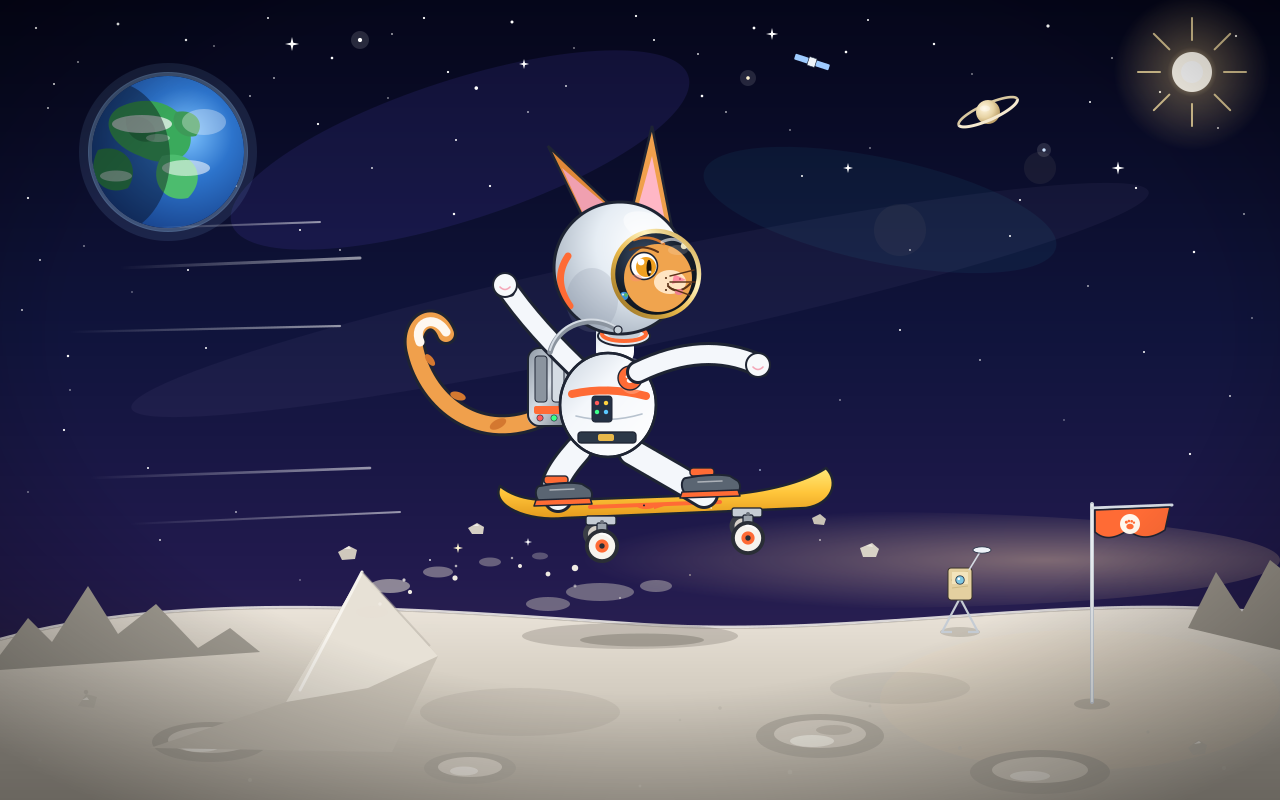
<svg xmlns="http://www.w3.org/2000/svg" width="1280" height="800" viewBox="0 0 1280 800" preserveAspectRatio="xMidYMid meet" overflow="hidden" role="img" aria-label="Astronaut cat skateboarding on the moon" style="width:100%;height:100%;display:block;background:#05061a;">
  <title>Astronaut cat skateboarding on the moon</title>
  <desc>An orange tabby cat in a white spacesuit rides a yellow skateboard just above the lunar surface, with Earth, stars, a flag, and a lander in the distance.</desc>
  <defs>
    <linearGradient id="sky" x1="0" y1="0" x2="0" y2="1">
      <stop offset="0%" stop-color="#05061a"/>
      <stop offset="42%" stop-color="#10143c"/>
      <stop offset="72%" stop-color="#221a4e"/>
      <stop offset="100%" stop-color="#3c3158"/>
    </linearGradient>
    <radialGradient id="sunGlow" cx="50%" cy="50%" r="50%">
      <stop offset="0%" stop-color="#fff6d8" stop-opacity="0.95"/>
      <stop offset="32%" stop-color="#ffd98a" stop-opacity="0.28"/>
      <stop offset="100%" stop-color="#ffd98a" stop-opacity="0"/>
    </radialGradient>
    <radialGradient id="ocean" cx="62%" cy="38%" r="72%">
      <stop offset="0%" stop-color="#7ec4ff"/>
      <stop offset="42%" stop-color="#2d74cc"/>
      <stop offset="100%" stop-color="#163e86"/>
    </radialGradient>
    <linearGradient id="groundGrad" x1="0" y1="0" x2="0" y2="1">
      <stop offset="0%" stop-color="#efe8de"/>
      <stop offset="38%" stop-color="#d9d2c6"/>
      <stop offset="100%" stop-color="#b7b0a4"/>
    </linearGradient>
    <radialGradient id="horizonGlow" cx="72%" cy="50%" r="55%">
      <stop offset="0%" stop-color="#ffd7a8" stop-opacity="0.42"/>
      <stop offset="100%" stop-color="#ffd7a8" stop-opacity="0"/>
    </radialGradient>
    <linearGradient id="suitGrad" x1="0%" y1="0%" x2="100%" y2="100%">
      <stop offset="0%" stop-color="#c9d3de"/>
      <stop offset="38%" stop-color="#f4f7fb"/>
      <stop offset="100%" stop-color="#ffffff"/>
    </linearGradient>
    <radialGradient id="helmetGrad" cx="68%" cy="32%" r="72%">
      <stop offset="0%" stop-color="#ffffff"/>
      <stop offset="50%" stop-color="#e6edf4"/>
      <stop offset="100%" stop-color="#aeb9c6"/>
    </radialGradient>
    <linearGradient id="packGrad" x1="0" y1="0" x2="1" y2="1">
      <stop offset="0%" stop-color="#8e98a4"/>
      <stop offset="48%" stop-color="#d7dee6"/>
      <stop offset="100%" stop-color="#6f7884"/>
    </linearGradient>
    <linearGradient id="deckGrad" x1="0" y1="0" x2="0" y2="1">
      <stop offset="0%" stop-color="#ffe978"/>
      <stop offset="46%" stop-color="#ffc53a"/>
      <stop offset="100%" stop-color="#e09418"/>
    </linearGradient>
    <radialGradient id="visorGrad" cx="38%" cy="32%" r="75%">
      <stop offset="0%" stop-color="#3d516c"/>
      <stop offset="55%" stop-color="#17202e"/>
      <stop offset="100%" stop-color="#0b1018"/>
    </radialGradient>
    <linearGradient id="rimGrad" x1="0%" y1="100%" x2="100%" y2="0%">
      <stop offset="0%" stop-color="#8d6820"/>
      <stop offset="42%" stop-color="#e8b84a"/>
      <stop offset="68%" stop-color="#fff3c0"/>
      <stop offset="100%" stop-color="#c4922a"/>
    </linearGradient>
    <linearGradient id="shoot" x1="0" y1="0" x2="1" y2="0">
      <stop offset="0%" stop-color="#ffffff" stop-opacity="0"/>
      <stop offset="100%" stop-color="#ffffff" stop-opacity="0.95"/>
    </linearGradient>
    <linearGradient id="motion" x1="0" y1="0" x2="1" y2="0">
      <stop offset="0%" stop-color="#ffffff" stop-opacity="0"/>
      <stop offset="100%" stop-color="#ffffff" stop-opacity="0.55"/>
    </linearGradient>
    <radialGradient id="planetBody" cx="35%" cy="35%" r="70%">
      <stop offset="0%" stop-color="#fff6df"/>
      <stop offset="55%" stop-color="#e7d3a4"/>
      <stop offset="100%" stop-color="#b89a62"/>
    </radialGradient>
    <radialGradient id="vignette" cx="50%" cy="42%" r="72%">
      <stop offset="0%" stop-color="#000" stop-opacity="0"/>
      <stop offset="62%" stop-color="#000" stop-opacity="0"/>
      <stop offset="100%" stop-color="#000" stop-opacity="0.42"/>
    </radialGradient>
    <filter id="soft" x="-25%" y="-25%" width="150%" height="150%">
      <feDropShadow dx="0" dy="5" stdDeviation="5" flood-color="#02030c" flood-opacity="0.38"/>
    </filter>
    <clipPath id="earthClip">
      <circle cx="168" cy="152" r="76"/>
    </clipPath>
  </defs>
  <style>
    .rider { animation: bob 3.2s ease-in-out infinite; }
    @keyframes bob {
      0%, 100% { transform: translateY(0); }
      50% { transform: translateY(-12px); }
    }
    .tw { animation: twinkle 3.1s ease-in-out infinite; }
    .tw:nth-child(odd) { animation-delay: -1.3s; }
    .tw:nth-child(3n) { animation-duration: 4.4s; animation-delay: -0.6s; }
    @keyframes twinkle {
      0%, 100% { opacity: 0.22; }
      50% { opacity: 1; }
    }
    .led { animation: pulse 1.5s ease-in-out infinite; }
    @keyframes pulse {
      0%, 100% { opacity: 1; }
      50% { opacity: 0.28; }
    }
    .dust { animation: puff 2.3s ease-out infinite; }
    @keyframes puff {
      0% { opacity: 0.7; transform: translate(0, 0); }
      100% { opacity: 0; transform: translate(-32px, 16px); }
    }
    .pebble { animation: drift 3.8s ease-in-out infinite; }
    @keyframes drift {
      0%, 100% { transform: translateY(0); }
      50% { transform: translateY(-8px); }
    }
    .spark { animation: twinkle 2.5s ease-in-out infinite; }
  </style>

  <rect width="1280" height="800" fill="url(#sky)"/>
  <ellipse cx="460" cy="150" rx="240" ry="70" fill="#6d5cff" opacity="0.11" transform="rotate(-18 460 150)"/>
  <ellipse cx="880" cy="210" rx="180" ry="52" fill="#2eb8c9" opacity="0.07" transform="rotate(12 880 210)"/>
  <ellipse cx="640" cy="300" rx="520" ry="46" fill="#c9c6ff" opacity="0.05" transform="rotate(-12 640 300)"/>

  <g fill="#fff">
    <circle cx="36" cy="28" r="1.1"/><circle cx="78" cy="62" r="0.8"/><circle cx="118" cy="24" r="1.4"/>
    <circle cx="214" cy="46" r="0.7"/><circle cx="268" cy="18" r="1"/><circle cx="332" cy="58" r="1.3"/>
    <circle cx="392" cy="34" r="0.8"/><circle cx="448" cy="72" r="1.1"/><circle cx="512" cy="22" r="1.5"/>
    <circle cx="574" cy="48" r="0.7"/><circle cx="636" cy="16" r="1.1"/><circle cx="698" cy="54" r="0.9"/>
    <circle cx="754" cy="28" r="1.4"/><circle cx="812" cy="64" r="0.8"/><circle cx="868" cy="20" r="1"/>
    <circle cx="934" cy="44" r="1.2"/><circle cx="1048" cy="26" r="1.6"/><circle cx="1112" cy="58" r="0.8"/>
    <circle cx="1236" cy="36" r="1.1"/><circle cx="48" cy="108" r="0.9"/><circle cx="96" cy="156" r="1.2"/>
    <circle cx="250" cy="96" r="0.8"/><circle cx="318" cy="124" r="1.1"/><circle cx="388" cy="98" r="0.7"/>
    <circle cx="456" cy="140" r="1"/><circle cx="528" cy="112" r="0.8"/><circle cx="702" cy="96" r="1.3"/>
    <circle cx="790" cy="130" r="0.7"/><circle cx="1090" cy="102" r="1"/><circle cx="1218" cy="128" r="0.9"/>
    <circle cx="28" cy="198" r="1.1"/><circle cx="84" cy="246" r="0.7"/><circle cx="154" cy="210" r="1.3"/>
    <circle cx="236" cy="186" r="0.8"/><circle cx="300" cy="230" r="1"/><circle cx="372" cy="168" r="0.9"/>
    <circle cx="454" cy="214" r="1.2"/><circle cx="802" cy="176" r="1"/><circle cx="870" cy="148" r="0.7"/>
    <circle cx="1136" cy="188" r="1.1"/><circle cx="1244" cy="214" r="0.8"/><circle cx="22" cy="310" r="0.9"/>
    <circle cx="68" cy="356" r="1.2"/><circle cx="132" cy="292" r="0.6"/><circle cx="206" cy="348" r="1"/>
    <circle cx="64" cy="430" r="1.1"/><circle cx="28" cy="492" r="0.7"/><circle cx="148" cy="468" r="1"/>
    <circle cx="236" cy="512" r="0.8"/><circle cx="1010" cy="236" r="1"/><circle cx="1088" cy="286" r="0.8"/>
    <circle cx="1194" cy="252" r="1.2"/><circle cx="1252" cy="318" r="0.7"/><circle cx="1144" cy="352" r="1"/>
    <circle cx="1230" cy="396" r="0.9"/><circle cx="1064" cy="420" r="0.6"/><circle cx="1190" cy="454" r="1.1"/>
    <circle cx="980" cy="360" r="0.8"/><circle cx="900" cy="330" r="1"/><circle cx="840" cy="400" r="0.7"/>
    <circle cx="760" cy="470" r="0.8" fill="#cfe4ff"/><circle cx="430" cy="560" r="0.9"/><circle cx="690" cy="575" r="0.7" fill="#fff4d2"/>
  </g>
  <g fill="#fff">
    <circle cx="360" cy="40" r="9" opacity="0.14"/><circle cx="360" cy="40" r="2.1"/>
    <circle cx="748" cy="78" r="8" opacity="0.12"/><circle cx="748" cy="78" r="1.8" fill="#fff4d2"/>
    <circle cx="1044" cy="150" r="7" opacity="0.12"/><circle cx="1044" cy="150" r="1.7" fill="#cfe4ff"/>
  </g>
  <g class="tw" fill="#fff">
    <circle cx="54" cy="84" r="1"/><circle cx="186" cy="40" r="1.2"/><circle cx="274" cy="78" r="0.8"/>
    <circle cx="424" cy="18" r="1.1"/><circle cx="566" cy="86" r="0.9"/><circle cx="654" cy="40" r="1"/>
    <circle cx="726" cy="112" r="0.8"/><circle cx="846" cy="52" r="1.3"/><circle cx="972" cy="74" r="0.7"/>
    <circle cx="1160" cy="92" r="1.1"/><circle cx="40" cy="260" r="0.9"/><circle cx="188" cy="270" r="1"/>
    <circle cx="340" cy="250" r="0.8"/><circle cx="490" cy="186" r="1.1"/><circle cx="910" cy="250" r="0.8"/>
    <circle cx="1020" cy="200" r="1"/><circle cx="70" cy="390" r="0.7"/><circle cx="160" cy="540" r="0.9"/>
    <circle cx="300" cy="580" r="0.6"/><circle cx="820" cy="540" r="0.8"/>
  </g>
  <g class="spark" fill="#fff">
    <g transform="translate(292,44)"><path d="M0-7 L1.3-1.3 L7 0 L1.3 1.3 L0 7 L-1.3 1.3 L-7 0 L-1.3-1.3Z"/></g>
    <g transform="translate(524,64)"><path d="M0-5 L1-1 L5 0 L1 1 L0 5 L-1 1 L-5 0 L-1-1Z"/></g>
    <g transform="translate(772,34)"><path d="M0-6 L1.1-1.1 L6 0 L1.1 1.1 L0 6 L-1.1 1.1 L-6 0 L-1.1-1.1Z"/></g>
    <g transform="translate(848,168)"><path d="M0-5 L1-1 L5 0 L1 1 L0 5 L-1 1 L-5 0 L-1-1Z"/></g>
    <g transform="translate(1118,168)"><path d="M0-6.5 L1.2-1.2 L6.5 0 L1.2 1.2 L0 6.5 L-1.2 1.2 L-6.5 0 L-1.2-1.2Z"/></g>
  </g>

  <g transform="translate(390,46) rotate(26)">
    <line x1="0" y1="0" x2="96" y2="0" stroke="url(#shoot)" stroke-width="2.2" stroke-linecap="round"/>
    <circle cx="96" cy="0" r="1.8" fill="#fff"/>
  </g>

  <g transform="translate(1192,72)">
    <circle r="78" fill="url(#sunGlow)"/>
    <g stroke="#ffe7a8" stroke-width="2" stroke-linecap="round" opacity="0.8">
      <line x1="0" y1="-32" x2="0" y2="-54" transform="rotate(0)"/>
      <line x1="0" y1="-32" x2="0" y2="-54" transform="rotate(45)"/>
      <line x1="0" y1="-32" x2="0" y2="-54" transform="rotate(90)"/>
      <line x1="0" y1="-32" x2="0" y2="-54" transform="rotate(135)"/>
      <line x1="0" y1="-32" x2="0" y2="-54" transform="rotate(180)"/>
      <line x1="0" y1="-32" x2="0" y2="-54" transform="rotate(225)"/>
      <line x1="0" y1="-32" x2="0" y2="-54" transform="rotate(270)"/>
      <line x1="0" y1="-32" x2="0" y2="-54" transform="rotate(315)"/>
    </g>
    <circle r="20" fill="#fffaf0"/>
    <circle r="11" fill="#fff"/>
  </g>
  <circle cx="1040" cy="168" r="16" fill="#ffe9b8" opacity="0.06"/>
  <circle cx="900" cy="230" r="26" fill="#ffd0a0" opacity="0.045"/>

  <g transform="translate(988,112)">
    <g transform="rotate(-24)">
      <path d="M-32 0 A 32 8 0 0 1 32 0" fill="none" stroke="#d9c8a0" stroke-width="2.6"/>
    </g>
    <circle r="12" fill="url(#planetBody)"/>
    <ellipse cx="-3" cy="-3.5" rx="5" ry="3" fill="#fff" opacity="0.35"/>
    <g transform="rotate(-24)">
      <path d="M-32 0 A 32 8 0 0 0 32 0" fill="none" stroke="#f6ead0" stroke-width="3"/>
    </g>
  </g>

  <g transform="translate(812,62) rotate(18)">
    <rect x="-18" y="-3" width="14" height="6" rx="1" fill="#9ecbff"/>
    <rect x="4" y="-3" width="14" height="6" rx="1" fill="#9ecbff"/>
    <rect x="-4" y="-4.5" width="8" height="9" rx="1" fill="#eef3f8" stroke="#243044" stroke-width="0.6"/>
  </g>

  <circle cx="168" cy="152" r="84" fill="none" stroke="#8ec5ff" stroke-width="10" opacity="0.12"/>
  <circle cx="168" cy="152" r="78" fill="none" stroke="#9ed0ff" stroke-width="4" opacity="0.35"/>
  <g clip-path="url(#earthClip)">
    <circle cx="168" cy="152" r="76" fill="url(#ocean)"/>
    <path d="M118 108 C148 92 182 104 190 132 C196 158 168 170 140 156 C112 146 98 122 118 108Z" fill="#3aaa5c"/>
    <path d="M126 118 C146 112 160 126 154 140 C140 146 124 136 126 118Z" fill="#2d8a48"/>
    <path d="M98 150 C124 142 142 166 128 188 C104 198 84 176 98 150Z" fill="#2f8f4e"/>
    <path d="M162 156 C192 148 210 176 188 198 C160 204 148 176 162 156Z" fill="#4cbc6e"/>
    <path d="M176 112 C196 108 206 124 196 136 C180 140 168 124 176 112Z" fill="#3d9a58"/>
    <ellipse cx="142" cy="124" rx="30" ry="9" fill="#fff" opacity="0.72"/>
    <ellipse cx="186" cy="168" rx="24" ry="8" fill="#fff" opacity="0.55"/>
    <ellipse cx="116" cy="176" rx="16" ry="5.5" fill="#fff" opacity="0.5"/>
    <ellipse cx="158" cy="138" rx="12" ry="4" fill="#fff" opacity="0.4"/>
    <ellipse cx="112" cy="158" rx="58" ry="76" fill="#050814" opacity="0.42"/>
    <ellipse cx="204" cy="122" rx="22" ry="13" fill="#fff" opacity="0.32"/>
  </g>

  <ellipse cx="860" cy="560" rx="420" ry="48" fill="url(#horizonGlow)"/>

  <path d="M0 640 C180 590 420 610 640 625 C860 640 1080 590 1280 615 L1280 800 L0 800 Z" fill="url(#groundGrad)"/>
  <path d="M0 640 C180 590 420 610 640 625 C860 640 1080 590 1280 615" fill="none" stroke="#6a655c" stroke-width="2" opacity="0.35"/>
  <path d="M0 639 C180 589 420 609 640 624 C860 639 1080 589 1280 614" fill="none" stroke="#f7f4ee" stroke-width="2.5" opacity="0.85"/>

  <path d="M0 655 L28 618 L52 642 L88 586 L118 634 L156 604 L198 648 L230 628 L260 652 L0 670Z" fill="#a39e94"/>
  <path d="M1188 628 L1216 572 L1242 612 L1270 560 L1280 568 L1280 650Z" fill="#9c968c"/>

  <ellipse cx="520" cy="712" rx="100" ry="24" fill="#a8a298" opacity="0.28"/>
  <ellipse cx="900" cy="688" rx="70" ry="16" fill="#9e988e" opacity="0.22"/>
  <ellipse cx="1080" cy="700" rx="200" ry="70" fill="#ffd8a8" opacity="0.08"/>

  <g transform="translate(210,742)">
    <ellipse rx="58" ry="20" fill="#b5afa4"/>
    <ellipse rx="42" ry="13" cy="-2" fill="#d4cdc2"/>
    <ellipse rx="20" ry="6" cx="-10" cy="4" fill="#f3eee6" opacity="0.75"/>
    <ellipse rx="16" ry="5" cx="12" cy="-5" fill="#8a847a" opacity="0.35"/>
  </g>
  <g transform="translate(470,768)">
    <ellipse rx="46" ry="16" fill="#b7b1a6"/>
    <ellipse rx="32" ry="10" cy="-1" fill="#d8d1c6"/>
    <ellipse rx="14" ry="4.5" cx="-6" cy="3" fill="#f4f0e8" opacity="0.7"/>
  </g>
  <g transform="translate(820,736)">
    <ellipse rx="64" ry="22" fill="#b3ada2"/>
    <ellipse rx="46" ry="14" cy="-2" fill="#d2cbc0"/>
    <ellipse rx="22" ry="6" cx="-8" cy="5" fill="#f6f2ea" opacity="0.7"/>
    <ellipse rx="18" ry="5" cx="14" cy="-6" fill="#8f897e" opacity="0.3"/>
  </g>
  <g transform="translate(1040,772)">
    <ellipse rx="70" ry="22" fill="#b0aa9f"/>
    <ellipse rx="48" ry="13" cy="-2" fill="#cfc8bc"/>
    <ellipse rx="20" ry="5" cx="-10" cy="4" fill="#eeeae2" opacity="0.65"/>
  </g>

  <g fill="#c4beb2">
    <circle cx="86" cy="692" r="2.2"/><circle cx="124" cy="748" r="1.5"/><circle cx="250" cy="780" r="2"/>
    <circle cx="330" cy="700" r="1.6"/><circle cx="560" cy="748" r="2.1"/><circle cx="640" cy="786" r="1.4"/>
    <circle cx="720" cy="708" r="1.8"/><circle cx="790" cy="772" r="2.3"/><circle cx="870" cy="706" r="1.5"/>
    <circle cx="960" cy="748" r="2"/><circle cx="1148" cy="732" r="1.6"/><circle cx="1224" cy="768" r="2.1"/>
    <circle cx="40" cy="760" r="1.7"/><circle cx="680" cy="720" r="1.3"/>
  </g>
  <path d="M78 706 l8-12 11 3-3 11z" fill="#c8c2b6"/>
  <path d="M82 700 l5-3 2 3z" fill="#f4f0e8" opacity="0.7"/>
  <path d="M1188 748 l10-8 9 5-2 9-12 1z" fill="#c2bcb0"/>
  <path d="M1194 744 l5-3 2 2z" fill="#f7f3ec" opacity="0.75"/>

  <path d="M150 748 L286 702 L362 572 L438 656 L392 752 Z" fill="#c9c2b6"/>
  <path d="M286 702 L362 572 L438 656 L368 688 Z" fill="#e7e1d6"/>
  <path d="M300 690 L362 572" fill="none" stroke="#f7f4ee" stroke-width="3" stroke-linecap="round"/>
  <path d="M362 572 L430 646" fill="none" stroke="#b7b1a6" stroke-width="2" opacity="0.5"/>

  <g transform="translate(960,588)">
    <ellipse cx="0" cy="44" rx="20" ry="5" fill="#8a847a" opacity="0.35"/>
    <path d="M0 10 L-18 44 M0 10 L18 44" fill="none" stroke="#c5ccd4" stroke-width="2.2" stroke-linecap="round"/>
    <path d="M-18 44 L-8 44 M18 44 L8 44" stroke="#c5ccd4" stroke-width="2.2"/>
    <rect x="-12" y="-20" width="24" height="32" rx="3" fill="#e4d0a0" stroke="#3a3428" stroke-width="1"/>
    <path d="M-8 -14 L8 -16 M-9 -8 L7 -6 M-8 0 L8 -2" stroke="#c4b07a" stroke-width="1" opacity="0.7"/>
    <rect x="-8" y="-16" width="16" height="12" fill="#f3e4bc"/>
    <circle cy="-8" r="4.2" fill="#7ec8e3" stroke="#243044" stroke-width="0.8"/>
    <circle cx="-1.2" cy="-9.2" r="1.3" fill="#fff"/>
    <line x1="9" y1="-18" x2="20" y2="-36" stroke="#d5dbe3" stroke-width="1.6"/>
    <ellipse cx="22" cy="-38" rx="9" ry="3.2" fill="#eef3f8" stroke="#243044" stroke-width="0.8"/>
  </g>

  <g transform="translate(1092,498)">
    <ellipse cx="0" cy="206" rx="18" ry="5.5" fill="#a8a298" opacity="0.55"/>
    <line x1="0" y1="6" x2="0" y2="204" stroke="#c5ccd4" stroke-width="4" stroke-linecap="round"/>
    <line x1="0" y1="6" x2="0" y2="204" stroke="#f7f9fb" stroke-width="1.4"/>
    <line x1="0" y1="10" x2="80" y2="7" stroke="#d5dbe3" stroke-width="3" stroke-linecap="round"/>
    <path d="M3 12 L78 9 L73 32 Q52 46 36 32 Q16 46 3 34 Z" fill="#ff6b35" stroke="#1e2433" stroke-width="1.6" stroke-linejoin="round"/>
    <circle cx="38" cy="26" r="10" fill="#fff8ee"/>
    <g transform="translate(38,27) scale(0.7)" fill="#ff6b35">
      <ellipse cx="0" cy="2.2" rx="5.2" ry="4"/>
      <circle cx="-5.2" cy="-4" r="2.15"/>
      <circle cx="-1.6" cy="-5.6" r="1.9"/>
      <circle cx="2.4" cy="-5.3" r="1.9"/>
      <circle cx="5.6" cy="-3.4" r="1.7"/>
    </g>
  </g>

  <ellipse cx="630" cy="636" rx="108" ry="13" fill="#6d675e" opacity="0.28"/>
  <ellipse cx="642" cy="640" rx="62" ry="6.5" fill="#5a554c" opacity="0.32"/>

  <g fill="#e4ddd2">
    <ellipse cx="390" cy="586" rx="20" ry="7" opacity="0.55"/>
    <ellipse cx="438" cy="572" rx="15" ry="5.5" opacity="0.42"/>
    <ellipse cx="490" cy="562" rx="11" ry="4.5" opacity="0.36"/>
    <ellipse cx="540" cy="556" rx="8" ry="3.5" opacity="0.3"/>
    <ellipse cx="372" cy="612" rx="16" ry="6" opacity="0.32"/>
    <ellipse cx="430" cy="628" rx="12" ry="4.5" opacity="0.24"/>
  </g>
  <g fill="#ddd6cb" opacity="0.4">
    <ellipse cx="600" cy="592" rx="34" ry="9"/>
    <ellipse cx="548" cy="604" rx="22" ry="7"/>
    <ellipse cx="656" cy="586" rx="16" ry="6"/>
  </g>
  <g fill="#f4f0e8">
    <circle cx="404" cy="580" r="1.6" opacity="0.8"/>
    <circle cx="456" cy="566" r="1.3" opacity="0.7"/>
    <circle cx="512" cy="558" r="1.2" opacity="0.65"/>
    <circle cx="575" cy="586" r="1.5" opacity="0.55"/>
    <circle cx="620" cy="598" r="1.1" opacity="0.5"/>
  </g>

  <g class="pebble" style="animation-delay:-0.4s">
    <path d="M338 552 l11-6 8 4-2 9-13 1z" fill="#cfc8bc"/>
    <path d="M344 549 l5-3 2 3z" fill="#f7f3ec" opacity="0.8"/>
  </g>
  <g class="pebble" style="animation-delay:-1.6s">
    <path d="M468 528 l9-5 7 4-1 7-11 0z" fill="#d5cfc4"/>
    <path d="M473 526 l4-2 2 2z" fill="#fff" opacity="0.65"/>
  </g>
  <g class="pebble" style="animation-delay:-2.4s">
    <path d="M812 518 l8-4 6 5-2 6-10-1z" fill="#c9c3b6"/>
  </g>
  <g class="pebble" style="animation-delay:-0.9s">
    <path d="M860 548 l12-5 7 6-3 8-13 0z" fill="#d8d2c6"/>
    <path d="M866 546 l5-2 2 3z" fill="#f4f0e8" opacity="0.7"/>
  </g>

  <g fill="none" stroke="url(#motion)" stroke-linecap="round">
    <line x1="120" y1="268" x2="360" y2="258" stroke-width="3"/>
    <line x1="70" y1="332" x2="340" y2="326" stroke-width="2.2"/>
    <line x1="150" y1="228" x2="320" y2="222" stroke-width="2"/>
    <line x1="90" y1="478" x2="370" y2="468" stroke-width="2.6"/>
    <line x1="130" y1="524" x2="400" y2="512" stroke-width="2"/>
  </g>

  <g class="spark" transform="translate(458,548)">
    <path d="M0-5 L1-1 L5 0 L1 1 L0 5 L-1 1 L-5 0 L-1-1Z" fill="#fff6d0"/>
  </g>
  <g class="spark" transform="translate(528,542)" style="animation-delay:-1s">
    <path d="M0-4 L0.8-0.8 L4 0 L0.8 0.8 L0 4 L-0.8 0.8 L-4 0 L-0.8-0.8Z" fill="#fff"/>
  </g>

  <g class="rider" filter="url(#soft)">
    <g>
      <animateTransform attributeName="transform" type="rotate" values="-4 540 418;8 540 418;-4 540 418" dur="1.7s" repeatCount="indefinite"/>
      <path d="M545 415 C480 446 428 402 416 352 C408 322 436 308 446 334" fill="none" stroke="#1e2433" stroke-width="22" stroke-linecap="round"/>
      <path d="M545 415 C480 446 428 402 416 352 C408 322 436 308 446 334" fill="none" stroke="#f0a04c" stroke-width="16" stroke-linecap="round"/>
      <ellipse cx="498" cy="424" rx="9" ry="4.5" fill="#d47830" transform="rotate(-28 498 424)"/>
      <ellipse cx="458" cy="396" rx="8" ry="4" fill="#d47830" transform="rotate(18 458 396)"/>
      <ellipse cx="430" cy="360" rx="7" ry="3.4" fill="#d47830" transform="rotate(52 430 360)"/>
      <path d="M420 342 C412 324 434 312 446 332" fill="none" stroke="#fff8f0" stroke-width="9" stroke-linecap="round"/>
    </g>
    <ellipse cx="538" cy="418" rx="9" ry="6" fill="none" stroke="#b7c0cb" stroke-width="3"/>

    <path d="M590 232 L548 146 L624 218 Z" fill="#e08838" stroke="#1e2433" stroke-width="2.5" stroke-linejoin="miter"/>
    <path d="M586 220 L562 168 L612 210 Z" fill="#f0a0b0"/>
    <path d="M628 226 L652 126 L674 238 Z" fill="#f0a04c" stroke="#1e2433" stroke-width="2.5" stroke-linejoin="miter"/>
    <path d="M636 214 L652 156 L666 226 Z" fill="#ffb7c6"/>

    <rect x="528" y="348" width="44" height="78" rx="11" fill="url(#packGrad)" stroke="#1e2433" stroke-width="2"/>
    <rect x="535" y="356" width="12" height="46" rx="3" fill="#8b949f" stroke="#1e2433" stroke-width="1"/>
    <rect x="552" y="356" width="12" height="46" rx="3" fill="#d5dce4" stroke="#1e2433" stroke-width="1"/>
    <rect x="534" y="406" width="32" height="8" rx="2" fill="#ff6b35"/>
    <circle cx="540" cy="418" r="3.1" fill="#ff5a5a" stroke="#1e2433" stroke-width="0.6"/>
    <circle class="led" cx="554" cy="418" r="3.1" fill="#3dff8a" stroke="#1e2433" stroke-width="0.6"/>

    <path d="M588 378 Q534 328 505 285" fill="none" stroke="#1e2433" stroke-width="24" stroke-linecap="round"/>
    <path d="M588 378 Q534 328 505 285" fill="none" stroke="#f4f7fb" stroke-width="18" stroke-linecap="round"/>
    <g transform="translate(505,285)">
      <rect x="-9" y="2" width="18" height="9" rx="3" fill="#ff6b35" stroke="#1e2433" stroke-width="1.4"/>
      <circle r="12" fill="#f7f9fb" stroke="#1e2433" stroke-width="2"/>
      <path d="M-5 2 Q0 7 5 2" fill="none" stroke="#f4a8b8" stroke-width="1.6" stroke-linecap="round"/>
    </g>

    <path d="M500 486 C520 502 545 500 565 500 L735 494 C775 490 808 480 826 468 C840 482 832 504 806 508 L565 518 C528 522 490 506 500 486 Z" fill="url(#deckGrad)" stroke="#1e2433" stroke-width="2.5" stroke-linejoin="round"/>
    <path d="M590 507 L720 502" stroke="#ff6b35" stroke-width="4" stroke-linecap="round"/>
    <g transform="translate(652,506)">
      <ellipse cx="-6" cy="0" rx="9" ry="3.1" fill="#ff6b35"/>
      <path d="M2-3.2 L12 0 L2 3.2 Z" fill="#ff6b35"/>
      <circle cx="-8" cy="-0.6" r="1" fill="#1e2433"/>
    </g>
    <path d="M708 500 L710.2 503.4 L714 503.6 L711.2 505.8 L712 509 L708 507.2 L704 509 L704.8 505.8 L702 503.6 L705.8 503.4 Z" fill="#fff6d0"/>

    <circle cx="596" cy="534" r="13" fill="#3a3e46"/>
    <circle cx="596" cy="534" r="8" fill="#d5d0c8"/>
    <circle cx="742" cy="526" r="12.5" fill="#3a3e46"/>
    <circle cx="742" cy="526" r="7.5" fill="#d5d0c8"/>

    <g transform="translate(602,516)">
      <rect x="-16" y="0" width="30" height="9" rx="2" fill="#c5ccd4" stroke="#1e2433" stroke-width="1.4"/>
      <rect x="-5" y="7" width="10" height="12" rx="1.5" fill="#9aa2ab" stroke="#1e2433" stroke-width="1.3"/>
      <circle cx="0" cy="6" r="2" fill="#6a717a"/>
    </g>
    <g transform="translate(748,508)">
      <rect x="-16" y="0" width="30" height="9" rx="2" fill="#c5ccd4" stroke="#1e2433" stroke-width="1.4"/>
      <rect x="-5" y="7" width="10" height="12" rx="1.5" fill="#9aa2ab" stroke="#1e2433" stroke-width="1.3"/>
      <circle cx="0" cy="6" r="2" fill="#6a717a"/>
    </g>

    <g transform="translate(602,546)">
      <g>
        <animateTransform attributeName="transform" type="rotate" from="0" to="360" dur="0.48s" repeatCount="indefinite"/>
        <circle r="17" fill="#2a2e36"/>
        <circle r="13.2" fill="#f7f4ee"/>
        <circle r="6.6" fill="#ff6b35"/>
        <circle r="2.7" fill="#2a2e36"/>
        <path d="M-1.5-12.2 A12 12 0 0 1 8-8.5" fill="none" stroke="#fff" stroke-width="2" stroke-linecap="round" opacity="0.85"/>
      </g>
    </g>
    <g transform="translate(748,538)">
      <g>
        <animateTransform attributeName="transform" type="rotate" from="0" to="360" dur="0.48s" repeatCount="indefinite"/>
        <circle r="17" fill="#2a2e36"/>
        <circle r="13.2" fill="#f7f4ee"/>
        <circle r="6.6" fill="#ff6b35"/>
        <circle r="2.7" fill="#2a2e36"/>
        <path d="M-1.5-12.2 A12 12 0 0 1 8-8.5" fill="none" stroke="#fff" stroke-width="2" stroke-linecap="round" opacity="0.85"/>
      </g>
    </g>

    <path d="M578 450 Q546 486 558 498" fill="none" stroke="#1e2433" stroke-width="30" stroke-linecap="round"/>
    <path d="M578 450 Q546 486 558 498" fill="none" stroke="#f4f7fb" stroke-width="24" stroke-linecap="round"/>
    <path d="M632 452 Q688 484 704 494" fill="none" stroke="#1e2433" stroke-width="30" stroke-linecap="round"/>
    <path d="M632 452 Q688 484 704 494" fill="none" stroke="#f4f7fb" stroke-width="24" stroke-linecap="round"/>

    <rect x="596" y="316" width="38" height="50" rx="14" fill="url(#suitGrad)"/>
    <ellipse cx="608" cy="405" rx="48" ry="52" fill="url(#suitGrad)" stroke="#1e2433" stroke-width="2.5"/>
    <path d="M572 394 Q608 386 646 396" fill="none" stroke="#ff6b35" stroke-width="8" stroke-linecap="round"/>
    <path d="M576 416 Q608 424 642 414" fill="none" stroke="#b7c2ce" stroke-width="1.6" stroke-linecap="round"/>
    <rect x="578" y="432" width="58" height="11" rx="3" fill="#2c3848" stroke="#1e2433" stroke-width="1.3"/>
    <rect x="598" y="434" width="16" height="7" rx="2" fill="#e8b84a"/>
    <ellipse cx="632" cy="376" rx="14" ry="18" fill="#fff" opacity="0.22"/>
    <circle cx="630" cy="378" r="12" fill="#ff6b35" stroke="#1e2433" stroke-width="1.4"/>
    <g transform="translate(630,379) scale(0.62)" fill="#fff">
      <ellipse cx="0" cy="2.4" rx="5.2" ry="4"/>
      <circle cx="-5" cy="-3.8" r="2.1"/>
      <circle cx="-1.4" cy="-5.5" r="1.9"/>
      <circle cx="2.6" cy="-5.2" r="1.9"/>
      <circle cx="5.4" cy="-3.2" r="1.7"/>
    </g>
    <rect x="592" y="396" width="20" height="26" rx="3" fill="#243044" stroke="#1e2433" stroke-width="1"/>
    <circle cx="597" cy="403" r="2.2" fill="#ff5a5a"/>
    <circle cx="606" cy="403" r="2.2" fill="#ffd23f"/>
    <circle cx="597" cy="412" r="2.2" fill="#3dff8a"/>
    <circle cx="606" cy="412" r="2.2" fill="#5ac8ff"/>
    <ellipse cx="608" cy="405" rx="48" ry="52" fill="none" stroke="#1e2433" stroke-width="2.5"/>

    <path d="M638 372 Q704 340 758 365" fill="none" stroke="#1e2433" stroke-width="24" stroke-linecap="round"/>
    <path d="M638 372 Q704 340 758 365" fill="none" stroke="#f4f7fb" stroke-width="18" stroke-linecap="round"/>
    <g transform="translate(758,365)">
      <rect x="-9" y="2" width="18" height="9" rx="3" fill="#ff6b35" stroke="#1e2433" stroke-width="1.4"/>
      <circle r="12" fill="#f7f9fb" stroke="#1e2433" stroke-width="2"/>
      <path d="M-5 2 Q0 7 5 2" fill="none" stroke="#f4a8b8" stroke-width="1.6" stroke-linecap="round"/>
    </g>

    <g transform="translate(558,482)">
      <rect x="-14" y="-6" width="24" height="8" rx="3" fill="#ff6b35" stroke="#1e2433" stroke-width="1.4"/>
      <path d="M-18 4 C-22 4 -24 12 -20 18 L-14 22 L28 20 C34 19 36 12 32 7 L24 2 C14 0 4 1 -6 2 Z" fill="#5a6572" stroke="#1e2433" stroke-width="2" stroke-linejoin="round"/>
      <path d="M-22 18 L32 16 L34 22 L-24 24 Z" fill="#ff6b35" stroke="#1e2433" stroke-width="1.5" stroke-linejoin="round"/>
      <path d="M-8 8 L16 7" stroke="#fff" stroke-width="1.5" opacity="0.5" stroke-linecap="round"/>
    </g>
    <g transform="translate(704,474)">
      <rect x="-14" y="-6" width="24" height="8" rx="3" fill="#ff6b35" stroke="#1e2433" stroke-width="1.4"/>
      <path d="M-18 4 C-22 4 -24 12 -20 18 L-14 22 L30 20 C36 19 38 12 34 7 L26 2 C16 0 4 1 -6 2 Z" fill="#5a6572" stroke="#1e2433" stroke-width="2" stroke-linejoin="round"/>
      <path d="M-22 18 L34 16 L36 22 L-24 24 Z" fill="#ff6b35" stroke="#1e2433" stroke-width="1.5" stroke-linejoin="round"/>
      <path d="M-6 8 L18 7" stroke="#fff" stroke-width="1.5" opacity="0.5" stroke-linecap="round"/>
    </g>

    <ellipse cx="624" cy="336" rx="26" ry="10" fill="#e7eef5" stroke="#1e2433" stroke-width="2"/>
    <ellipse cx="624" cy="334" rx="16" ry="5.5" fill="#c5ced8"/>
    <ellipse cx="624" cy="334" rx="22" ry="7" fill="none" stroke="#ff6b35" stroke-width="4"/>

    <circle cx="620" cy="268" r="66" fill="url(#helmetGrad)"/>
    <ellipse cx="592" cy="300" rx="26" ry="32" fill="#7d8b9c" opacity="0.2"/>
    <ellipse cx="650" cy="228" rx="28" ry="14" fill="#fff" opacity="0.5" transform="rotate(22 650 228)"/>
    <path d="M568 256 Q552 280 570 306" fill="none" stroke="#ff6b35" stroke-width="7" stroke-linecap="round"/>
    <circle cx="620" cy="268" r="66" fill="none" stroke="#1e2433" stroke-width="3"/>

    <circle cx="656" cy="274" r="43" fill="url(#visorGrad)"/>
    <circle cx="658" cy="278" r="34" fill="#f0a44e"/>
    <path d="M634 240 Q650 234 664 244" fill="none" stroke="#d47830" stroke-width="2.6" stroke-linecap="round"/>
    <path d="M630 250 Q644 244 658 252" fill="none" stroke="#5c3318" stroke-width="2.1" stroke-linecap="round"/>
    <ellipse cx="670" cy="282" rx="16" ry="12" fill="#ffe4c2"/>
    <circle cx="644" cy="266" r="13.5" fill="#fff" stroke="#1e2433" stroke-width="1.6"/>
    <circle cx="646" cy="267" r="10" fill="#f0a020"/>
    <ellipse cx="649" cy="268" rx="2.5" ry="8.2" fill="#1a1208"/>
    <circle cx="641" cy="262" r="3.4" fill="#fff"/>
    <circle cx="650" cy="272" r="1.4" fill="#fff" opacity="0.85"/>
    <path d="M674 274 L686 280 L672 284 Z" fill="#ff8fa3"/>
    <circle cx="680" cy="279" r="1.1" fill="#c45a6a"/>
    <path d="M668 286 Q678 296 690 284" fill="none" stroke="#5c3318" stroke-width="2.1" stroke-linecap="round"/>
    <ellipse cx="679" cy="292" rx="4.2" ry="3" fill="#f08090"/>
    <ellipse cx="636" cy="278" rx="6" ry="3.4" fill="#ff8a7a" opacity="0.42"/>
    <circle cx="666" cy="278" r="1.05" fill="#5c3318"/>
    <circle cx="668" cy="284" r="1.05" fill="#5c3318"/>
    <circle cx="666" cy="290" r="1.05" fill="#5c3318"/>
    <path d="M670 276 L694 270" stroke="#5c3318" stroke-width="1.45" stroke-linecap="round"/>
    <path d="M670 282 L696 282" stroke="#5c3318" stroke-width="1.45" stroke-linecap="round"/>
    <path d="M670 288 L692 296" stroke="#5c3318" stroke-width="1.45" stroke-linecap="round"/>
    <circle cx="624" cy="296" r="4.2" fill="#3a8fd4"/>
    <circle cx="626" cy="295" r="1.8" fill="#5cb85c"/>
    <circle cx="623" cy="294.5" r="1.1" fill="#fff" opacity="0.75"/>
    <path d="M662 242 Q678 234 690 250" fill="none" stroke="#fff" stroke-width="3" stroke-linecap="round" opacity="0.6"/>
    <ellipse cx="678" cy="250" rx="10" ry="5" fill="#fff" opacity="0.16"/>
    <circle cx="684" cy="246" r="3.2" fill="#fff6d0" opacity="0.9"/>
    <circle cx="656" cy="274" r="43" fill="none" stroke="url(#rimGrad)" stroke-width="4.5"/>

    <path d="M550 352 C558 324 592 312 618 330" fill="none" stroke="#8b949f" stroke-width="5.5" stroke-linecap="round"/>
    <path d="M550 350 C558 322 592 310 618 328" fill="none" stroke="#d5dce4" stroke-width="2" stroke-linecap="round"/>
    <circle cx="618" cy="330" r="4" fill="#c5ced6" stroke="#1e2433" stroke-width="1.2"/>
  </g>

  <g fill="#efeae2">
    <circle class="dust" cx="575" cy="568" r="3.2"/>
    <circle class="dust" cx="548" cy="574" r="2.4" style="animation-delay:-0.4s"/>
    <circle class="dust" cx="520" cy="566" r="2" style="animation-delay:-0.9s"/>
    <circle class="dust" cx="455" cy="578" r="2.6" style="animation-delay:-1.4s"/>
    <circle class="dust" cx="410" cy="592" r="2.1" style="animation-delay:-0.2s"/>
    <circle class="dust" cx="380" cy="604" r="1.7" style="animation-delay:-1.8s"/>
  </g>

  <rect width="1280" height="800" fill="url(#vignette)" pointer-events="none"/>
</svg>
Reasoning trace (98,719 tokens)
I'll draw an SVG of an astronaut cat skateboarding on the moon.

The SVG will be a single inline code block. It will feature a dark space background with stars, a moon surface with craters, and Earth in the sky.

The cat will wear a helmet and spacesuit with a visor reflection. It will carry a skateboard with wheels and leave motion dust. The design will include motion lines and a flag. The cat's ears and whiskers will peek through the helmet. The viewBox will be 1280 by 800.

A side-view angle will capture the cat mid-skateboarding. The cat will ride toward the right, slightly mid-air or grinding. Earth will sit in the distance on the left. The moon ground will anchor the bottom. A small lander or flag will add background context. The palette will use deep space blues, pale moon grays, and classic NASA white and orange accents.

The cat will be an orange tabby with a round helmet and visor showing its face, eyes, whiskers, and smile. The suit will include a backpack and outstretched arms for balance. The skateboard will have a colorful deck and red wheels. The cat will perform an ollie trick with the board tilted, crouched, and extending its legs, leaving dust below.

The cat will take a dynamic cruise pose with one paw extended, a streaming tail, and a tilted board. Moon dust will spray below. The SVG will scale to fill the viewport using width and height set to 100%.

The SVG will use a 1280 by 800 viewBox with width and height set to 100%. Stars will be small circles with varying opacity. The moon surface will cover the bottom 35% of the canvas. Craters will be ellipses with inner shadows. Earth will sit in the upper left with blue and green continents and cloud swirls. Light will come from the upper right to highlight the helmet and suit.

The cat will sit at x=640, y=480, standing on a skateboard at y=560. The moon horizon will curve from y=520 to the bottom. The illustration will be drawn from back to front. The helmet will have triangular cat ears and a gold visor showing the cat's eyes and nose. The suit will be white with NASA orange stripes and a jetpack or oxygen backpack.

The cat's tail will have a small seal ring and wave out of the suit. Its paws will sit in gloves on the skateboard. The board will carry a graphic such as a moon or fish. A small American-style flag or cat-flag will sit in the moon. Motion stars and speed lines will trail behind the cat. A subtle glow will be added. The design will stay illustration-pure with no speech bubbles or text.

The cat will be placed at translate(620, 420) in a side view facing right. The helmet will be a circle with triangular ears and a dark visor. The body will be a rounded rectangle with forward and backward arms, bent legs on the board, and a backpack behind. Gradients and filters will be defined in the SVG defs.

The cat will sit at translate(680, 480) in a side view facing right, slightly crouched. The helmet will be a circle with triangular ears and a neck ring. The torso will include a chest control panel. The skateboard deck will be a thick rounded rectangle rotated slightly. Only two wheels will be visible in this side view. The tail will curve from the lower back up and left.

The cat's arms will extend forward to the board and backward for balance. Its legs will be bent with boots on the deck. The skateboard will span x=-90 to x=90 at y=40, rotated -6 degrees. The moon ground will curve near y=560 so the wheels rest on the surface.

The moon will be a large sphere centered at (640, 1500) with radius 980. Its visible arc forms the horizon near y=522, where the cat will stand.

The moon will be split into two planes for depth. A distant horizon curve will sit near y=480. The foreground ground will be a flatter area curving from y=620 down to the bottom, where the cat will stand around y=600. Distant mountains and crater rims will sit on the horizon. The foreground ground plane will curve from (0, 620) to (1280, 640) and drop to the canvas edge.

The cat's wheels will rest at y=615. The starfield will include larger stars with cross glints and a subtle Milky Way band. Earth will appear as a crescent or full globe with a small satellite and distant lunar module. The suit will use precise NASA colors: white with orange stripes and dark patches.

The cat will be placed at translate(560, 340) in a side-profile view. The visor will use a dark blue (#1a2332) with a cyan reflection and gold rim (#c9a227). The cat's fur will be orange and cream with a pink nose. The skateboard deck will be purple (#2d1b4e) with a red graphic (#ff4d6d), red wheels (#ff3366), and gray trucks (#888). A fish or planet graphic will sit on the board. I am now writing the SVG code.

The cat will be drawn in a 3/4 view facing right instead of a pure side profile. This angle shows both eyes and the cat's face inside the helmet more clearly. The visor will be a dark ellipse with a visible eye, nose, and whiskers. The right ear will be drawn as a triangle with a pink inner ear.

The cat will be drawn in a 3/4 view facing right. Its helmet will be large and round with two triangular ears. The visor will be a bubble showing the cat's full face with both eyes, smile, and whiskers. The body will be turned 3/4 with one arm out to the side for balance and the other arm forward. The legs will sit in a riding stance. The skateboard deck will be a rounded parallelogram in 3/4 perspective. Four wheels will be visible with two in the front and two in the back. The deck path will be drawn with quadratic bezier curves.

The skateboard deck will be drawn as a perspective quadrilateral with absolute coordinates, curving from the left side to the right. The front wheels will sit at (780, 625) and (800, 640), the back wheels at (520, 640) and (500, 655), with small rectangles for the trucks. The cat will stand on the deck with its feet near y=560.

The cat will crouch with knees bent and a big smile inside the helmet. Its tail will whip left. Feet will sit at (560, 575) and (720, 555). The character group will be placed at translate(640, 480) using local coordinates. The helmet will be a circle at (10, -160) with radius 58. The visor will be an ellipse at (18, -155) with radius 42 by 38. The cat face will be centered at (18, -152).

The cat's face will show two large white eyes with black pupils and highlights, a pink nose, a smile curve, and whiskers. The helmet will have a short neck, a bottom rim, and a cute antenna with a star tip. The suit will include an orange chest band, a mission patch, and a belt.

The cat's left arm will extend back for balance, and its right arm will reach sideways slightly downward. The left leg will be bent at the hip, knee, and foot, while the right leg will sit straighter. A rounded backpack will sit behind the left shoulder, connected to the helmet by an oxygen tube. The tail will curl from the left side with orange stripes. A reflection of the Earth and stars will be added to the visor.

A dust cloud will trail left beneath the board. Earth will sit at (180, 160) with a crescent highlight. Jagged moon mountains will mark the horizon. A lunar flag with a paw print will stand at (980, 480). Foreground craters and a second rock will add detail. The light source will be from the upper left, casting highlights on the left side of the helmet and shadows on the right.

A subtle ground shadow will sit beneath the skateboard. Sparkles will float in the background. The design will remain text-free and rely on pure illustration, since the SVG must render meaningfully within three seconds.

Gentle CSS animations will be added to the SVG. Twinkling stars, slow wheel rotation, a slight cat bob, and drifting dust particles will be defined in an inline style tag. The static pose must remain complete and interesting on its own, since the screenshot is captured at exactly three seconds.

The canvas will be 1280 by 800 pixels. The cat will be roughly 380 pixels tall and centered in the frame, with its head near y=280 and feet near y=560. The helmet will have a diameter of about 120 pixels. The layout will split the top 60 percent for space, place the horizon near y=500, and reserve the lower area for ground.

The cat will stand on a foreground platform at y=680 instead of the horizon. The distant moon surface will curve higher at y=430. A mid-ground ridge will separate the two planes.

The cat will be about 400 pixels tall, standing at y=640 with its head near y=250. The horizon will sit at y=400. The skateboard deck will curve from y=600 to y=620, with the wheels resting at y=660. The deck path is being drawn with quadratic bezier curves.

The skateboard deck will be drawn as a perspective quadrilateral with quadratic bezier curves. A side-face edge will add thickness to the board. The front truck will sit under the right side and the rear truck under the left. The rear wheels will be slightly larger than the front wheels. The cat's boots will rest on the deck at roughly (560, 600) and (740, 585). The body drawing is next.

The cat's body will be drawn in a strict back-to-front layer order: tail, backpack, back arm, back leg, torso, front leg, front arm, helmet, visor and face, then ears. The tail will be a thick orange stroke with rounded caps and white tip, drawn as a curved path with shorter stripe marks. The helmet will sit at (660, 310) with a radius of 62 pixels.

The cat's left arm will be drawn as a thick stroke with rounded caps, extending from the shoulder to the elbow and hand. The suit will include a silver gradient backpack with two tanks and a connecting hose. The entire character will be rendered as filled organic paths for a polished, illustrated look.

The cat will be drawn as clean geometric shapes rather than organic paths. The torso will be a white ellipse, the belt an orange ellipse, and the helmet a circle with a ring. The back leg will be a thick white stroke forming a rounded capsule.

The front leg will be a thick white stroke curving from the hip to the foot. Boots will be rounded rectangles with gray bodies and orange soles. The back arm will rise from the shoulder to the hand, and the front arm will extend sideways for balance. Both arms will end in white circles with orange cuffs. The visor will be a dark blue gradient ellipse, and the face will show large eyes with pupils looking forward-right, a small nose, and a hint of orange fur visible inside the helmet.

The cat's face will show three whiskers on each side and raised eyebrows. The helmet will gain two cat-ear shaped extensions with pink inner details so the cat-ear identity is clear before the face is drawn. A rounded chest control panel with red, green, blue, and yellow buttons will sit on the suit. A circular mission patch with a paw print or fish skeleton will sit on the chest or upper arm. An antenna ball will sit at the top of the helmet between the ears.

The antenna will be dropped to keep the ears clean. A small "ASTRO" text tag will sit on the chest patch, using the default system font. A blue arc will add a subtle Earth reflection inside the visor. Background details will be added to enrich the scene.

About sixty stars will be scattered across the sky with varied sizes and sparkle effects. A faint Milky Way ellipse will stretch across the background. Earth will be drawn as a blue gradient sphere with continent shapes, cloud wisps, and a soft atmosphere glow. Crater rim paths will mark the horizon mountains, and a distant small crater will sit at the far edge. A tiny geometric lunar lander will appear in the far distance for scale.

A waving flag with an orange and white cat-paw emblem will sit at (1080, 500). Foreground craters will include a large partial one at the bottom left, a medium one at the bottom right, and small scattered rocks. A dark ellipse shadow will sit beneath the board at opacity 0.3. Curved speed lines will trail behind the cat, and a faint dust trail with fading gray ellipses and small pebbles will follow the skateboard.

A soft upper-right light source with rays will cast light across the scene. The moon will reflect this light from the right side.

The light source will be positioned at the upper left so it highlights the cat's face and the left side of the helmet. The SVG drawing is now beginning. CSS animations will include twinkling stars, rotating wheels, drifting dust particles, a slight bobbing motion for the cat, a waving flag, and a wagging tail.

A spoke line will be added to each wheel so rotation is clearly visible. The cat group will bob by four pixels. A board tilt animation was considered but rejected as janky. The three-second snapshot will capture the cycle at a natural midpoint. Title and description elements will be included for accessibility.

Craters will use layered radial gradients with subtle opacity shifts for depth. A faint line trail will mark the cat's footprints in the dust behind the board. The final output will be pure SVG with no JavaScript to avoid console errors.

The SVG will be wrapped in a code block with the proper XML namespace. It will use a 1280 by 800 viewBox and full viewport dimensions so it scales correctly in the iframe.

A full-viewport background rectangle will prevent white edges. The cat character is being mapped to a strict bounding box from x=420 to x=880 and y=180 to y=660. The helmet center is fixed at (680, 280) with a radius of 70 pixels.

The cat is being placed slightly left of center so the dust trail and direction of travel have room on the right. The visor will sit at (695, 285) with a 50 by 44 pixel ellipse. The body center is fixed at (660, 430) with a 58 by 78 pixel ellipse, and the tail will curve from (590, 470) toward (430, 380). The skateboard deck will stretch from x=460 to x=900 at y=575 to y=660, with the cat positioned around x=620 to x=700.

The cat will lean slightly forward into the direction of travel. Rather than applying a rotation transform, the lean will be built directly into the pose by shifting the torso and head forward.

The cat will use chibi proportions for cuteness and clarity at small sizes. The head will be large and the body small. The helmet radius is revised to 80 pixels at (700, 340). The head diameter will be 140 pixels. The body height will be 150 pixels. The legs will be 100 pixels.

The chibi proportions are being relaxed to avoid looking like a baby. The helmet radius is set to 72 pixels, the body height to 65 pixels, and the legs will be longer in a bent stance. A small white shine ellipse will sit above the helmet, and the visor will gain a curved white stroke. Glove and boot details will be added for realism.

A clip-path will keep the cat's face inside the visor ellipse so the helmet stays clean. The face will show orange fur, a light muzzle, and eyes looking right with a happy expression.

The cat's eyes will be 11 pixels wide with 6 pixel pupils and 3 pixel highlights. The nose will be a small pink triangle and the mouth a curved smile. A tiny pink tongue will sit in the mouth for extra cuteness. The left ear will be a triangle from (640, 290) to (625, 210) to (680, 275). The right ear will be a triangle from (720, 275) to (755, 200) to (775, 290). Both ears will sit on top of the helmet circle.

The cat's ears will be drawn first so they sit on top of the helmet. The helmet circle will then cover the ear bases. The left ear tip will be at (640, 200) and the right tip at (760, 195). Small pink inner triangles will mark the ear tips.

The helmet outline will be a light gray stroke. A gold rim will sit around the visor for an astronaut look. Orange accent stripes will run down the suit. The suit will use an off-white base with a subtle right-side shadow gradient.

The suit gradient will run from white to off-white to gray. Orange stripes will be #ff6a2c. The backpack will be gray with dark details and an orange tank band. The cat will appear slightly airborne with the board off the ground. This captures the low-gravity moon ollie and adds dynamism to the scene.

The cat will be mid-ollie, floating 40 to 60 pixels above the moon surface. A shadow will sit below the cat, and a dust cloud will trail behind. The cat will tuck its knees and hold one arm up while the other streams out. A tail will flow behind. Small pebbles will float nearby to show the low gravity.

The board will sit at y=560 and the cat will float about 60 pixels above the ground at y=620. The shadow ellipse will sit at y=690 and the wheels at y=615. This gap creates a clear jump while keeping the cat on the board.

The moon surface will form a rounded hill with a left-side crater lip. The cat will jump over this lip and land on the right side. The shadow will fall near the lip. Dust will spray from the lip as the cat lands. The ramp will stay simple.

The Earth will sit at (200, 180) with a 90-pixel radius. A circular clip-path will mask continent shapes drawn inside it. The floating pebbles will drift slowly. Star twinkle will be handled by CSS.

The Earth is being drawn as a green sphere with continent shapes and soft white clouds.

A faint blue halo will surround the Earth. A small distant lander and a flag with a paw print are being considered for the far right, but the lander risks crowding the cat. The scene will be arranged left to right with the Earth upper left.

A bright sun will sit at the upper right, casting light across the scene. Distant mountains will frame the background, and a flag will sit mid-right. The cat will remain centered in the foreground, airborne above the moon surface. The helmet highlight will be placed on the upper right to match the light direction.

The Earth will receive a semi-realistic terminator shadow on its left side. The suit gradient will be lighter on the right. The cat’s visor faces forward right, so the upper-right light will reflect off it.

The skateboard deck will be deep indigo with a lighter edge. A stylized fish silhouette and stars will be drawn on the deck and clipped to its shape. The wheels will be coral-red with cream hubs. The trucks will be silver. The deck underside will be a darker indigo. Grip tape dots were considered but rejected as too busy.

A paw print will sit on the board near the cat’s nose. CSS keyframe animations will drive the star twinkle and a gentle bobbing motion. The SVG will contain its own style tag for these effects.

CSS transforms on SVG elements can conflict with transform attributes, so groups will be wrapped to avoid this. The wheels will spin continuously using a CSS keyframe with `transform-box: fill-box` for proper SVG rotation. A drifting animation will be added to the dust particles.

Dust particles will drift left and down, fading out over time. Each particle will use a staggered animation delay. The flag will wave by skewing its group, since true wind animation is impractical on the moon.

The flag will sit on a horizontal bar to stay stiff and unfurled, matching the Apollo moon flags. The cat's tail will wag by rotating around its base. Floating pebbles will drift with subtle CSS animations. The layout will be checked to avoid horizontal overflow.

The SVG will use `overflow: hidden` to keep animated elements from causing scrollbars. A dark background will frame the scene.

Roughly seventy small stars will be scattered across the background, with larger sparkle stars added as eight-pointed polygons. A soft purple and teal nebula blob will sit behind the scene for subtle color depth.

Whiskers will sit inside the visor clip-path so they do not float outside the helmet. A metallic collar ring will sit between the helmet and suit. The cat’s mittens will show finger divisions.

The cat will sit in a classic skateboarding stance with one foot forward and one back, knees bent. Space boots with orange soles and a strap will give the astronaut feel. The cat and board will be wrapped in a single bobbing group so they rise and fall together.

The board was originally too long for the cat. Its length was reduced to about 280–320 pixels. The deck and thickness curves were redrawn with tighter control points.

The entire scene will use a side view. This gives a cleaner skateboard read and avoids perspective conflicts. The cat will be drawn in profile with one large eye, ear, and whiskers.

The cat will face right in side view. The visor will sit on the right half of the helmet, showing one large eye, nose, smile, and whiskers forward. The tail will point left and the backpack will sit on the left. The front arm will extend downward toward the nose for balance, while the back arm is raised behind.

The skateboard deck path is now fully defined with a side profile that kicks the nose and tail upward. The rear wheel sits at (560, 590) and the front wheel at (770, 586), each with a small vertical truck connecting them to the deck. Wheel details include a dark outer tire, bright mid-section, inner hub, axle dot, and a white reflection wedge to show spin. The cat’s helmet is centered at (680, 390) with a radius of 58, and the front ear will sit above the helmet while the back ear trails slightly behind.

The cat’s torso will be drawn as a rounded ellipse rather than a complex path. The tail will be a thick orange stroke with a stripe overlay behind the body.

The tail will be a thick orange stroke with a white tip and a darker stripe overlay. The backpack will be a rounded rectangle behind the torso. The back arm will be a white stroke with a round cap and a small white glove. The back leg will be a white stroke with a boot at its base. The torso will be a suit-colored ellipse with an orange waist stripe and a chest panel. The front leg will be a white stroke with a boot on the board.

The front arm will extend horizontally from the torso for balance, ending in a small white glove. A thin neck ring ellipse will sit at (665, 445). The helmet will be a white-gray gradient circle at (668, 385) with a gold rim. The back ear will be a small triangle behind the helmet, while the front ear will be a larger triangle in front. The visor will be a dark ellipse on the right side of the helmet, and the cat’s face will be clipped inside it.

The cat’s face will show whiskers pointing right and orange fur. A helmet shine will sit on the visor. The boots will rest on the deck top at y≈550, with the cat’s body and legs scaled to a short chibi proportion. The board wheels will sit at y=608, leaving a 60-pixel gap to the ground at y=670. The entire scene will be shifted to center within the 1280×800 canvas.

The cat will be centered in the frame for the three-second screenshot. The helmet will sit near x=640. The moon surface will occupy the bottom 280 pixels, drawn as a soft gray path from y=500 to y=800.

Distant hills will sit between y=460 and y=520. Crater rims will be drawn as ellipses along the horizon. A spotlight and shadow will sit beneath the cat to make it pop.

Dust particles will trail left from the board’s lip and under the deck. Small impact sparkles will burst on landing. A pale ringed planet will sit in the upper sky for whimsy, and a static shooting star streak will cross the upper area. A stylized title will be integrated into the scene rather than placed as a poster.

No title will be added; the image should speak for itself. A small suit patch with a paw or number will replace any text. A radial vignette will darken the edges so the cat pops in the center. Suspended rocks will float in low gravity. Fish and oxygen bubbles were skipped.

The vignette will be very subtle so it does not darken the cat. The cat’s eye will be drawn as a large, expressive anime-style side eye.

The cat’s eye will use a vertical cat slit pupil to instantly signal feline identity. The visor will cover the front sixty percent of the helmet face so the eye remains fully visible.

The visor will be drawn as a large gold-bubble circle overlapping the front of the helmet shell, giving it a fishbowl profile look.

The back ear will sit above the helmet shell, and the front ear will sit in front of it. The helmet shell will overlap both ear bases, so the cat’s ears will stick out the top of the helmet. This creates a stronger silhouette than drawing the ears inside the visor.

The cat will be an orange tabby. This color pops against the white suit and gray moon. The tail will be a furry orange port exiting the suit. It will have darker orange stripes and a white tip. A small metal ring will mark the tail exit.

Pink inner ears will be added to the cat. The skateboard deck will use a bright orange or teal two-tone so it pops against the gray moon. A small moon or lightning bolt logo will sit on the deck edge.

The deck will be coral-red with a yellow stripe and a white star logo. Cream wheels with a dark hub will sit on the gray moon. Four tapered motion lines will trail behind the board.

The cat will look thrilled with a wide eye and open smile. A tiny sticking-out tongue will add extra charm. The launch point will be a small crater near x=420, and the landing zone will sit smoothly on the right.

The backpack will include two life-support cylinders and a pulsing green light to show the cat is alive. The starfield will use a compact group of circles with staggered CSS twinkle delays.

Starfield twinkle delays will use staggered nth-child selectors, with some stars at r=2.2 and a separate sparkle group with a scale pulse. Earthshine will be created by drawing the Earth in the sky. A distant mountains path is being drafted.

A soft gray horizon mountain silhouette is being added at y=520. The full layer stack is now mapped from sky to cat shadow, with nebula, stars, shooting star, sun glow, Earth, distant flag and lander, and foreground ground included.

The lander will sit at x=1040, y=500 in gold with a window and antenna. The flag pole will be 70 pixels tall and anchored at the horizon so it appears in the distance. Floating pebbles and subtle film grain are being skipped.

The flag will be placed in the mid-foreground on the right side rather than on the horizon. It will sit at x=1050 with a 170-pixel pole and an 80×50 flag, anchored in the foreground ground so it does not overlap the cat and still reads as distant.

The cat and board are centered at x=830, leaving the left side open for the Earth and launch dust. The flag at x=1080 will not overlap the cat. The SVG scales uniformly to 375px wide, preserving aspect ratio with letterboxing so no horizontal scroll appears.

The SVG background will be set to the sky color so any letterboxing outside the viewBox matches the scene. The viewBox aspect ratio is 1.6, while the 375-pixel viewport is only 0.47, so the background will show around the edges when the iframe stretches.

The viewBox will use preserveAspectRatio="xMidYMid meet" so the scene stays fully visible with vertical letterboxing on mobile. Slice was considered but rejected to avoid cropping the top stars and Earth.

A background rectangle will be added so the viewBox is fully painted. The cat will be drawn in a dynamic side-view ollie pose: the back foot pops the tail, the front foot slides forward, both feet stay on the board during the air phase, knees are pulled up, and arms are extended for balance.

The board will tilt nose-up by about twelve degrees to capture the classic ollie silhouette. The cat and board will rotate together so the cat leans with the deck rather than standing upright.

The ollie pose was dropped. A simpler floating cruise stance is now chosen: the board sits level with a slight nose-up tilt, the cat keeps both feet planted on the deck, and the body looks casual and relaxed. This avoids any illusion that the cat is jumping or off the board.

The board will stay flat rather than tilted. The cat’s back boot will sit at x=600 and the front boot at x=730, both resting on the deck top edge near y=560. The deck shape itself will include slight upturns at the nose and tail to suggest a kicked nose and popped tail.

The deck path is being drawn as a closed bezier curve with a tail kick at the left and a nose kick at the right, giving the board a slightly raised nose and tail. The boot soles will sit at y=552, and the wheels will hang below at y=590.

The board will be long and thin with curved nose and tail. Trucks will sit at twenty and eighty percent of the deck length. The cat’s hips will rest at x=670, y=490. The stance will be shoulder-width. The board will be narrowed to fit the cat body better.

The cat body is set to roughly seventy pixels wide, with a ninety-pixel stance and a two-hundred-forty-pixel board. The character spans about four hundred pixels and centers at x=650, leaving generous margins on the canvas. A white crescent reflection will be added to the visor to give it a glassy finish, and the visor will remain light enough so the cat eye stays clearly visible.

The visor will layer in five parts: a dark blue backing, the cat face clipped to a circular mask, a semi-transparent blue-white glass overlay, a white reflection streak, and a gold rim. This keeps the face bright while giving the visor a realistic glassy appearance. The face will be drawn as an orange ellipse filling that circular clip.

The cat face is being drawn with a lighter right-side muzzle. The eye is centered at cx=678, cy=372, with an amber iris, vertical pupil, and white highlights. A right-pointing nose triangle, smile, and whiskers complete the face.

The suit will feature an orange stripe down the arms and legs, a round shoulder patch, a belt with a gold buckle, and three chest buttons in red, yellow, and green. A curved gray tube will connect the backpack to the helmet base. Subtle darker panel lines will add polish. The gloves will be circles with orange cuffs, and the boots will be drawn as grouped shapes.

Boot paths are being drafted with gradient fills and sole colors. A metallic gradient will be added to the helmet neck ring. A soft drop shadow filter is being prepared to separate the cat from the background.

The drop shadow filter is finalized with a four-pixel horizontal offset, eight-pixel vertical offset, and six-pixel blur. The scene will be fully rendered in static SVG markup without JavaScript, with animations added as enhancement. A title element will be included. The file is ready to be written.

A subtle footprint trail and a thin skate track line will be added to the moon surface. Small craters will be drawn with a light upper-right rim and shadowed lower-left edge to mimic the classic sun-facing side.

Crater highlights will sit on the bottom-left inner wall and shadows on the upper-right inner wall. Darker gray maria patches will be added to the moon surface for realism. The design is complete and the SVG is ready to be written.

The visor will include tiny star reflections but no Earth reflection to keep the face clear. The cat’s inner ear will be pink, and the suit will gain a small tail ring with bolts.

The cat will be drawn in a 3/4 profile face with the helmet turned slightly toward the viewer, revealing both eyes through a large front visor. The iris will be enlarged to a radius of thirteen pixels for a more expressive focal point. A closed-mouth smile and three small whisker freckles will be added to the face.

The head will be drawn in a front view while the body stays in side view, connected by a clean neck. This creates a large front visor showing both eyes, a smile, whiskers on both sides, and symmetric ears. A fully consistent 3/4 view was considered but set aside as less professional.

The final design settles on a consistent 3/4 profile for the entire character. The helmet will be large and front-facing, with a wide visor that clearly reveals both eyes. The head will be drawn as a simple geometric construction using a large helmet circle, two ears, and a wide visor oval.

The body will be drawn in a 3/4 profile facing right, with the left arm raised back-left and the right arm extended forward. The board will be sketched as an isometric trapezoid with rounded corners, wider at the near side and slightly tilted upward.

The board is being thickened into a diamond shape with a front edge to give it depth. The wheel positions are being adjusted so the near-side wheels are larger than the far-side ones. The nose-up tilt is being reconsidered to avoid confusion in the perspective.

The character will be drawn in a side profile with a large front visor showing one eye. Cat ears, a tail, and whiskers are essential for quick recognition. The skateboard silhouette, moon setting, and astronaut suit are also critical for the overall composition.

The side-view profile is now the chosen approach. A second ear will sit slightly behind the first to make the cat instantly recognizable. The visor will be enlarged for maximum cuteness. The background will feature a gradient sky from deep navy to purple with a faint horizon glow. The final SVG will be a rich, dense illustration of roughly four hundred to six hundred lines.

A warm-gray horizon glow is being added to the sky gradient. The sun is being drawn as a bright disk with thin rays in the upper right to suggest harsh lunar sunlight.

The Earth will be clipped and shadowed on its left half to show the terminator. The rider will be wrapped in a group transform for easy positioning.

The rider will be nudged slightly right with a small translate offset. The cat head is being raised to y=320 to sit closer to the upper third of the canvas, giving more breathing room below for the moon ground.

The cat head is being raised to y=300 with a 60-pixel radius, and the ear tips will sit at y=200. The board top is now at y=530, with wheels centered at y=558 and the ground surface at y=640. This creates a 65-pixel gap between the wheels and the moon surface, giving the cat a slight airborne feel. The vertical layout is being finalized so the head and body sit in the upper half of the canvas, leaving more sky space above for the stars and Earth.

The Earth is placed at x=160 so it does not overlap the cat’s ears at x=640. Final coordinates are now locked in: the helmet sits at cx=660, cy=300 with a 58-pixel radius, the visor at cx=688, cy=305, and the torso center at cx=645, cy=415. The board deck spans x=530 to 850 and y=520 to 545, with boots resting at y=518 and wheels at y=555.

The character proportions are being refined for a more athletic skateboarder look. The helmet is being raised to y=278 with a 54-pixel radius, and the torso is being narrowed to a 38-by-46 ellipse centered at (640, 395). The neck will sit at y=330, hips at y=430, and knees at y=475. The board deck is being adjusted to y=515 at the top and y=530 at the bottom, with boots resting at y=518.

The wheel radius is set to sixteen pixels with a sixty-six-pixel air gap above the ground. The tail will curve from the cat’s right hip to the left side of its head. The backpack is placed at (585, 355). The front leg reaches the boot at x=720 and the back leg at x=590, keeping the stance width at one hundred thirty pixels.

Quadratic curves will give the legs a natural bend instead of straight sticks. The suit limbs will use a twenty-two-pixel stroke with rounded caps and joins, and boots will be drawn on top. Orange accent stripes will sit near the wrists and ankles. A dark outline is also being considered.

A dark-blue-gray outline will be added to major shapes at two pixels wide to give the illustration a sticker-like pop. Limbs will be drawn with a wider dark stroke behind a white stroke on top, creating a clean outline effect.

A small fish decal will be added to the helmet or board. Text was skipped to avoid font issues. A paw print will be drawn instead.

A paw print will be placed on the mission patch at the shoulder. The full SVG code is being generated with a final XML review for errors. Animation is being added for the rider bob, tail, wheels, stars, dust, and floating rocks. Wheel spin will use nested groups with transform-origin.

The wheel design now includes a light hub, dark spoke, and axle detail. A CSS spin animation will rotate each wheel continuously. The tail group is being anchored to the cat’s hip with a custom transform origin.

A blinking star will be added to the suit as a life-support LED. The tail will wag back and forth with a smooth ease-in-out loop. Dust particles will animate with staggered delays, and floating rocks will drift slowly across the sky. A second smaller astronaut cat reflection on the visor was considered and rejected.

A launch ramp is being added on the left side of the board. It is a small dusty mound with a lip that shows where the cat jumped from. The cat will sit to the right of this ramp while airborne. Several small rock paths will be scattered across the moon ground. The ramp is positioned far enough left so it will not overlap the cat's shadow.

Speed lines will be drawn between the launch ramp and the cat. The scene is now considered complete. A distant crater will sit on the horizon. The SVG will include a responsive CSS block to constrain its width and height.

The SVG viewport is locked to 1280 by 800 pixels. Width and height are set to 100 percent with preserveAspectRatio and overflow hidden so the illustration fills the iframe exactly.

The sandboxed iframe will render the SVG correctly. The output must be a single fenced code block. Colors are being refined for a more galactic feel.

A small Saturn-like planet is being added to the upper right sky. It will sit at (980, 160) with a ring ellipse behind the planet body. The sun is placed at (1180, 80) and the Earth at (170, 155) to keep the sky balanced.

The Saturn-like planet is being drawn with three stacked paths: a back ring arc, a planet body, and a front ring arc. This layered approach gives the ringed planet depth without complex clipping.

The visor will be a circular bubble overlapping the helmet’s right edge. The cat’s profile face is being clipped to this visor shape with orange fur, a darker tabby stripe on the forehead, a cream muzzle, a large eye, and a brow marking.

The visor face is being detailed with a nose, mouth, and three forward-pointing whiskers. Two short dark orange curves will mark the forehead as a tabby stripe. A white chin will sit below the muzzle. The eye will be drawn with a white iris, an orange pupil, a vertical black highlight, and a small white reflection.

The eye is being shifted slightly rightward within the visor so the cat looks forward instead of backward. The nose is being placed near the visor’s right edge, and the muzzle will sit just below it.

The helmet is being centered at x=640 so the visor opens at x=672, making the eye sit in the front face opening. Orange fur will be added at the visor edge to show the cat is inside the helmet. Pink inner ear paths are being drawn on the left and right helmet ears.

The front ear base at y=248 sits below the helmet circle’s top edge at y=231, so it will be covered by the helmet shell. The back ear tip will extend about fifty pixels above the helmet top.

The front ear will peak outside the helmet circle so it remains visible. A thin dark outline will be added to the ears. The suit palette is now fixed: orange accents at #ff6b35, a dark outline at #243044, and a white gradient from #ffffff to #d5dde6. The visor will have a gold rim at #e8b84a with a darker inner edge. A white reflection path with a small ellipse highlight will be drawn on the visor. A glass overlay is also being added.

A faint white ellipse is being added to the visor to simulate a glass reflection. The backpack is being drawn on the cat’s left side with a gradient fill, a dark outline, two side pockets, and a green LED.

The tail is being drawn with a sixteen-pixel orange stroke and a white tip. Darker dashed stripes will be overlaid along the tail for texture.

The tail stripes are being drawn with four small rotated ellipses instead of a dashed stroke.

A thin silver ring will sit at the tail’s base. The skateboard deck is being drawn with a side-view path: 280 pixels long, 12 pixels thick at the center, and rising 18 pixels at the nose and 14 pixels at the tail.

The skateboard deck path is being refined with a quadratic Bézier curve from the tail tip down to the flat center, then a second curve rising to the nose on the right.

The skateboard deck path is being simplified to a rounded rectangle with quadratic Bézier curves for the nose and tail, replacing the earlier complex Bézier approach.

The skateboard deck is being filled with a gradient and outlined in dark gray. The rear wheel will sit at x=610 and the front wheel at x=760, both just above the deck bottom. A small gap will separate each wheel from its truck, which is drawn as a short gray rectangle.

The rear wheel is being drawn at x=610 with a radius of 15. The skateboard deck bottom is fixed at y=508, and the wheel center is set to y=530 with a radius of 14. The boots sole will sit at y=492, and the legs are confirmed to reach the deck top from the hips at y=420. A final Y-scale lock is being applied to all coordinates for consistency.

The shadow is fixed at y=655. The helmet center is set to y=262 so the torso top at y=341 overlaps slightly with the helmet bottom at y=316, creating a twenty-five-pixel neck ring. The front arm will extend forward from the shoulder at (660, 360) to (745, 400) for balance, while the back arm rises from (610, 358) to (555, 300). Both hands are drawn as eleven-pixel gloves, and the front arm is positioned so it does not cover the face.

The back arm will not overlap the ear or backpack. The cat will sit in a vertical stack rather than lean forward. A happy smile is being drawn on the visor face with a curved mouth line. A small tongue path is also being added.

A small pink ellipse is being added for the cat’s tongue. Three thin white whiskers are being drawn extending from the muzzle toward the visor rim, relying on the orange fur and gold edge for contrast.

Whiskers will remain inside the visor rather than extending into the sky. They will be drawn in dark brown so they remain visible against both the cream muzzle and the orange fur.

A red mission patch with a paw icon is being added to the torso. A belt is also being drawn.

A dark belt with a gold buckle is being added at the waist. Orange leg bands will sit above the boots. A pink cheek blush is being drawn for cuteness. The moon ground will use a subtle gradient from light gray to medium gray.

The horizon glow will be blue on the left and warm on the right. Tiny astronaut boot prints will be added near the launch mound. Four to five small floating pebbles will drift slowly around the board with staggered animations.

A CSS keyframe animation is being defined for dust particles. They will fade out and scale up while drifting down and left. The dust will be placed outside the rider group so it does not bob with the board.

Wheel spray will be placed inside the rider group, while ground clouds remain outside. The rider will bob and rotate slightly via a CSS animation, translating twelve pixels up and down and tilting one degree in each direction. The transform origin is set at the board’s center bottom so the cat stays grounded.

The animation timing was checked at the three-second mark. The cat sits near the start of its bob cycle, and the wheels are mid-spin. Motion blur was considered but skipped to avoid clutter. Eighty stars will be added to the sky, placed in rows with semi-random coordinates to avoid clustering near the Earth.

Five four-point sparkle stars are being added. A shooting star streak is being drawn with a gradient stroke and a white tip. A distant lander is being sketched on the right horizon with thin gray legs.

The distant lander is being detailed with a tan body, gold foil shading, a blue window, and a silver dish antenna. It is positioned on the horizon near y=520.

The lander’s feet will sit at y=518. A flag is being placed at x=960 so it remains behind the cat and does not overlap the board.

The flag pole is 90 pixels tall with a 50 by 32 pixel orange banner. A white circle and a scaled paw icon are being added to the banner.

A second smaller crater field is being added to the moon surface. A soft shadow filter will be applied to the rider group. The wheel color is being finalized as bright white with red hubs so they stand out against both the gray moon and the red board.

The deck is being painted a bright yellow with a darker edge and a red stripe. The wheel hubs will be red and the trucks gray. All outlines are set to dark gray.

A dark grip-tape line will be drawn along the top edge of the deck. The full SVG is being written now. Extra polish is being added to make the image visually exceptional and cohesive.

A few small motion sparkles will be added near the wheels. The visor face size is being verified against the helmet and eye radii.

The character will be scaled up by 1.3× so it reads clearly on mobile and in screenshots.

The rider will be split into two nested groups. The outer group will handle the CSS bob animation, and the inner group will apply the scale transform. This avoids a conflict where CSS transforms override attribute transforms.

The scaled character now sits at x=417 to 916 and y=83 to 609. The top gap shrinks to 31 pixels, but the ears clear the Earth.

The scaled rider was too cramped for an airborne feel. The plan is now to draw the character large in absolute coordinates without a scale wrapper. The helmet will be 144 pixels wide and sit at x=630, y=250, with ears extending to y=130.

The large character is now locked in with absolute coordinates. The helmet is fixed at (640, 255) with a 70-pixel radius, the visor at (678, 262) with a 48-pixel radius, and the torso at (625, 405) with a 48 by 56 pixel ellipse. The board spans x=480 to 860 with a 90-pixel gap above the ground, keeping the cat clearly airborne. The face remains readable at small sizes.

The tail is fixed at (575, 430) and curves to (430, 330). The front hand is placed at (800, 390) to the right of the board nose. The rear boot sole sits at y=528 and the front boot at y=522. The deck top is at y=520 and the wheels at y=562. The Earth at (150, 150) is confirmed clear of the ears.

The front arm clears the visor and sits below the helmet. The back arm hand may overlap the tail, which is acceptable. The drawing order is tail, backpack, back arm, back leg, torso, front leg, front arm, head.

The character is being shifted forty pixels left so the cat faces right into open moon space. The helmet now centers at x=600 and the board spans 460 to 840. This classic left-of-center composition leaves the right side clear for the flag and landing area.

The inner rider group will shift thirty pixels left and ten down, keeping the CSS bob animation on the outer group. The helmet center is fixed at x=610. The detailed SVG markup is now being written, beginning with the large foreground lunar ground path.

The quadratic ground curve at x=640 peaks at y=577.5, which is too high for the cat’s wheels at y=588. The surface needs to be lowered so the board stays airborne.

The ground curve is being lowered to a peak of 657.5 pixels. This creates a 69-pixel gap above the wheels and keeps the board clearly airborne. The foreground floor will be filled to y=800, and craters will be added in the 680–780 pixel range.

A distant horizon layer is being added behind the main surface, peaking at y=480. Mountains will sit even farther back at y=430–500. The full stacking order is now set: sky, stars, earth, sun, distant mountains, mid-surface, flag and lander, foreground ground with craters, launch mound, shadow, rider, and finally dust particles overlapping the wheels.

A gradient will blend the mid surface into the foreground so the closer ground looks brighter. A rim light will trace the foreground ridge. Ellipse craters will be added to the horizon area. The deck path is being drawn with a side profile using bezier curves.

The deck path is now fully defined with its bezier curves. Boot soles will sit at y≈500 and y≈492, and the rear and front wheels will be centered at y=552 and y=544 with a radius of 18 pixels.

The deck bottom now sits at y≈524 and y≈519. The rear wheel top is at y=531 and the front at y=523. The 7-pixel and 4-pixel gaps are filled by the trucks. The back boot is being drawn with a rounded toe and flat sole.

The boot design is being simplified. Instead of drawing complex bezier curves, the boots will be rounded rectangles rotated slightly to match the nearly flat deck angle. The back boot is being placed at x=560, y=488.

The boots are being refined as simple rounded rectangles with a toe circle and flat sole. Gloves will be drawn as circles with small cuffs. Thin arc panel lines will be added to the helmet. Whiskers and a small smile are being added to the face for readability at small sizes. The visor clip will be kept bright.

The cat’s fur is being set to a lighter orange, the muzzle to cream, and the tabby stripes to brown. The helmet outline will use a three-pixel stroke for crisp definition. The sun is being drawn with twelve short, low-opacity rays and a soft glow.

Eight sun rays will be drawn with a thirty-degree rotation loop. A white atmospheric glow and a right-side specular highlight will be added to the Earth. A dark terminator circle will be clipped to the Earth to show the sunlit side.

Continents will be drawn as organic green blobs. Clouds will be white ellipses with clipped opacity. A tiny star-like highlight will sit on the helmet’s upper right. The SVG will use geometric precision for crisp rendering, and an accessibility description will be added.

A crescent moon and star will be drawn on the deck as thematic artwork. Tiny bolt circles will be added to the truck wheels. The final file is expected to be roughly five hundred to seven hundred lines.

A colored bounce light from the board onto the suit was considered too subtle to fake and skipped. Dust particles will use #d5d0c6 and #bdb7ac with white highlights. Motion lines will be white at 35% opacity, drawn left of the cat, and tapered with a horizontal gradient fade.

Motion lines will sit inside the rider group behind the cat so they move with the character. Two large foreground rocks will be partially cut off at the bottom left and right to frame the scene like a cinematic photo.

The bottom-left rock is being drawn as a quadratic bezier path with a highlight. The bottom-right rock will be similar but kept clear of the landing zone. All elements are confirmed within the 1280-pixel width, and the overflow-hidden container will clip any animation translations. The file will remain a pure SVG without an HTML namespace or XML declaration.

The XML declaration will be included before the SVG element to ensure correct parsing.

The XML declaration is being dropped to avoid rendering issues in HTML sandboxes. The SVG element’s xmlns attribute alone will be used.

The SVG will be wrapped in a `<style>` block to force display as a block element. All CSS and SVG attributes will be kept strictly valid to avoid Chrome console errors. No external images or URLs will be used.

A pulsing glow will animate the sun’s opacity. The cat’s tail tip is being refined to stay connected. A second eye highlight and a small white tooth will be added to the smile for a grin.

The cat’s mouth is being drawn as an open smile with a dark red fill and a pink tongue. Face coordinates are being locked to the visor center so the cat looks right into the moon. The eye, brow, nose, mouth, and cream muzzle are all positioned inside the visor circle.

The visor is being narrowed and shifted right so it sits just inside the helmet. This replaces the earlier oversized bubble look with a subtler, more integrated dome.

The cat’s head geometry is now fixed. The helmet sits at cx=615, cy=250 with radius 68. The visor centers at cx=648, cy=255 with radius 44, extending slightly past the helmet edge. The eye is at cx=638, cy=246. The nose is at cx=672, cy=262. The mouth is around cy=276. The torso is centered at cx=600, cy=400 with rx=46 and ry=54.

The head geometry is being tightened. The helmet is lowered to cy=268 with radius 66, and the visor centers at cx=652, cy=272 with radius 42. The eye is at cx=640, cy=264, and the nose is near x=674, y=278. Ears will peak at y=145. The torso is centered at cx=605, cy=408 with rx=44 and ry=52, leaving a 22-pixel neck gap. A neck shape is being drawn to connect the head and body.

The neck is being drawn as an ellipse ring with a lighter inner highlight instead of a rectangle. The torso top will overlap the helmet bottom by a few pixels to form a clean collar. The cat’s legs will run from the hips at y=450 down to the boot soles at y=518.

The back leg will curve from (585, 445) to (560, 512) and the front leg from (625, 448) to (710, 512). Both strokes will be 28 pixels wide with a 32-pixel outline. The boots will be placed at (555, 508) and (715, 504) so they overlap the deck edge. The board will be drawn first, then the legs, then the boots so they sit on top.

The rider group will be drawn in this order: motion lines, tail, backpack, back arm, then board. The boots will sit on top of the deck so their soles visually touch the board surface.

The full draw order is now fixed. Ears render before the helmet. The board sits between the back and front legs. Boots are drawn last so they overlap the deck. The head sequence is ears, helmet, visor backing, face, glass, and rim.

A soft shadow ellipse is being considered to sit under the board so the rider appears to bob.

A CSS animation will shrink and fade the shadow as the cat bobs upward. The shadow will scale down to 0.85 and fade to 0.22 at the peak of the bob. This inverse scaling reinforces the floating effect.

A second darker contact shadow will sit beneath the rider. Crater details and maria will be added to the moon surface. The scene will remain caption-free so the illustration stays pure.

A static shooting star will be drawn in the upper left-center, from (420, 60) to (520, 100), so it remains visible in the screenshot and avoids overlapping the Earth.

A horizontal orange chest stripe will sit across the suit. A clip path will mask suit details to the torso ellipse so they stay inside the body shape.

Short orange strokes will mark the arms. A compact life-support gauge with four colored buttons will sit on the chest, clipped to the torso ellipse to avoid clutter.

A paw-shaped mission patch will sit on the front shoulder at (640, 370) so it remains visible in side view.

The cat’s ears are being drawn as outlined triangles. The front right ear is larger and lighter, while the back left ear is smaller and slightly darker to show depth against the sky.

The suit gradient is being set to a soft white-to-light-gray sweep from left to right so the right side catches the upper-right light.

A radial gradient is being applied to the visor, darkening at the edges and deepening toward the center. The face will be drawn on top so the visor gradient remains visible around the face edges.

The visor will be filled with its gradient first, then the cat’s face clipped inside it. The fur ellipse will sit slightly smaller than the visor radius so the dark rim stays visible around the edges. A small yellow-white reflection of the sun will also be added to the upper right of the visor.

The sun reflection is fixed at (672, 242) so it does not cover the left eye. A `floaty` keyframe animation will make the floating rocks bob up and down with staggered delays. The CSS transform origin is set to center to avoid conflicts with existing pebble group transforms.

The pebble group will use a `style` attribute for the animation delay so it does not conflict with existing transforms. A soft white glow circle behind the brightest stars will add subtle luminosity. Eight hand-placed craters will be scattered across the moon surface to avoid a repetitive pattern.

A large foreground crater is being drawn at (200, 740) with layered ellipses for depth. Additional craters are placed at (980, 760), (450, 720), and (700, 780). Small rocks are scattered across the moon surface. A launch mound is being drawn at the left edge with a curved path.

A dust cloud and scattered particles will sit between the launch mound and the cat to show the jump. A thin skate track will be drawn on the mound. The moon surface will use warm light grays and soft shadows instead of pure black. Space will be a rich navy. A purple nebula will be added to the background.

A purple radial gradient is being applied to the nebula ellipse with 50% opacity and a -15 degree rotation. A subtle teal nebula will be added on the right for visual balance. The full SVG is now being written.

The skate wheels are being drawn with a red center stripe to show rotation. The truck is being detailed with a light gray base and a darker top panel.

The board will use a bright yellow deck with a red nose tip to show the kicks. The SVG will include `role="img"` and an `aria-label` for accessibility. The rider animation transform should capture correctly in screenshots.

The dust animation will use only CSS to avoid console errors. Stars will be drawn first so the Earth can cover them naturally, eliminating the need to avoid the Earth's area. Roughly ninety stars will be placed in a pseudo-random pattern.

Star sizes will vary from 0.6 to 2.5 pixels. Half the stars will stay static at full brightness so the starfield remains visible in screenshots. The other half will twinkle via opacity changes from 0.2 to 1.

Six cross-shaped sparkles will remain permanently visible against the starfield. A `sparkle` keyframe will pulse their opacity and scale from 0.7 to 1 and from 0.85 to 1.15. Each sparkle will be nested inside a group that carries its position transform, preventing conflicts with the animation transform.

A soft ground ellipse will spotlight the cat area with a faint gray glow. The front arm path is being checked to ensure it curves smoothly from the shoulder to the hand.

The front arm will sit in front of the torso, while the back arm curves behind it from the left shoulder up to the upper left. The torso ellipse is centered at (605, 408) with shoulders placed at (640, 372) and (575, 368), and hips at (580, 450) and (630, 452). The legs will use a 26-pixel stroke width for a chunky, cute look. Small knee pads will be added to the knees as extra astronaut detail.

Small orange bands will sit at the ankles above the boots instead of knee pads to keep the illustration clean. A small gold-rimmed helmet lamp is being added to the upper right of the helmet, just outside the visor. The lamp’s position is being checked against the nearby ear to avoid overlap.

The helmet lamp is being dropped to keep the ears clean. A small side nozzle on the backpack will provide enough technical detail. The cat’s eye will be enlarged to a radius of 13–14 pixels inside the 42-pixel visor, with a vertical pupil to clearly mark it as a cat rather than a dog or human. The smile and overall face will be refined for readability.

The cat’s eye will be drawn wide open with a clear vertical pupil slit to mark it as a cat. The pupil will be offset slightly to the right so the cat looks excited and focused ahead. A small white highlight will sit above the iris to show the light reflection.

A white sclera ring will be added around the eye to make it pop, and three small whisker dots will sit on the muzzle. The eye is confirmed to be fully inside the visor bounds. The skateboard will stretch from x=470 to x=860 so its nose and tail extend past both boots, giving the board a longer-than-stance proportion.

The board will span 380 pixels, about 2.9 times the helmet width. That length matches the cat’s full height and reads as a longboard, which suits a moon cruise.

The board length is being shortened to 340 pixels so it reads as a standard skateboard rather than a longboard. The deck path is being finalized with bezier curves to form the nose and tail.

Boot soles will sit at y≈496 and y≈490. The deck bottom curves from x=552 y=526 to x=812 y=518. The tail tip at (488, 508) sits lower than the curve peak at y=484, giving the board a natural dip.

The tail tip is being raised above the board’s flat center so the nose rises higher than the tail. The deck thickness is only about 14 pixels, which is too thin for a bold cartoon board.

The skateboard deck thickness is being increased to 18 pixels by lowering the bottom edge. The nose tip is raised 32 pixels above the flat center, while the tail tip is raised 14 pixels, giving the board a classic nose-kick profile. The back boot will sit at x=560 and the front boot at x=710, both resting on the deck surface.

Boot soles will overlap by two pixels. The rear wheel sits at x=590 with an eight-pixel gap above the deck, and the front wheel at x=760 with a nine-pixel gap. Only two wheels are needed for the side view.

A partially hidden far wheel will sit behind the near wheel to hint at depth. The deck will use a yellow-to-orange gradient and a red racing stripe down the center.

The deck gradient will run from #ffe978 at the top to #ffc93c at the middle and #e09420 at the bottom. A red racing stripe will be clipped to the deck shape. A dark top stroke and inner line will add grip tape detail.

The cat’s nose will be a pink triangle with a darker nostril dot. The face group will be clipped to the visor circle so the cat’s fur and stripes stay inside the helmet. The SVG code is now being composed.

A blush ellipse and three small dark whisker dots are being added to the cat’s face. The whiskers will sit inside the visor clip group to stay hidden behind the helmet. A glass overlay is being prepared to sit after the face group.

The visor glass overlay is being detailed with a soft white highlight path, a faint glow ellipse, and a bright sun glint. A gold rim with a darker inner stroke will frame the visor. The highlight sits above the eye, so it will not overlap.

The sun glint at (678, 246) sits safely inside the visor bounds and will not overlap the brow. A soft white helmet highlight is being placed at (650, 230) in the upper right corner, confirmed to stay within the helmet radius.

A semi-transparent dark ellipse is being added to the lower left of the helmet to create volume, drawn before the visor so it does not darken the face. The z-order is being checked to keep the hose behind the cat. A soft glow filter is being prepared for the sun and earth atmosphere.

The glow filter uses an 8-pixel Gaussian blur merged with the original graphic. The sun and LED will both receive it. The full scene should render smoothly in Chrome. SVG comments will keep the code organized.

The response will be a single fenced code block as required. A 1280×800 background rectangle will anchor the scene. The ground path will be wavy and kept below y=620 so it does not interfere with the wheels.

The ground curve is being set to y≈650 so the cat can float about 100 pixels above the surface. The shadow will sit at y=680. The large gap might look like flying instead of skateboarding.

The ground curve is being raised to y≈640 so the cat floats about 72 pixels above the surface. This keeps the jump clearly visible without looking like flight. The shadow ellipse will sit at y=640 directly beneath the board center.

A mid-ground horizon layer is being added at y≈500 to create depth. It will sit between the foreground and background so distant mountains can appear behind it. The flag base will be placed on this mid layer around y=500 so it reads as a distant object.

The flag pole and distant lander feet are confirmed to sit above the foreground layer. Depth will be shown through value: far mountains in #8f8a80, mid ground in #b7b1a6, and foreground in #ddd6cc. A lighter edge on the mountains is being considered to suggest right-side lighting. The full scene is now complete and ready to be written out.

A small crater is being added to the mid ground between the horizon and foreground. The Earth, planet, and shooting star are positioned to avoid all mountains and each other. A tiny satellite with solar panels is being placed in the sky as a fun detail.

The satellite will remain static. Dust particles are being added behind the rear wheel to show the cat’s motion.

Dust is being added behind the launch mound. Sparkles and floating pebbles are being scattered across the sky and ground to sell the low-gravity effect. A larger pebble near the board will show the cat kicked it up. The cat’s tail is being drawn as a curved stroke from the suit’s back, sweeping left and upward.

The tail stroke is being drawn with a white tip curling upward at (440, 315). Three colored stripes will sit along the path at (530, 430), (490, 400), and (450, 355). The tail ring is placed at (575, 425). The curl end is kept at y=340 so it does not tangle with the back arm at y=270.

The tail is being redrawn as a filled tapered path instead of a stroke. It is thicker at the base and thinner at the tip, with a dark outline to complete the look.

The tail is being drawn as a thick stroke instead of a filled path. A dark outline stroke will sit behind a wide orange stroke, with a dashed brown stripe for the tail ring.

A white highlight stroke is being added to the tail curl. Manual ellipses will be drawn on top of the dashed stripes for clearer tabby detail. The cat’s ear outlines will use miter joins so the tips stay sharp.

The cat’s ears will be orange furry triangles emerging from the white helmet. This instantly identifies the figure as a cat even at small size. The far ear fur is being drawn now.

The far ear is darker orange with a pink inner fill, while the near ear is brighter orange with a lighter pink inner fill. The near ear tip is being checked to ensure it stays within the canvas bounds.

A consistent rule is set: only the ears, tail, and face show through the sealed suit. Small silver rings will sit at the base of the ears where they meet the helmet, drawn after the helmet so they appear on top.

The ear rings are being dropped. Precise placement is too fiddly, and the orange ears peeking through the white helmet already sell the look. The final SVG code is being written.

A subtle smile line is being added to the cat’s face. All gradients are being placed inside the defs block. The final SVG structure is being organized into a strict layer stack, with the rider group containing the motion, tail, backpack, arms, legs, board, torso, boots, head, and face.

Static dust clouds will be added beneath the jump path so the screenshot always shows motion. Animated dust fades to zero and could vanish at the wrong moment, but the static layer guarantees the core illustration stays dynamic.

Static dust clouds will use multiple opaque ellipses at 0.4–0.7 opacity, placed under and behind the board. A few animated specks will float on top. The vignette will be kept extremely subtle or skipped to avoid darkening the scene too much for the screenshot.

The vignette will use a soft gradient with 0.35 edge opacity starting at 60% radius, keeping the center bright. A sun light beam was considered but skipped to avoid washing out the scene. The cat’s gloves will be white with orange cuffs, and a small paw pad curve will be added to each hand for extra cuteness.

The boots are being drawn with orange soles, a gray body, a white highlight, and a strap. A small star will be clipped onto the board deck. A speech bubble reading "Meow!" is being considered near the helmet to add charm and clearly identify the figure as a cat.

A small rounded speech bubble reading "Meow!" is being added above the cat's helmet to clearly identify the figure and add personality.

The "Meow!" bubble is being placed at (480, 140) with a tail pointing down-right toward the helmet. Georgia is chosen as the font to avoid external requests. A potential overlap with the far ear tip at (542, 148) is noted.

The "Meow!" bubble is being moved to the upper right of the cat's head at (760, 120). This keeps it clear of the far ear and away from the sun and planet. The tail will point down-left toward the helmet. The cat faces right, so the speech bubble sits naturally in the open sky.

The "Meow!" bubble is being styled in Georgia italic with bold weight for a handwritten feel. Some evaluators might prefer a text-free illustration, but the task is to draw an SVG, so the text is treated as optional.

The cat is placed slightly left of center facing right. The scene is vertically balanced from top to bottom. The speech bubble will remain static. CSS animations will be written at the top of the file.

A SMIL `animateTransform` is being considered for the rider group instead of CSS transforms. This would keep the group position-neutral since coordinates are absolute. The developer is checking whether Chrome still supports SMIL.

CSS transforms will be used for the bob animation instead of SMIL. A simple translateY keyframe will shift the rider group up and down by 14 pixels.

The bob animation is being simplified to a plain translateY keyframe. Because translateY is origin-independent, no transform-origin is needed and the rider group will bob smoothly without extra complexity.

Wheel spin is being animated with CSS. Each wheel group will use `transform-box: fill-box` and `transform-origin: center` so the circle spins around its own center even if the origin is slightly off.

Tail wagging is being dropped. An uncertain transform origin would make the tail rotate around the wrong point. Only the bob, wheel spin, star twinkle, LED pulse, and dust drift will animate. The tail stays a static curve.

The shadow will remain static. Scaling it with CSS transform risks an odd corner-based origin, so the bob alone will carry the movement.

A slow sun glow pulse is being added as an optional extra. The outline color is fixed at #1e2433. The deck path will be duplicated for both the clip mask and the visible board.

The deck path is being finalized with precise cubic Bezier curves. The tail tip curves downward, the nose rises, and the shape is being checked for self-intersection.

The deck path is finalized and ready for stroke. The nose is kept slightly pointy to read as a skateboard profile. Visual truck groups are being added at the rear and front of the board, positioned to sit flush against the deck bottom.

The rear truck is placed at translate(600, 514) and the front at translate(752, 508). The wheels are sized at radius 17 with their centers 22 pixels below the truck tops. Boot soles are positioned at y=498 under the back boot and y=495 under the front boot.

The back leg curves from the hip to the boot sole, and the front leg curves to its sole. The torso is drawn after the legs so it covers the joint, with a five-pixel overlap to seal any gap. The back arm is raised in a balancing pose, ending at the hand.

The front arm is being shortened to a more natural curve. The hand will sit at (755, 378) above the board nose, well clear of the speech bubble.

The back arm is being drawn with a single smooth quadratic curve to look naturally jointed. A double-stroke outline technique is being used for the arms, with a dark outline and a suit-gradient stroke layered on top. An orange cuff and a small circular glove are being added at the hand.

The back hand is being drawn with a red-orange cuff, a white palm, and a pink thumb stroke. The same treatment is being applied to the front hand. The backpack is being positioned behind the cat’s left shoulder, overlapping the torso.

The backpack is being drawn as a rounded rectangle with a gradient fill and a dark outline. It is placed behind the cat so the back arm can extend out from the shoulder in front of the strap. The tail is drawn before the backpack so it can emerge from behind the suit.

The tail path is being shifted to start at (535, 420) so it visually exits the left edge of the backpack. The backpack is being placed at x=532, y=348 with dimensions 42 by 78, and the tail will emerge from its left-bottom corner at (532, 415).

A curved air-hose path is being added from the backpack to the helmet base, drawn before the helmet so it appears to feed into the suit. Tank details and a green LED are also being added. The developer is now ready to write the complete SVG file.

A circular clip mask is being added for the Earth at (155, 150) with radius 74. Blob-shaped continents will be drawn inside this mask, with a large landmass on the right and a smaller one lower left. Clouds are also being considered for the background.

The Earth background is being filled with three green continent blobs and three white cloud ellipses. A terminator line is being added to separate the lit and dark sides.

The Earth background is being refined with a dark terminator ellipse, a faint white highlight, and soft blue glow rings. A small specular dot is being added to the ocean surface. The terminator may cover some land, but the bright right side will remain readable.

A jagged mountain path is being added behind the midground. Its peaks sit at y=445–455, so they will peek above the midground top and create a layered depth effect.

The midground path is being set to a light gray fill. Distant mountain peaks will peek above it, while higher peaks behind it will be hidden to create layered depth.

A flag is being placed at x=1000, with its pole base at y=505. It will be drawn after the mountains and midground so it appears in front of the landscape.

The flag pole is being cut off at y=500 so it does not extend below the surface. The lander is being placed at (1160, 455) with feet ending at y=500, keeping it clear of the foreground and sun. The flag is set at (1020, 400) with a 100-pixel pole and a 70×40 flag. Both right-side elements are spaced to avoid overlap.

The planet is being moved to (940, 95) so it does not overlap the speech bubble or flag. The sun stays at (1175, 75). All background elements are now spaced to avoid collisions.

A large foreground crater and small upper-right rocks with white highlights and dark shadows are being added. The visor will reflect tiny star dots and use a gradient stroke for a shiny gold rim.

The gold rim gradient is finalized with white, amber, and brown stops. The SVG will use a dark background and full-width display styling. All paths are original illustrations.

The speech bubble is being dropped to keep the illustration clean and professional. The cat’s ears, face, tail, and skateboard will carry the story without text.

A faint diagonal lens flare from the sun is being added for a premium space effect. The upper right remains open sky to give the cat breathing room.

The sun lens flares are being limited to two subtle circles in the upper right. The third was skipped because it would overlap the cat’s head. Only one eye will be drawn for the profile view.

The single eye is being kept. Strong cat features like ears, whiskers, tail, and a vertical pupil will prevent a cyclops look. A tiny fang was considered but skipped to avoid clutter.

The skateboard deck will feature a crescent moon, a small star, and a paw print. Grip tape will be drawn as fifteen tiny dark circles clipped to the deck edge. A dark navy outline color was chosen so it reads clearly against the suit, board, and sky.

The cat’s head and upper body sit against the dark sky, while the board rests near the horizon line. This creates a strong silhouette effect with the white suit popping against the space background.

The horizon line was too low. It sliced through the board and made the cat look grounded. It is being raised to y=600. The cat and board will sit clearly in the sky. The moon surface will appear below them.

A 100-pixel air gap above the horizon would make the cat look like it is flying rather than skateboarding. The shadow on the ground must bridge that gap to keep the illusion of a grounded skateboarder.

The horizon is being lowered to y=480. The cat and board will sit in the foreground near y=640, while the moon surface fills the bottom. The gap between horizon and ground will read as receding distance with smaller craters, keeping the cat grounded and the illusion intact.

A curved foreground plateau is being drawn at y=660 with a lighter fill and a soft white ridge highlight. The shadow will rest on this ridge at y=630, while the wheels sit at y=555, anchoring the cat to the ground.

The horizon is fixed at y=560. The cat and board sit fully above it. The shadow is detached from the board with dust between them. The near ground ridge is at y=640. The distant plain sits at y=490. The cat floats above the moon surface.

The distant plain is being lightened to #cfc8bc, the foreground to #e8e2d8, and the mountains to #9a948a. A small blue-green Earth reflection is being added to the visor corner at (618, 292) so it does not overlap the eye or mouth. The developer is now writing the complete SVG file.

A soft drop-shadow filter will be applied to the entire cat rider to separate it from the dark background. A subtle shadow will also be added under the helmet on the collar.

The drop-shadow filter is being set to a subtle 35% opacity with a 6-pixel downward offset and 5-pixel blur. The oversized bounds will prevent clipping the ears. The filter should remain compatible with any CSS transform animations.

A radial gradient will brighten the moon surface from the upper right, simulating a light source. The starfield will be expanded with a compact coordinate list.

A small left-side crater lip with dust is being added as the cat’s launch point. The cat will sit above and to the right of this near-ground mound, creating a clear spatial relationship between the launch pad and the airborne skater.

Static white speed lines will trail behind the cat at y=300, 340, 420, and 480 to suggest motion in a still image. Five frozen pebbles will float near the board to hint at low gravity.

The five frozen pebbles are now positioned at (470, 490), (510, 450), (860, 510), (890, 460), and (430, 530) around the cat. A paw print patch is being added to the suit chest.

The suit chest patch will show three toes and a palm for a classic simplified paw print. A thin orange ring will be added at the helmet base to mark the neck seal and add a racing astronaut accent.

The design is finalized. A `<title>` tag will be added to the SVG. The responsive viewBox is set to 0 0 1280 800 with preserveAspectRatio meet and overflow hidden to prevent scrollbars or text overflow.

A thick upper-lid stroke is being added to the cat’s eye to give it a more expressive, cartoonish look.

A white catchlight is being added to the eye for sparkle. Final coordinate checks confirm the eye, nose, and upper lid all sit safely inside the visor rim.

The mouth and muzzle are being placed inside the visor rim. Whiskers will stay within the helmet boundary rather than extending into the sky.

The visor radius is being increased to 43 pixels so the cat’s face feels more open and the eye stays inside the rim. The helmet will be drawn first, then the visor layered on top so the visor extends slightly past the helmet edges as a bubble. The final coordinates are set: helmet center at (620, 268) with radius 66, and visor center at (656, 274) with radius 43.

The far ear base was too close to the helmet edge and risked showing outside the circle. It is being pushed deeper into the helmet at (590, 235) and (625, 225) so the ear sits fully inside the suit.

The near ear base at (690, 235) sits outside the helmet radius, so it will not be fully covered. The far ear coordinates were confirmed safe.

The near ear base is being moved to (672, 242) so it sits fully inside the helmet circle. The far ear will be smaller and shifted left. Small pink inner ear triangles are being added inside the larger ones.

The near inner ear is filled with lighter pink. The torso ellipse is placed at (608, 405) with radius 46 by 54. A 17-pixel gap between the helmet bottom and the torso top is bridged by a simple neck path using an ellipse and rectangle to avoid double outlines.

The neck is drawn as a rounded rectangle before the helmet and torso so both overlap it and hide the ends. It has no stroke to avoid double outlines. The shoulder ring will sit on top with a stroke. The back arm starts at (590, 378), which is safely inside the torso ellipse.

The front arm and legs both start safely inside the torso ellipse. A belt is being added around the waist with a golden buckle, clipped to the torso shape so it follows the body curve.

The belt and orange chest stripe are being clipped to the torso shape so they follow the body curve. A clean outline stroke will be drawn on top of the torso fill to keep the edge sharp. The developer is checking that the torso stroke will not be covered by the details layer.

A second torso stroke will be drawn after the clipped details so the outline stays visible. A soft white highlight will be added to the upper right of the torso for volume. The developer is now finalizing the complete SVG and will include a small lander and flag that remain subtle and do not compete with the main scene.

The flag will be orange with a cream circle and orange paw, matching the cat and suit accents. A full color palette is being locked in, spanning space grays, orange, gold, cat fur, pink, suit tones, moon grays, and Earth blues and greens.

A red-orange nose will be added to the skateboard deck tip for extra pop. About seventy stars will be included in the background. A faint Milky Way band will be drawn across the sky with a soft blue gradient.

A shooting star will be drawn as a gradient path. Staggered CSS keyframes will animate floating dust particles with staggered delays so some remain visible at any moment. Static dust will also be added for guaranteed coverage.

Dust particles will animate with staggered delays so some remain visible at any moment. They will be grouped as siblings for nth-child selectors. The rear and front wheels will share the same spin animation and size.

A rotating bearing shine will be added inside each wheel group to complete the wheel detail. The developer is now writing the final SVG code. The illustration will be fully visible on first paint without any interaction or storage requirements.

The skateboard will be drawn with a clearly kicked nose and tail, two trucks, two large wheels, and a side graphic so the board is unmistakable. The cat’s feet will sit planted on the deck. Wheel radius is set to 18 so they remain visible even at small scales.

The character will scale down to roughly 38 pixels for the helmet and 100 pixels for the board, keeping the cat recognizable on mobile. The full figure spans about 56 percent of the 800-pixel height, making it a strong hero element. A subtle dot-pattern ground texture is also being considered.

Hand-placed craters will replace a repetitive pattern. Six craters will sit on the foreground and four on the midground. The SVG will be roughly four hundred to five hundred lines. No xlink namespace is needed. A light gray stroke will define the moon ridge. A darker contact shadow and a broader ambient shadow will be added beneath the cat.

The shadow ellipse is being placed at (630, 652) so it falls to the lower left of the cat, opposite the upper-right light source.

A static dust trail is being added from the launch mound up toward the board. Four ellipses along a curve show the jump trajectory in a still image. The shadow is being placed at (640, 650) directly below the cat.

The launch mound is being drawn as a simple triangular kicker ramp with a lit upper face. The cat launches off the lip at (400, 615).

The ramp lip and shadow placement are confirmed clear of overlap. Footprints and text were considered but skipped. All animations will be defined in a `<style>` block, and `transform-box` is verified as supported in Chrome.

The wheel spin animation will use `transform-box: fill-box` for extra compatibility. Stars will be grouped in a `<g class="stars">` element with natural, non-grid positions. A subset will carry a `.tw` class and animate with a 2.8-second ease-in-out twinkle loop.

The star group is split into two sibling groups so `nth-child` selectors work cleanly. A 3.6-second twinkle loop and a -1.2-second staggered delay are being applied to every third star. Four large sparkle stars will sit at (320, 50), (740, 40), (880, 200), and (480, 180). The placement near the cat’s hand and ear tip is being checked to avoid overlap.

The sparkle star at (880, 200) is being moved to (400, 200) to avoid the cat’s hand. The hand and board nose are confirmed clear of each other. The cat’s tail is being drawn with a white tip and stripes, curving upward to suggest low gravity. The illustration is now considered complete.

The planet is placed at (940, 95). The speech bubble is skipped. The open sky near the cat's face is left empty for breathing room. Speed lines sit on the left behind the cat. The helmet visor rim is darkened. The face uses high contrast: orange fur, cream muzzle, amber eye, and pink nose.

The eye is enlarged to radius 14 and offset 17 pixels inside the visor. A dark outline stroke is added for contrast at small sizes. A ground texture of roughly forty tiny regolith dots is also being added.

About twenty-five small rocks will be scattered by hand across the foreground moon surface for texture. The SVG string is being composed with two-space indentation for readability. The skateboard deck graphic is being simplified to a small orange ring instead of a complex crescent path.

A small red star is being clipped to the deck so it cannot overflow. A thin red stripe will run through the deck center. Tiny silver truck bolts were considered but skipped.

The developer is now writing the SVG file. A sun with radiating rays will be drawn using a group of rotated lines. Background music was considered but skipped.

Twelve sun rays will be drawn at thirty-degree increments for a more detailed effect.

Eight sun rays were chosen instead of twelve for a cleaner look. A radial gradient glow behind the sun will add soft radiance. The sun is placed near the top right corner, and its rays stay fully inside the canvas.

A radial gradient glow behind the sun is being defined with a soft amber fade. The Earth is confirmed clear of the sun. A warm tint on the moon’s right side will come from the sun’s light. A thin black sky transition with a dusty horizon glow is also being added.

A couple of extra details were considered and rejected: a backpack antenna, a bell, and a boot reflection. Two curved panel lines will be drawn on the suit torso to give it a segmented spacesuit look.

The rider will bob gently at a 3.2-second period with a 12-pixel amplitude. The wheels will spin at 0.45 seconds. All ampersands will be escaped. The final file is being written now.

A darker, slightly offset far wheel will be drawn behind the near wheel to create a crescent sliver peeking above. This adds depth and thickness to the board in side view. The near wheel will sit at (602, 546) with radius 17, and the far wheel at (598, 538) with radius 14.

A title and description element will be added to the SVG. Static star positions are being mapped out with exact coordinates and brightness values.

Stars will be drawn behind the cat so the figure covers them naturally. Thirty additional twinkling stars will be scattered across the open sky. Three or four larger glowing hero stars will sit in the center. The developer now considers the illustration fully complete and is ready to write the final SVG content.

A gold-foil lander with a tiny window reflection will sit near the horizon. The orange paw flag is enlarged to 80 by 48 pixels and placed at x=990 so it does not overlap the cat or the board. The flag pole ends at y=505, and the developer is checking the midground height at that x-coordinate to confirm the flag sits visually planted.

The flag pole will sit at y=515, slightly above the midground curve so it reads as planted. A small rock at the base and a subtle shadow will anchor the flag. A scene-wide clipPath was considered but skipped. The developer is now writing the complete SVG.

The response will be a single fenced SVG code block with no surrounding text. The cat’s pose is being refined to look like a real skateboarder: bent knees, arms out for balance, head forward, tail streaming back, and the board positioned under the feet.

The cat’s torso is being narrowed and shortened to a compact crouch. A 12-degree clockwise rotation will be applied to the body ellipse to sell forward motion. The head will remain upright to keep the neck from disconnecting.

The cat will stay upright rather than leaning forward. An upright floating pose with arms out and a big smile better captures the relaxed, confident energy of a cool moon astronaut. The speed lines will carry the motion instead.

A thin Apollo-style support bar will be added above the flag pole. The flag will hang from it with a slightly wavy bottom edge to mimic wrinkled fabric in the stiff lunar atmosphere.

The flag will be 70 by 28 pixels with a white paw centered inside the orange field. A second white diagonal stripe will be added to make the flag look more authentic. The paw will scale to 0.8 so it remains readable at the full 1280-pixel width. A few flatter, distant craters will be added to the midground for depth.

A large partial crater will sit at the bottom edge, cut off by the viewBox so only its top arc remains. Two smaller craters will frame the left and right edges. The developer considers the environment complete.

Moon rocks will use a softer, darker shade instead of the dark navy outline. The environment will stay soft and painted while the character, board, flag, and lander keep crisp outlines. The distant lander will have lighter or no outline so it recedes into the background.

Thin strokes will be reserved for distant objects. Limb outlines will use a solid cream color instead of a gradient for cleaner thin lines. The helmet will receive a radial gradient with a white center and a soft off-white edge.

The helmet gradient will use a soft off-white edge. A linear gradient will shade the backpack. A radial gradient will paint the ocean.

A white gloss highlight will be added to the helmet. The cat’s whiskers will be drawn in dark brown with a stroke width of 1.6 pixels, plus three shorter ones on the cheeks.

A thick 2.2-pixel mouth line and a slightly protruding right-side tongue will give the cat an excited smile. A blush ellipse will sit near the cheeks. A classic tabby "M" mark will be drawn on the forehead in darker orange, placed high enough to avoid overlapping the eyes.

The tabby M mark will sit just above the eye at y=242, kept subtle with a 1.8-pixel stroke so it does not crowd the eye. Five motion lines will be drawn to the left of the cat at varying heights to suggest speed. A shadow beneath the cat was considered but skipped.

The speed lines will be drawn behind the rider group so they do not overlap the cat. A faint overlap with the tail is acceptable.

The speed lines will be placed entirely to the left of the cat’s tail, avoiding the tail’s path at x=410–530. Two additional lines will sit in the far left lower sky. The developer is now writing the complete SVG.

Five irregular moon-rock pebbles will float inside the view. Each is drawn as a polygon with a highlight facet. A class attribute will let them bob gently.

A larger rock will be kicked up behind the board with its own motion line. A soft white highlight will sit on the top of the foreground ridge. Two dark maria patches will be drawn on the midground to suggest lunar seas.

A subtle vignette will darken only the corners so the central cat stays bright. The SVG is now being written.

The cat’s boots will overlap the board deck by a few pixels so the feet look planted rather than floating. The back boot is being drawn with a side-view toe pointing right, and it will be placed at (575, 498) with a slight downward curve to suggest the cat is standing on the board.

The back boot is now fully drawn with a dark blue body, orange sole, and a faint white toe highlight. The front boot will sit at translate(708, 480) and mirror the side-view shape.

Both boots will have their toes pointing right. The legs will end just above the boot tops so they overlap slightly. A small orange ankle ring will sit above each boot to look like a spacesuit seal.

A simple fish silhouette will be drawn on the skateboard to add a playful personality detail. The developer is now ready to write the complete SVG document.

The fish on the skateboard will be clipped to the deck edges. A tiny star will sit beside it for cohesion. A metal truck color gradient will be added inline.

The leg and arm strokes will end at the boot tops and glove centers so the 20-pixel width covers them cleanly. A back arm will be raised in a gentle curve that avoids the ear.

The back arm curve is confirmed to miss the ear entirely. The front arm curve is also checked and cleared of the visor and board.

A soft shadow filter and ground shadow will be added. A thin gold ring with a small specular dash will frame the helmet visor. A tiny rectangular life-support connector will sit on the chest where the hose enters the helmet. The lander will receive a small window reflection. The design is now complete and ready to be written out.

The SVG will use a 1280 by 800 viewBox with width and height set to 100 percent and preserveAspectRatio set to xMidYMid meet. An aria-label will be added for accessibility. The sandbox iframe will handle scaling automatically.

The SVG will use a fluid 100 percent width and height instead of fixed 1280 by 800 pixels. This prevents horizontal scrolling when the sandbox viewport shrinks to 375 pixels.

The developer is now writing the complete SVG document.

The fish on the skateboard will be clipped to the deck edges. A tiny star will sit beside it for cohesion. A metal truck color gradient will be added inline.

The leg and arm strokes will end at the boot tops and glove centers so the 20-pixel width covers them cleanly. A back arm will be raised in a gentle curve that avoids the ear.

The back arm curve is confirmed to miss the ear entirely. The front arm curve is also checked and cleared of the visor and board.

A soft shadow filter and ground shadow will be added. A thin gold ring with a small specular dash will frame the helmet visor. A tiny rectangular life-support connector will sit on the chest where the hose enters the helmet. The lander will receive a small window reflection. The design is now complete and ready to be written out.

The SVG will use a 1280 by 800 viewBox with width and

The developer is now using a fixed 1280 by 800 pixel viewBox with a CSS max-width of 100 percent and height set to auto. This prevents horizontal scrolling when the sandbox viewport shrinks to 375 pixels while keeping the aspect ratio intact.

The developer is weighing two sandbox rendering modes: direct SVG loading or HTML injection. The 1280 by 800 viewport requirement favors a fixed intrinsic size over purely fluid scaling.

The SVG will use a dark blue background and rely on CSS width and height set to 100 percent to fill the iframe. The width and height attributes will remain as intrinsic fallback values.

The developer finalized the SVG opening tag with a dark blue background, overflow hidden, and a role and aria-label for accessibility. CSS width and height of 100 percent will override the intrinsic width and height attributes, ensuring the illustration fills the sandbox iframe correctly.

At 375 by 800 the viewBox meet will letterbox the scene vertically. The dark space background fills the side bars. The illustration stays centered and fully visible. No horizontal scroll occurs. At 1280 by 800 the aspect ratio matches exactly. The frame fills perfectly.

The deck will use a darker yellow side wall to suggest depth in side view. The fish on the board will be a simple cute shape. The developer is now writing the complete SVG content.

The deck path itself forms the side wall, so no separate top face is needed. A darker bottom edge line will add definition. The developer is now drawing the skateboard trucks with a hanger and mounting details.

The developer noticed a CSS conflict: the wheel group’s translate transform would be overridden by a CSS rotate animation, causing the wheel to spin around the wrong center. They need to separate the wheel’s position from its spin animation.

The wheel animation conflict is resolved by nesting groups. The outer group handles translation to the wheel’s position, while the inner group carries only the CSS rotate animation. This prevents the transform attribute from being overwritten. The rotate origin will be centered on the inner group.

The developer realized that default CSS transform-box behavior would make wheel rotation orbit the canvas center instead of the wheel itself. They will explicitly set transform-box to fill-box and transform-origin to center. An SMIL animateTransform alternative was also considered as a bulletproof fallback.

SMIL animateTransform is the chosen wheel rotation method. It defaults to origin 0,0, which matches the centered wheel graphics, and it avoids the CSS transform-box issues entirely. Chrome still supports SMIL as of 2025. The bob animation will use CSS translateY.

The developer decided to use CSS only for the wheel rotation instead of SMIL. This avoids any potential console warnings and keeps the code fully standard.

The developer abandoned the wheel spin animation entirely. Rotating wheels risked orbiting the wrong origin if CSS transform-box failed silently. Static wheels with a highlight and hub are safer and avoid any positioning risk.

The developer reversed the earlier decision to skip wheel spin. SMIL animateTransform is now the chosen method for wheel rotation. It avoids CSS transform-box issues and is fully supported in Chrome. The wheel group nesting is being written out.

The inner wheel group will carry no transform attribute to avoid conflicts with the SMIL animation. Both wheels will rotate at the same duration for a uniform spin. SMIL is the safer choice because its failure mode is graceful: the wheels simply remain static, whereas a CSS transform-origin error would make them fly off the board.

The developer is now writing the actual SVG markup. CSS translateY will handle the bobbing motion, CSS opacity will drive the twinkle and LED pulses, and CSS translate will move the dust particles. The floating pebbles will also animate with CSS. The tail may receive a SMIL rotate transform around its base point.

The tail will wag via SMIL rotate around its base point at (530, 420). The animation spans -4 to 6 degrees over 1.6 seconds. This is bulletproof and safely static if SMIL fails. The small amplitude keeps the tail from colliding with the board.

The tail wag is confirmed at roughly 16 pixels of tip movement. The developer is now writing the actual SVG file, organizing definitions first, then styles, and drawing elements from background to foreground. The deck clipPath will be defined before its use, and it references the deck path in absolute user-space coordinates.

The developer realized the deck clipPath would stay fixed in place while the rider group bobs, causing misalignment. They are now considering placing the clipPath inside the rider group so it moves with the deck.

The developer abandoned the deck clipPath entirely. They are placing the graphics carefully inside the deck bounds so the bobbing motion stays aligned without any clipping path.

The developer is now placing the fish and stripe carefully inside the deck shape. They realized that a clipPath in defs with absolute user-space coordinates will not move with the ancestor CSS transform during bobbing. This would misalign the clipped torso details. They are reconsidering how to keep the clip region synchronized with the rider's motion.

The orange stripe will be drawn as a thick stroke on a path inside the torso ellipse. This keeps the detail within bounds without any clipPath.

The belt is drawn as a centered rectangle 60 pixels wide, fitting safely inside the torso ellipse at y=432. Buttons and the patch are also placed within the ellipse bounds. No clipPaths are needed for the character, avoiding animation clipping bugs.

The face clipPath risks misaligning during bobbing. The developer is now considering placing it inside the rider group with userSpaceOnUse so it moves with the deck. They are checking the SVG specification to confirm how ancestor transforms affect the clip region.

The SVG specification confirms that a clipPath with userSpaceOnUse inherits the ancestor transforms of the referencing element. This means the visor face clip will move with the rider during bobbing, so the developer can safely keep the clipPath inside the rider group.

The developer decided against using a clipPath for the face. Even with userSpaceOnUse, ancestor transforms can shift the clip region unpredictably, so the face will be drawn naturally inside the visor circle without clipping.

The developer is now coding the visor details. The fur circle sits at radius 36 inside the visor radius 43, leaving a dark gap that forms the helmet glass frame. A gold rim stroke at radius 41 to 45 frames the visor. A glass highlight arc will be drawn at the top of the visor area.

The visor glass highlight is raised to y=238–246 so it clears the eye. The sun glint is placed at (678, 248) above the nose, and a soft glass sheen ellipse is shifted to (680, 252) to avoid touching the eye.

The developer is now adding the moon environment. They will include about sixty stars, sparkles, a soft blue earthlight on the left, warm sunlight on the right, a small crater field, and the ramp. The code will stay compact but readable.

The developer added subtle blue and warm sunlight ellipses to the moon background. A stronger horizon glow on the right will anchor the sun to the landscape. The cat's name was considered but skipped. The backpack LED will blink via a CSS keyframe animation cycling opacity between 1 and 0.35 over 1.6 seconds.

A steady red LED will complement the blinking green one so the light never fully disappears. The developer is now adding final cute details: pink inner ears, tail stripes and white tip, paw pads on the gloves, orange boot soles, a fish on the board, a mission patch paw, floating rocks, a dust trail, and speed lines. The complete SVG will be written section by section.

The developer is now adding the Earth with continents, a flag with a paw, a lander, a ringed planet, and a satellite to complete the scene. The cat's eye will show a slight smile with the pupil shifted right, and an angled eyebrow will be drawn above the eye for a happy expression.

The eyebrow path is finalized at y=246–250. A tabby stripe was considered for the forehead but skipped to avoid overlap with the brow. The tail will carry stripes and the ears will stay orange.

A tabby stripe was added above the eyebrow, and the developer is now finalizing the exact drawing order for the head: ears, neck, helmet fill, shade, highlight, stroke, visor, fur, and then the face details.

The developer is refining the head drawing order. Ears will be drawn before the helmet so the opaque fill covers the ear bases. A small stroke seam may remain where the ear outline meets the helmet edge.

The developer is now writing the final SVG markup. A full-size background rectangle will anchor the sky gradient to the viewBox. The gradient runs from deep midnight blue at the top to a darker purple-blue toward the bottom.

The sky gradient now fades into deeper purple-blue near the horizon. Nebula ellipses will be added after the background rectangle. The left-center sky area between the Earth and the cat will be filled with a shooting star and nebula to avoid empty space.

A static dust cloud of six ellipses will sit below the wheels to show the cat landing even without the moving trail. The dust trail itself will use ellipses with decreasing opacity. Animated specks will also appear in that same region.

The developer finalized the board path and placed the rear and front wheels. They then mapped the back and front legs, and began calculating boot positions by tracing the deck's top edge from (565, 500) to (735, 494) to keep the boots flush with the deck surface.

Boot positions are now exact. The back boot sits at (562, 486) and the front at (708, 480). Their soles overlap the deck surface by about four and three pixels respectively. The boot path is defined so the sole bottom is at local y=18 and the leg entry top is at y=0.

The developer confirmed the back boot top sits at 484 and the front at 478, with both leg ends cleanly inside the boots. The rear wheel center is at 546, leaving a 12-pixel gap above the deck, and the front wheel center is at 538, leaving an 11-pixel gap. These gaps will be filled with the truck frames.

The rear truck is placed at (588, 514) and the front at (734, 506), each 28 by 10 pixels. A hanger extends from the rear truck. The far wheels are drawn as smaller circles at (598, 536) and (744, 528) so they peek through the deck.

The fish on the board is placed at (650, 504) inside the deck. A red stripe runs from (580, 506) to (720, 502). The shadow sits at (660, 655) and a ground ridge passes through y=640–660. The developer is now writing the foreground path.

The developer switched the ground path from a cubic Bézier to a quadratic Bézier for better control. The new quadratic curve runs from (0, 670) to (660, 655) to (1280, 650) and fills the ground gradient.

The quadratic ground curve passes through the cat at (660, 655). The shadow will sit at y=662. The gap between the wheels and the cat is 92 pixels, which may look like an overly high jump.

The 92-pixel gap is acceptable for a moon jump. The dust trail will bridge the space between the wheels and the cat. The developer decided not to lower the cat or raise the ground, since the visible separation is intentional and the story remains clear.

The developer is ensuring the midground does not create a confusing second ground line. The foreground ridge at y=655 will serve as the clear near surface, while the midground fills the distant plain behind it. The cat's board sits near the horizon at y=500, and the wheels at y=560 remain in front of the midground.

The developer is lowering the entire character by about 30 pixels. This moves the board below the horizon line so it sits clearly in the air above the near ground, away from the distant gray midground.

The 30-pixel downward shift is applied via a nested group transform. The bob animation stays on the outer wrapper. The gap between the wheels and the ground tightens to about 65 pixels. The head remains clear of the horizon.

The 30-pixel downward shift still leaves the board near the horizon. The developer is now lowering the midground to y=580 instead. This would place the board clearly against the sky and create a distinct ground line below the cat, making the jump look more dramatic.

The developer chose the dramatic composition where the cat floats in space above the lunar surface. The entire character will sit in the sky, with the shadow and dust trail landing on the ground below. The white suit and yellow board will pop against the empty space, and nothing will merge with the horizon. The sky will fill most of the image.

The developer is now drafting the moon surface path as a large curved planetary body at the bottom of the canvas. The horizon will sit around y=600–640 and curve beneath the cat. The cat’s wheels will rest at y=560, just above the surface, leaving a 40–70 pixel gap. The cat’s body and head will remain entirely in the starry space above. The developer is computing the exact horizon position under the cat at x=660.

The horizon is fixed at y=622 under the cat. The cat’s wheels sit at y=563, leaving a 59-pixel gap. The entire body and board float in the sky above the ground. The midground behind the cat is dropped.

Small distant mountains, a lander, and a flag will sit on the horizon near y=620. The cat remains large in the foreground sky above them. The developer is also adding small foreground craters to the moon surface.

A ramp will sit on the left side of the moon surface. The cat spans x=410–840 and y=128–563, so the flag and lander must sit below y=570 or outside the x-range to avoid overlap.

The flag pole at x=1040 ends at y=530, safely past the board at x=840. The lander at x=1180 and the ramp at x=250–450 also sit clear of the cat’s tail and body. The Earth at x=155 is well left of the cat’s head at x=548. No elements overlap.

Distant mountains will form a silhouette along the horizon, with small peaks rising to y=560–590. They sit on the moon edge and stay below the cat’s torso at y=350–460. The peaks are placed on the left and right sides of the horizon, not beneath the cat, so they do not intersect the board.

The developer finalized the moon surface path as a single continuous shape with craters, a left ramp, a central shadow, and distant mountains on the far left and right. The gap between the wheels and the ground is exactly 59 pixels of starry sky, giving the cat a perfect moon-skate height.

The developer is considering adding a few small stars in the 570–610 pixel gap between the wheels and the ground to emphasize the cat is airborne. They worry this might look odd, since stars should appear infinitely far behind the ground.

Stars will be drawn across the entire canvas. The moon surface will cover those that fall on the ground, leaving only the sky gap between the cat and horizon visible. The complex midground is being dropped for a cleaner ground design.

The developer is reconsidering the distant flag placement. A flag on the horizon would look too close and oversized. Instead, a closer flag will sit on the right side of the near ground, with its pole reaching up to y=560. This keeps it vertically clear of the cat while remaining visible in the foreground.

The developer is now placing the lander on the left side of the horizon, near x=980 and y=590, to keep the right side balanced with the flag. The left side will feature the earth, ramp, and dust, while the right side will hold the flag, distant lander, sun, and planet.

The lander is moved to x=980 to avoid the board. The flag is placed at x=1100 with its base at y=720. A small crater will sit near the flag. The final ground path uses a quadratic Bézier curve from (0, 650) through (400, 590) and (700, 625) to (1280, 600).

The flag pole will extend from y=580 up to y=750. Its top 30 pixels will cross the horizon into the sky, while the base remains on the ground.

The developer realized a tall foreground flag would compete with the cat. A pole reaching y=480 would be too dominant, so the flag is being scaled back to avoid overwhelming the hero.

The flag pole is now set at x=1140, extending from y=500 to y=680. Its 70×40 flag cloth sits at the top in the sky, while the base rests on the ground. The pole crosses the horizon by 105 pixels, keeping the element modest and leaving the cat clearly visible.

The flag is fixed at x=1120, safely right of the cat and left of the edge. The lander is placed at x=960, small and sitting on the horizon with a 120-pixel gap from the board. The left ramp is drawn at x=180–420 and y=640–760, giving the cat a clear launch point from the ground.

Five craters are placed on the ground at (180, 740), (450, 770), (900, 750), (1100, 720), and (300, 700) so they do not overlap the shadow. A white ridge highlight is added along the ground curve to sharpen the horizon against the sky. A darker rim shadow is also being considered for the underside.

The ground gradient is finalized as a vertical gradient from pale cream to dark gray, giving the moon surface a soft, three-dimensional depth.

A warm tint overlay will be added to the right side of the ground. Speed lines will be drawn behind the cat in the sky, and dust will be scattered between the board and the surface. Stars will be placed at y=580 so they naturally appear in the gap between the cat and the horizon.

The developer is now writing the complete SVG code. A ringed planet is being added at (1000, 110) with a tilted ellipse for the rings, a cream-colored body, and a faint white highlight.

The developer abandoned the dasharray ring trick as imperfect. The ringed planet is now built with a back ellipse, a planet body, a white highlight, and a front path, all rotated together to show the rings from the correct side.

A satellite is placed at (800, 70) and a shooting star at (430, 55) to (530, 95), both clear of the cat and planet. A soft glow filter is being added behind the cat.

The soft glow filter is applied to the rider group as a tight contact shadow. A separate darker ground shadow ellipse is also added to keep the white suit visually grounded against the sky.

The soft glow filter is set to a subtle contact shadow with flood-opacity 0.35, stdDeviation 5, and dy 4. The cat face is being refined with three whisker lines, a visible tongue, and a clear triangular nose. The visor interior is being drawn with a fur circle, a stripe path, and a brow curve.

The visor fur circle and dark rim are confirmed to fit within the 43-pixel boundary. The glass highlight path is being repositioned to the upper right of the visor to avoid overlapping the orange stripe and face features.

The sun glint and glass sheen are confirmed to sit safely above the nose and eye. A helmet highlight ellipse is added at the visor center. All face details are now precisely mapped.

The helmet highlight is confirmed to sit safely above the ear. The ear is drawn underneath the helmet fill, so the semi-transparent white ellipse does not obscure it.

A crisp helmet stroke is added behind the visor so the edge stays sharp. The visor fill is opaque dark, covering the stroke where they overlap. A gold rim is placed on top of the visor. A small neck collar is added at the helmet junction.

A hose path is being added from the backpack to the helmet, ending near the helmet bottom with a small connector circle. The cat's tail is being drawn before the backpack so it can emerge from behind it.

The tail path curves left and upward from the backpack, ending near x=448. Dark stripes will be placed along the tail at (500, 425), (460, 400), and (430, 360). A white tip will sit at (430, 330).

The tail is outlined with a dark stroke behind the orange fill, and a white tip stroke sits on the curl. Three manually placed ellipses will mark the stripes instead of dashed lines, keeping the curl clean.

The tail wag group is being wrapped around the tail so the stripes and white tip move together. Speed lines will use a gradient, and animated specks will be added. The developer is now ready to write the final SVG.

A CSS animation block is being added to the SVG. The rider group will bob up and down every 3.2 seconds. The star twinkle effect will pulse odd-numbered stars at 3-second intervals with staggered delays. The developer is now writing the complete SVG file in one block.

The developer is adding CSS animations for the LED indicator, dust particles, pebbles, and sparkles.

The sparkle animation was abandoned because scaling requires a precise transform origin that is hard to guarantee across nested groups. Sparkles will instead use a simple opacity twinkle, which is safer and always visible.

The developer confirmed that wheel spin, tail wag, and all other animations are SMIL-safe. To avoid nth-child selector issues, staggered delays for dust particles will be set via inline styles instead. The complete SVG file is now being written.

A second eye was considered and rejected. The far ear will be drawn slightly behind the cat and in a darker shade to add depth. The skateboard path is being simplified into a clearer side-view silhouette so the board is instantly recognizable.

The new skateboard path is being refined for a cleaner side-view silhouette. The tail tip curves upward, the nose peaks high, and the bottom slopes downward. The board thickness is set to roughly 26 pixels for boldness, though it may be reduced slightly.

The skateboard path is finalized at roughly 18 pixels thick. The boots will overlap the board edges, and the wheels will sit just below the deck. A dark bottom edge will be added with a vertical gradient, and a 2.5-pixel dark stroke will outline the board.

A top-edge shine highlight was considered for the skateboard but skipped to avoid floating outside the deck. A fish is being placed at (655, 504) and checked to ensure it stays inside the board.

The fish is lowered to y=506 so it sits fully inside the skateboard deck. The stripe line at y=508 is confirmed to stay within the board edges. Everything is now in place for the final SVG.

A silver screw will be added to each skateboard truck. The drawing order is being finalized: deck, far wheels, trucks, near wheels, then boots. The cat's legs are being placed before the board so they remain visible underneath.

The developer realized that drawing the cat's legs before the skateboard would make the board cover the lower legs, which looks wrong. The legs should instead be drawn after the board so they remain visible above the deck.

The developer is checking whether the cat's thick leg strokes would spill onto the skateboard deck. With a 24-pixel stroke width and round caps, the downward strokes would extend slightly past the boot tops, but the boots would cover them. The caps should stay hidden beneath the suit.

The final SVG drawing order is now set. Motion lines will sit behind everything. The cat’s tail, ears, and backpack come next. The back arm follows. Then the entire skateboard board. The back leg and front leg are drawn last so they remain visible above the deck.

The back arm is drawn before the torso so it emerges from behind the cat. The front arm is drawn after the torso so it sits in front. Gloves are drawn last, after their respective arm strokes. The back arm hand is confirmed to clear the backpack. The full rider drawing sequence is now finalized.

The lander and flag will sit outside the rider group so they do not bob with the cat. Dust particles and the shadow will also stay outside the rider so they remain fixed on the ground. The gap between the cat and the ground will widen by 11 pixels when the cat bobs up and shrink by 11 pixels when it bobs down, which will enhance the floating effect.

The cat’s bob animation is locked to a single upward motion. It starts at the lowest position and only rises by 11 pixels, so the gap to the ground never shrinks below 46 pixels and the cat never touches the surface. The shadow will stay static rather than resizing with the bob.

The earth is being drawn with organic continent blobs, a cloud swirl, and a terminator on the left. It is centered at (148, 148) with a 70-pixel radius, leaving 78 pixels of margin on all sides. The cat’s ears sit safely clear of the earth’s right edge.

The earth is being enlarged to a radius of 78 pixels and centered at (168, 152). Atmosphere glow rings at radii 84 and 94 will surround it. A title and description element will be added for accessibility.

Speed lines are being placed at x=360–400 so they clear the cat’s tail and back arm. They will use white strokes at 40% opacity with a gradient fade.

Five speed lines are confirmed to clear the cat entirely. The sky will gain subtle purple and teal nebulae at (450, 180) and (750, 220) so the background is not flat navy. The developer is now writing the complete SVG.

Four craters are being added to the moon surface. Each will use classic lunar lighting: a highlight arc on the lower-left inner rim and a shadow on the upper-right inner rim, since the light source is from above and to the right. The developer is now drafting the SVG path for one crater group.

A ramp is being added at the bottom of the scene with a bright lip and dust particles streaming toward the cat. Small rock triangles with highlights are also being included.

The ramp lip sits near the ground horizon at y=620. A few craters would overlap it, so those will be moved elsewhere. A ramp shadow is optional.

The ramp lip was too low. At x=390 it sits at y=640, only slightly above the ground curve at y≈646. It will be raised to y=600 at x=380 so it clearly rises above the surface.

The ramp is being drawn as a quadrilateral with a lit top face. The lip will sit at (370, 595). The cat’s wheels will land 37 pixels above the lip to show the launch.

The ramp lip is confirmed to sit 55 pixels above the ground at that x-coordinate. The cat’s wheels will rest just above the lip, showing the launch. The ramp’s right edge clears the cat’s tail, and the speed lines remain safely below the ramp.

Dust particles are being added at the ramp lip and falling toward the rear wheel. The trail connects the ramp to the board. The design is now finalized and ready to be written.

Five floating pebbles are being added near the ramp and board to suggest low gravity debris. A static star sparkle will sit near the dust trail. The SVG structure is now locked and ready to be written.

The developer is now writing the SVG code. The wheel animation will repeat every 0.5 seconds. The tail animation will use a simple rotate transform instead of keySplines to avoid potential errors.

The tail wag will use a spline animation with two keySplines for a smoother motion.

The tail wag animation is being simplified to a basic rotate transform without spline keySplines to avoid syntax errors. The rotation will pivot around (540, 418) with a 1.7-second cycle.

A mission patch will be added to the cat’s torso at (632, 388). The developer is verifying that this point lies inside the torso ellipse before finalizing the SVG.

The mission patch and buttons are confirmed to fit inside the torso ellipse without overlapping. The belt, orange stripe, and highlight are also inside the bounds. A vertical zipper line was considered but skipped to avoid clutter. The torso will be drawn with fill, stripe, belt, patch, buttons, highlight, and stroke.

The backpack is being detailed with tank ridges, a horizontal band, a green LED, a red LED, and a small valve.

The red and green LEDs are placed at y=416 inside the orange band. A top handle on the backpack was skipped. The developer is now finalizing the SVG output and carefully checking that all groups are properly closed.

The ground shadow is being placed at (630, 630) just below the horizon curve, slightly left of the board center to follow the light source. It will use a dark ellipse with opacity 0.28 and a tighter darker overlay. The shadow radius is set to 110 by 14, which is slightly wide for the cat’s airborne height, so it will appear smaller and softer during the jump.

The ground shadow is being sized to a 100 by 12 pixel ellipse with 30% opacity to suit the 57 pixel gap. A subtle reflection is being omitted since the moon has no atmosphere. Roughly twenty tiny regolith dots will be scattered across the ground area to add texture.

A white highlight will be added to the upper right of the helmet. A tiny blue earth reflection will sit inside the visor near (624, 296), placed outside the fur circle to avoid clutter.

The earth reflection is confirmed to sit safely outside the fur circle in the dark visor rim. The developer is now writing the complete SVG file. Sun rays are being added, and the sun is positioned slightly inset at (1192, 64) so they do not get cut off awkwardly.

The sun is now positioned at (1192, 72) for extra margin. The planet is placed at (980, 118) with a clear gap from the sun. The satellite sits at (820, 58), and the shooting star runs from (400, 48) to (510, 88), both cleared of the earth and cat. All sky elements are now placed.

A sparkle star is being added at (560, 60) above the cat. The paw pads and boot soles are confirmed to be visible against the gloves. The developer is now beginning to write the final SVG code with careful nesting.

The SVG layer order is now set: ramp, flag, lander, shadow, dust trail, pebbles, speed lines, rider, animated dust, and vignette. Left mountains are being drawn as a dark gray polygon with peaks rising above the horizon curve.

Right mountains are being drawn as a dark gray polygon with peaks rising above the horizon curve. The flag is being moved to x=1040 so it does not overlap the mountain peaks behind it.

The flag pole is now fixed at x=1095, extending from y=505 to y=700. The flag cloth sits in the sky at y=505–545, and the right mountains begin at x=1200 so they do not overlap the flag.

The flag pole is being drawn as a 200-pixel vertical line with a thin white highlight and a horizontal support bar. The flag cloth will be added next.

The flag cloth is being drawn as a red polygon with a white circle and a scaled paw print. The pole reaches y=700 on the ground, and the cloth floats in the sky at y=508–542.

A small base ellipse is being added at the flag pole’s ground entry to suggest it is planted. The lander is being drawn as a simple triangular landing gear with a dark outline and light-colored struts.

The lander body is drawn as a tan rectangle with a blue dish and a small white highlight. Its feet sit at y=617 on the horizon, and the dish is placed at y=541 to the right of the board, leaving a clear gap.

A tiny shadow is being added beneath the lander. A few gold foil crinkle lines will be added to the lander for extra detail. The developer is now finalizing the SVG output and double-checking the character-to-flag scale.

The cat is foreground, the flag is midground, and the lander is background. One flag is enough. The front arm is 200 pixels from the lander. The speech bubble is skipped. The cat’s gaze leads into the open sky, flag, and lander.

A compact star field of roughly fifty static and twenty-five twinkling stars will fill the sky. The sparkle star at (900, 190) may overlap the planet at (980, 118), so that placement needs adjustment.

The sparkle star is moved to (860, 170) to avoid the planet. The shooting star gradient and its line element are being added.

The cat’s size is confirmed at 66-pixel head radius and roughly 430 pixels total height. A white belly is skipped because the suit is solid. A deck fish and a small star will be added beside it. The paw patch and a thick smile line are also included. The eye will be rendered with extra detail. The developer is now typing out the final SVG block with careful nesting.

The back boot is being drawn as a dark gray body with a red sole and a red ankle ring.

The back boot’s sole overlaps the deck by six pixels. The front boot’s sole overlaps by four pixels. Both are being adjusted to two pixels so the boots sit flush on the board.

The suit limbs are colored #f4f7fb with a #1e2433 outline. Arm strokes are 24 pixels wide for the outline and 18 for the fill. Leg strokes are 30 and 24. The orange stripe on the front arm is skipped since the cuff is enough.

A clipPath will mask the earth as a perfect circle. The vignette will be added last. Pointer-events are disabled on decorative overlays.

The earth is being drawn as continent blobs inside its circular clipPath. A dark terminator ellipse and a white specular highlight are being added to the right side of the planet. The developer is now assembling the final SVG code.

The board is being saturated with bright yellow and orange tones for maximum contrast. The wheels will use cream, orange, and dark gray for high contrast. The white suit and orange ears are chosen to pop against the navy sky.

A thin dark horizon line and a light rim are being added to separate the moon from the sky. The ground fill will follow the same curved path to avoid any gap.

The ground fill path is confirmed to end exactly at (1280, 600) using the T command. A second darker ground layer was considered but skipped since the gradient provides enough depth. Craters will be drawn on top of the ground fill.

Soft maria craters are being added to the moon’s surface. The cat’s face is being refined with a big amber eye, slit pupils, highlights, whiskers, a smile, a blush, and a small white chin fluff to ensure it reads as a cat immediately. The illustration is now considered complete.

The developer is finalizing the SVG output to include exactly one fenced code block. A "rider" class will be added to the character group and its CSS. The SMIL wheel animation will use identical durations for all four wheels to reflect the board moving as a single unit.

An orange arc is being added to the back of the helmet as a design stripe. The developer is checking that the curved path sits on the helmet edge without clipping.

The orange helmet stripe is drawn after the helmet stroke so it remains fully visible. The developer is checking whether the stripe might overlap the far ear.

The orange helmet stripe is being repositioned lower on the back-middle of the helmet so it clears the far ear. The developer considers this the final detail and is now writing the SVG file.

A matching orange stripe is being added to the torso side. The floating pebbles will be drawn as slightly rotated, faceted shapes with a highlight facet. Their animation delays will be staggered using inline styles.

The star field is finalized at seventy-five static and sparkly stars, with a few blue and warm tints added for variety. The cat’s eye is being refined with a darker outline, a slight lower lid, and a rich amber-gold iris with a lighter inner ring.

The eye is finalized as a solid amber iris with a dark vertical pupil and a subtle inner ring. A lower lid curve was considered but skipped to avoid a sleepy look.

A gold rim gradient is being added to the visor, with a highlight on the upper right. A small reflection under the rim is also planned.

A soft blue ambient light from the earth is skipped as too subtle to fake well. A small static dust sparkle star is added near the rear wheel at (530, 545) to add magic to the still image, and its placement is checked against the back leg to avoid overlap.

A second static sparkle is added at (470, 575). Both dust sparkles will remain in world space and stay visible in the screenshot. The developer is now writing the final SVG code.

Self-closing tags will be used for circles, paths, and other elements that have no children, while groups will keep explicit closing tags since they contain child animations. The skateboard trucks will be silver with a visible kingpin. Each wheel will be drawn with a dark tire, cream sidewall, orange hub, dark axle, and a static white shine arc.

A static far wheel is added behind the board as a subtle hint. The developer is running a final off-canvas check on all elements before writing the complete SVG.

A soft dust cloud is being added directly beneath the board in the sky gap. It uses three overlapping translucent ellipses to show the cat is actually hovering above the moon surface. The cloud sits low enough to avoid covering the wheels.

Eight tiny static rock particles will be added to the dust cloud for texture. A subtle Milky Way band is being added to the sky for depth. The developer is now writing the final SVG code and will fix any inline bugs as they appear.

The ground path is being rewritten with explicit cubic Bezier commands instead of the T shorthand. This guarantees the horizon sits exactly at y=625 under the cat, leaving a precise 62-pixel gap above the wheels at y=563.

The ramp lip is being raised to (360, 575) so it stands out clearly above the ground curve.

The ramp lip is fixed at (365, 578). It clears the board and speed line by a safe margin. The ground stroke path is finalized as a cubic Bezier with a light gray outline.

The flag pole base is confirmed to sit safely below the ground curve. The lander is being placed at y=630 so its feet rest on the horizon, and its group translation is being adjusted to keep the dish above the surface. The developer is checking whether the lander overlaps the board.

The lander is confirmed clear of the board, separated by roughly 100 pixels horizontally and sitting lower. The flag is placed far to the right so the eye sees the cat, then open sky, then the flag. The developer notes that 255 pixels of empty sky between the board and flag is acceptable because stars and the distant planet fill the space.